Business.com aims to help business owners make informed decisions to support and grow their companies. We research and recommend products and services suitable for various business types, investing thousands of hours each year in this process.
As a business, we need to generate revenue to sustain our content. We have financial relationships with some companies we cover, earning commissions when readers purchase from our partners or share information about their needs. These relationships do not dictate our advice and recommendations. Our editorial team independently evaluates and recommends products and services based on their research and expertise. Learn more about our process and partners here.
Henry Mintzberg’s 10 Management Roles and Organizational Design
Discover the business management concepts developed by scholar and writer Henry Mintzberg and learn how they can improve your organization.
Business.com earns commissions from some listed providers. Editorial Guidelines.
Table of Contents
Henry Mintzberg is a Canadian management theorist and longtime professor at McGill University known for studying what managers actually do day to day and how organizations are structured to support that work. His research identified 10 specific roles managers take on, along with key insights into how strategy develops and how companies coordinate their activities.
We’ll break down Mintzberg’s 10 management roles, explore his ideas on organizational design and explain how his frameworks apply in real-world business settings. With a clear understanding of his approach, you can better align your leadership style, team structure and strategy over time.
Tip
Strengthen your organization with business.com+
Mintzberg's theory is all about building a strong organization, and Business.com+ can help you strengthen yours. When you sign up for a free membership, you'll get access to exclusive deals and savings on the products and services you need most. That's not to mention one-on-one guidance from our expert advisors, which can help you take your business to the next level.
Mintzberg’s 10 managerial roles explained
Mintzberg identified 10 roles that reflect the reality of management work. He grouped them into three categories: interpersonal, informational and decisional, each representing a different part of the job.
Together, these roles give managers a practical way to understand their responsibilities and where they may need to adjust how they lead.
Interpersonal roles
Interpersonal roles reflect how managers interact with people inside and outside the organization. These responsibilities stem from a manager’s formal authority and focus on building relationships, leading teams and representing the company.
Here’s how those roles tend to play out in real-world management.
Figurehead
The figurehead role involves handling ceremonial and symbolic responsibilities that represent the organization. Managers act as visible leaders, helping reinforce company values and maintain a positive public image.
Examples: Signing official documents, attending industry conferences, participating in community events, representing the company at award ceremonies
Leader
The leader role centers on guiding and developing employees. This includes direct responsibilities like handling the hiring process, overseeing employee training, motivating teams and setting a clear sense of direction.
Examples: Conducting performance evaluations, providing mentoring and coaching, setting team objectives, creating professional development opportunities for employees
Liaison
In the liaison role, managers build and maintain relationships across the organization and with external partners. They act as connectors, helping teams share information, resources and opportunities.
Examples: Networking at professional associations, maintaining relationships with suppliers and customers, coordinating with other departments, building partnerships with external organizations
Informational roles
Informational roles focus on how managers gather, interpret and share information. In this category, managers act as a central point of communication, helping teams stay informed and respond to changes.
Within this category are three roles that focus on how managers gather and share information.
Monitor
The monitor role involves actively seeking out information to understand both the organization and its broader environment. Managers scan internal and external sources to spot emerging issues, opportunities and trends, often picking up insights through informal channels.
Examples: Reading industry reports, attending staff meetings, monitoring competitor activities, tracking key performance indicators, staying informed about regulatory changes
Disseminator
In the disseminator role, managers pass along information to the people who need it. That usually means deciding what’s worth sharing and making sure it actually reaches the right teams.
Examples: Conducting team briefings, distributing policy updates, sharing market intelligence with relevant departments, communicating strategic direction to employees
Spokesperson
The spokesperson role involves representing the organization to external audiences. Managers communicate on the company’s behalf, helping shape how it is understood by clients, partners and the public.
Examples: Presenting at industry events, conducting media interviews, communicating with government agencies, representing the organization in public forums or board meetings
Decisional roles
Decisional roles focus on how managers use information and relationships to make choices that move the organization forward. These situations vary, but they all come down to making decisions under different kinds of pressure.
In the entrepreneur role, managers look for ways to improve or grow the business. They identify opportunities, test new ideas and push changes that keep the organization moving forward.
Examples: Launching new products or services, implementing process improvements, leading digital transformation initiatives, developing strategic partnerships
Disturbance handler
The disturbance handler role comes into play when something goes wrong. Managers step in to address issues as they arise, working to stabilize operations and keep things on track.
Examples: Managing client complaints, addressing workplace conflicts, handling supply chain disruptions, responding to competitive threats or market downturns
Resource allocator
In the resource allocator role, managers decide how to use available resources, including time, budget and personnel. This often means weighing competing priorities and making trade-offs.
Examples:Budget planning for departments and the overall organization, assigning staff to projects, approving capital expenditures, prioritizing resource allocation across competing initiatives
Negotiator
The negotiator role involves working through agreements with both internal teams and external partners. Managers represent the organization’s interests while trying to reach workable outcomes.
Examples: Negotiating contracts with vendors, mediating disputes between departments, discussing terms with clients, resolving salary or resource allocation disagreements
Did You Know?
Mintzberg's ideas still show up in how organizations handle people management, from tech companies like Google to firms like Deloitte and healthcare systems like Mayo Clinic. His focus on flexible structures and clearly defined roles continues to shape how teams are organized and managed.
Mintzberg’s organizational design principles
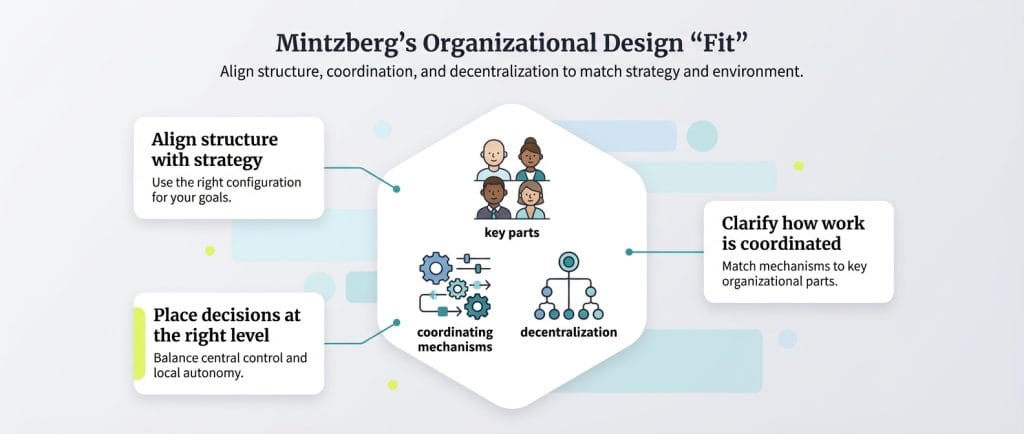
Mintzberg’s approach to organizational design looks at how structure, coordination and decision-making come together in practice.
Here’s a look at those three elements:
Key parts of the organization
Mintzberg breaks organizations into a few core parts, each with a distinct role in how work gets done:
Strategic apex: Senior leaders who set direction and ensure the organization responds to external demands.
Middle line: Managers who translate strategy into day-to-day operations.
Operating core: Employees who produce goods or deliver services.
Technostructure: Analysts who design, standardize and measure work processes.
Support staff: Specialist units that provide internal services, such as HR, legal and IT.
He later added ideology — shared values and beliefs — as a sixth element that shapes how the organization operates.
Coordinating mechanisms
Each part of the organization tends to rely on a different way of keeping work aligned. In Mintzberg’s model, coordination typically happens through the following mechanisms:
Direct supervision (strategic apex): Leaders coordinate work by giving direction and making decisions.
Standardization of work processes (technostructure): Tasks are guided by defined procedures and systems.
Standardization of skills (operating core): Work is coordinated through shared training and expertise.
Standardization of outputs (middle line): Managers align work by setting targets and expected results.
Mutual adjustment (support staff and project teams): People coordinate informally through communication and workplace collaboration.
Degree of centralization
Organizations also differ in how decision-making is distributed. Some rely on centralized authority, while others push decisions closer to teams or specialists.
Mintzberg’s types of organizational structures
When you look at the above three elements together — structure, coordination and decision-making — clear patterns start to emerge. Mintzberg identified several common organizational configurations, each with its own strengths, trade-offs and typical use cases.
Here’s an overview of how they compare, followed by more information on each configuration:
Configuration
Key part of the organization
Coordinating mechanism
Strengths
Vulnerabilities
Typical use cases
Entrepreneurial organization
Strategic apex
Direct supervision
Fast decisions, clear direction
Overreliance on one leader, limited scalability
Startups, small businesses, crisis situations
Machineorganization
Technostructure
Standardization of work processes
Efficiency, consistency, repeatable processes
Rigidity, slow to adapt
Manufacturing, government agencies, large administrative organizations
Professionalorganization
Operating core
Standardization of skills
Expert judgment, autonomy
Coordination challenges, siloed work
Law firms, hospitals, universities, consulting firms
Divisional organization
Middle line
Standardization of outputs
Local accountability, business-unit flexibility
Duplication of effort, internal competition
Large corporations with multiple divisions or product lines
Each configuration reflects a different way of organizing work. The right fit depends on your strategy, environment and how much flexibility or control you need. When these pieces line up, organizations are better positioned to support their strategy and adapt to their environment.
Here’s a closer look at how each structure works in practice.
Entrepreneurial organization
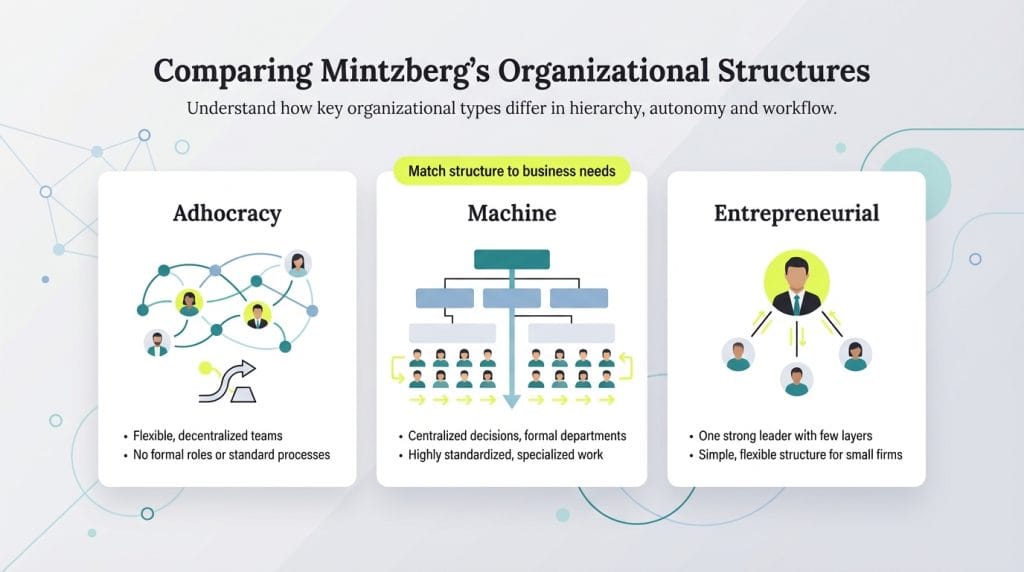
An entrepreneurial organization is built around a single leader who makes most of the key decisions. The structure is simple and informal, which gives the business flexibility, especially in its early stages.
Many small businesses and startups begin this way, with a founder or small leadership group guiding direction. This setup can support innovation and rapid growth, but concentrating too much authority at the top can lead to bottlenecks and poor decision-making as the company scales.
Entrepreneurial organization characteristics:
Simple, centralized structure
Strong leadership with few senior managers
Decision-making concentrated at the top
Flexible operations
Limited delegation of authority
Machine organization
In a machine organization, work is highly standardized and structured. Employees operate within clearly defined roles, and decision-making is centralized at the top. Departments are formalized and organized around specific functions, such as accounting, marketing or human resources.
This structure creates consistency and efficiency, but it can also lead to silos. When departments become too isolated or processes drift from broader business goals, coordination issues and misaligned outputs can follow.
Machine organization characteristics:
Standardized work processes
Centralized decision-making
Formal, function-based departments
Clearly defined roles
High degrees of specialization
Professional organization
A professional organization relies on highly skilled specialists who work with a significant degree of independence. Unlike a machine organization, decision-making is more decentralized, and coordination happens through shared expertise rather than strict oversight.
This structure is common in environments like universities, law firms and accounting firms, where professionals bring deep subject-matter knowledge. While this setup supports autonomy and high-quality work, it can make coordination and oversight more challenging for leadership.
Professional organization characteristics:
Standardization of skills
Decentralized decision-making
Clearly defined roles
Independent work and judgment
High degrees of specialization
Divisional organization
A divisional organization is typically used by large companies with multiple product lines or business units. Each division operates with a high degree of autonomy, making its own decisions about workflows, staffing and day-to-day operations.
This structure allows the central leadership team to focus on overall strategy and long-term direction. However, it can also create internal competition, especially when divisions are vying for shared resources, which can lead to silos and slower coordination.
Divisional organization characteristics:
Autonomous operating units
Decentralized decision-making
Clear focus within each division
Greater accountability for managers
Adhocracy
An adhocracy is a flat organization built around flexibility and decentralization. Instead of working within formal hierarchies, teams come together as needed, pulling in specialists to tackle problems or adjust as things change.
This model works well in fast-moving environments where creativity and adaptability are critical. However, the lack of clear structure can create confusion around roles and decision-making, which may lead to conflict or inefficiencies.
Adhocracy characteristics:
Minimal formal structure
Teams built around expertise
Few standardized procedures
Flexible roles
High levels of collaboration
Tip
Don't try to force one structure across your entire organization. Many businesses end up with a mix — for example, a centralized leadership team, specialized departments and flexible project teams — depending on how work actually gets done.
Practical applications of Mintzberg’s theory
Businesses can use Mintzberg’s theory to better define managerial roles and clarify how responsibilities are shared across a team. It’s been around since the 1970s, but the core idea still holds: Managers don’t do just one thing; they shift between roles depending on what the situation calls for.
“Mintzberg introduced an early view of how leaders are required to fulfill a variety of different roles, depending on the tasks and situations at hand,” explained Matt Paese, senior vice president of leadership insights at Development Dimensions International.
Here are four practical ways to apply his framework:
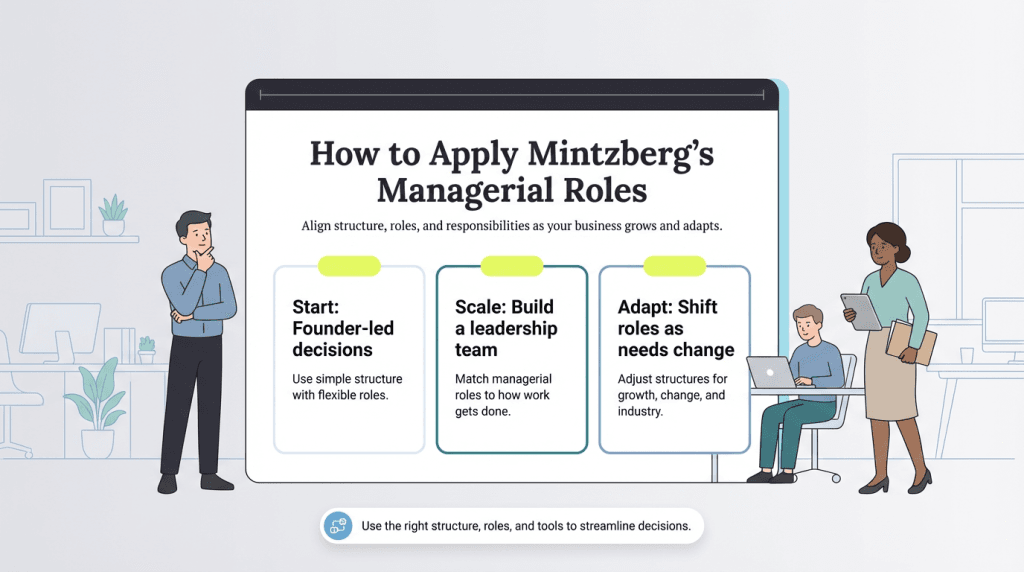
Starting a business
Most small businesses begin with an entrepreneurial structure, where decision-making sits with the founder or a small group of leaders. Early on, that usually works — speed matters and the people in charge are closest to the idea.
“Small business leaders juggle multiple roles (e.g., manager, innovator, spokesperson) due to limited resources, so these people may benefit from Mintzberg’s emphasis on informal communication and decision-making,” said Catherine Rymsha, management lecturer at the University of Massachusetts Lowell and author of The Leadership Decision.
Scaling a business
As you scale your business, leadership responsibilities can’t stay concentrated at the top. At some point, founders need to share decision-making with a broader leadership team to keep things moving.
This is where structure starts to matter more. Pay attention to how work actually gets done across your organization, including where decisions slow down, where teams rely on each other and where gaps start to show. Those patterns can help you decide which roles to formalize and how to distribute responsibility as you grow.
Adapting to business needs
As your business evolves, the roles leaders need to play will shift as well. Mintzberg’s framework helps you recognize when to adjust your focus, whether that means prioritizing people, communication or decision-making at different moments.
“At times, leaders may need to emphasize relationships and people leadership (e.g., when staffing up to respond to rapid growth), while other times focusing more on communication and decision-making (e.g., when communicating and implementing a strategic pivot or rapid shift in focus),” said Paese. “Being aware of these different roles, and the critical behaviors that enable effectiveness in each, can help leaders make adjustments to their approaches as business and priorities shift.”
Those shifts aren’t always easy. Handing off control or reworking established processes takes time, and it’s not always clear right away what’s working. Give changes enough time to play out before making major adjustments.
“Mintzberg’s identified roles can be helpful in segmenting work or even encouraging small business owners to consider what ‘hat’ they want to wear versus delegate,” said Rymsha.
Industry-specific use cases
Mintzberg’s managerial roles and organizational structures show up across industries, often in ways that reflect how work is actually done on the ground. Here are a few examples:
Healthcare: In hospitals and large healthcare systems, most of the real work sits with specialists. Clinicians rely on their training, while administrators deal with patient safety protocols. When something goes off-script, leadership and coordination roles step in so teams can keep things moving.
Manufacturing: On a high-volume production line, the work is tightly structured. Processes are standardized, performance is tracked closely and most of the focus is on keeping things running without interruption. When something breaks down, managers step in to sort it out.
Technology and product development: In software companies and R&D teams, work is usually less structured. People move between projects, pull in different specialists and test ideas as they go, rather than following a fixed process.
Professional services: Consulting, law and accounting firms tend to follow a professional organization structure, where expertise is decentralized to client-facing professionals. Knowledge-sharing and coordination are key to delivering consistent, high-quality work across engagements.
Retail and multi-brand corporations: As retail businesses grow, they often shift to a divisional organization. Individual units or brands operate independently, while central leadership sets overall strategy and performance expectations.
Public sector and nonprofits: Government agencies often resemble machine organizations, with formal processes and centralized oversight, but may adopt more flexible approaches for policy development or innovation. Nonprofits frequently start with a simple, founder-led structure and evolve into more formal models as they grow.
FYI
As your business grows, workflow automation tools can take over routine coordination tasks like scheduling, reporting and task tracking, freeing managers to focus on higher-level roles like decision-making and strategy.
Alternatives to Mintzberg’s management theory
Mintzberg isn’t the only one who outlined the importance of a proper and clearly defined management structure. Here are some other widely used management theories worth exploring for your business.
Mayo management theory
Elton Mayo’s management theory — often referred to as Human Relations Management Theory — grew out of the Hawthorne experiments and is one of the earliest frameworks to highlight the role of social dynamics at work. It argues that factors like communication, teamwork and recognition often have a greater impact on employee motivation and productivity than pay or working conditions alone.
In practice, this means creating a work environment where team members feel connected, supported and valued, which can improve both employee engagement and retention.
Weber management theory
Max Weber’s management theory (often called the bureaucratic theory of management) focuses on structure, hierarchy and clearly defined rules. It emphasizes a formal approach to organizing work, with defined roles, a clear chain of command and decisions based on established procedures rather than personal relationships.
Weber argued that this kind of structure can improve consistency and efficiency, especially as organizations grow. His model also stresses that advancement should be based on qualifications and performance, not personal connections.
His framework, built around key characteristics of bureaucracy, continues to influence how organizations create processes, define roles and scale operations.
Follett management theory
Mary Parker Follett’s management theory emphasizes collaboration and the alignment of individual and organizational goals. Rather than relying on rigid hierarchies, she advocated for a more participative approach, drawing on psychology and human relations to shape how teams work together.
Follett believed conflict should be addressed directly through integration, not avoided, and that power should be shared between employees and managers. Her focus on coordination and engagement helped shape modern management thinking and remains especially relevant for organizations that prioritize an employee-centric company culture.
Mintzberg management theory FAQs
Mintzberg identified 10 managerial roles, grouped into three categories that reflect how managers work day to day.
Interpersonal roles:
Figurehead: Performing ceremonial duties
Leader: Motivating and guiding employees
Liaison: Building relationships inside and outside the organization
Informational roles:
Monitor: Gathering and analyzing information
Disseminator: Sharing information with the team
Spokesperson: Communicating with external audiences
Decisional roles:
Entrepreneur: Driving change and new initiatives
Disturbance handler: Managing problems and disruptions
Resource allocator: Distributing time, budget and personnel
Negotiator: Representing the organization in discussions and agreements
These roles highlight that management isn't a single, fixed function. Instead, it involves constantly shifting between responsibilities based on what the situation demands.
Mintzberg's ideas still show up in how companies operate today, especially as teams move away from rigid hierarchies. Many organizations rely on flexible, project-based structures (what Mintzberg called an adhocracy), where people collaborate across roles and adjust quickly as priorities shift.
His framework also helps explain why cross-functional teams are so common. Instead of waiting for decisions to move up and down a chain of command, teams coordinate directly, share information and solve problems in real time.
For managers, Mintzberg's roles are still a useful way to think about the job. Leading today isn't just about planning; it's about shifting between responsibilities, whether that means guiding a team, making decisions or communicating across the organization.
Mintzberg's organizational design explains how companies structure work and decision-making. Instead of using a one-size-fits-all model, it shows that different organizations need different setups depending on how they operate.
He broke organizations into a few core elements, including leadership, managers, frontline employees and support teams, along with how work gets coordinated and where decisions are made.
When those pieces come together, they form distinct organizational structures, such as entrepreneurial, machine, professional, divisional and adhocracy. The goal is to find the right fit between how your organization is built and how it actually works.
Sammi Caramela contributed to this article. Source interviews were conducted for a previous version of this article.
Sean Peek co-founded and self-funded a small business that's grown to include more than a dozen dedicated team members. Over the years, he's become adept at navigating the intricacies of bootstrapping a new business, overseeing day-to-day operations, utilizing process automation to increase efficiencies and cut costs, and leading a small workforce. This journey has afforded him a profound understanding of the B2B landscape and the critical challenges business owners face as they start and grow their enterprises today.
At business.com, Peek covers technology solutions like document management, POS systems and email marketing services, along with topics like management theories and company culture.
In addition to running his own business, Peek shares his firsthand experiences and vast knowledge to support fellow entrepreneurs, offering guidance on everything from business software to marketing strategies to HR management. In fact, his expertise has been featured in Entrepreneur, Inc. and Forbes and with the U.S. Chamber of Commerce.