Business.com aims to help business owners make informed decisions to support and grow their companies. We research and recommend products and services suitable for various business types, investing thousands of hours each year in this process.
As a business, we need to generate revenue to sustain our content. We have financial relationships with some companies we cover, earning commissions when readers purchase from our partners or share information about their needs. These relationships do not dictate our advice and recommendations. Our editorial team independently evaluates and recommends products and services based on their research and expertise. Learn more about our process and partners here.
Connect with your target audience on the go to boost sales and engagement.
Smartphones are ubiquitous these days. People have near-constant access to their phones, using their mobile devices to shop, research purchases, compare prices and more. Small businesses need a mobile marketing strategy to reach and engage with their smartphone-using customers and prospects.
However, mobile marketing is a nuanced part of your marketing plan that requires strategies specifically formulated for the medium and its users’ unique preferences. We’ll explore the most effective digital marketing strategies to reach on-the-go customers and prospects.
Mobile marketing is a strategy that focuses on sending marketing messages to current and prospective customers on their mobile devices, including iPhones, iPads and Android smartphones and tablets. Mobile marketing utilizes unique mobile device hardware, software features and strategies, including mobile apps and ads, text messaging, mobile web browsers, device cameras, location-based advertising and mobile search SEO.
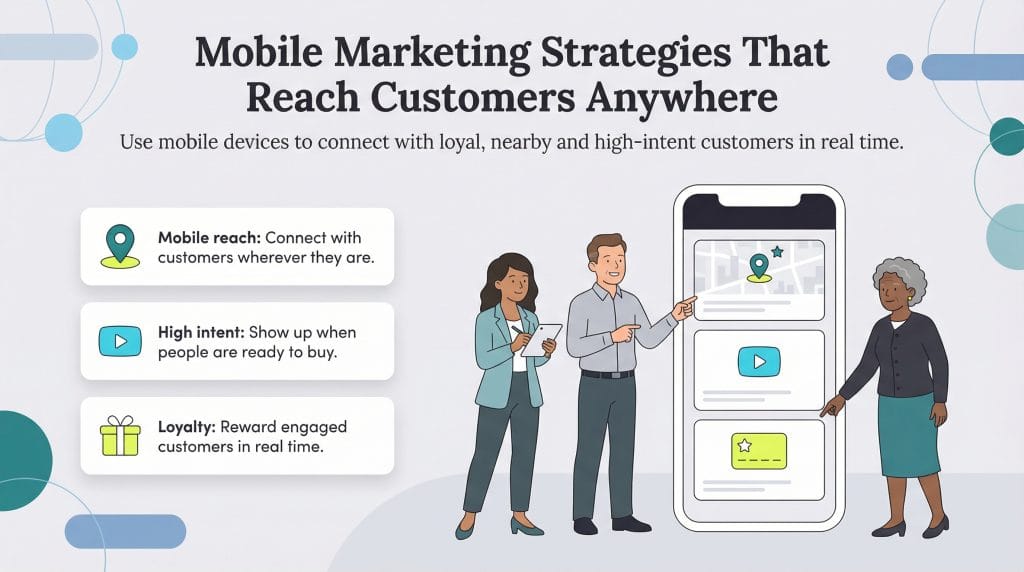
According to the Pew Research Center, 98 percent of U.S. adults between the ages of 18 to 29 own a smartphone, while 97 percent of 30 to 49 year-olds, 91 percent of 50- to 64-year-olds and 79 percent of those 65 and older are smartphone owners. These devices aren’t sitting idle. According to Sensor Tower’s State of Mobile 2025 Report, users spend an average of 3.5 hours a day on their smartphones. Clearly, targeting smartphone users with mobile marketing can get your message in front of a vast, engaged audience.
Here are 10 specific mobile marketing strategies to consider.
Mobile apps dominate how people interact with their smartphones. According to the 2025 State of Mobile report, global consumers downloaded 136 billion apps, spending $150 billion. This engagement presents significant opportunities for businesses willing to invest in app-based marketing.
A custom mobile app can help you engage with loyal customers and build stronger relationships. For example, skincare giant Sephora uses its app to dramatically expand consumer engagement by offering rewards, loyalty programs and customized shopping experiences. It harnesses artificial intelligence to let consumers test makeup and leverages customer data to steer users toward products that would likely appeal to them.
If you’re creating a mobile app for your business, ensure its design focuses on ease of use, customer engagement and fun. If you lack the funds for a dedicated app, you can still reach your target audience through the Google AdMob service, which helps businesses place ads in third-party apps. You can also use Facebook’s boosted posts — a Facebook marketing strategy that integrates ads into the Facebook mobile app’s news feed.
App-based marketing can foster an intimate and constantly evolving relationship with your customers and help you utilize predictive data for a more personalized shopping experience. However, it’s worth noting that your audience is largely limited to existing customers, so this method isn’t optimal for bringing in new users.
Technically, in-game mobile marketing falls under general app-based marketing. However, gaming is such a vast segment of the mobile market that it deserves specific attention. In fact, Sensor Tower’s report found that revenue generated from mobile games reached $81 billion worldwide. And Statista estimates that over 46 percent of the U.S. population plays video games, with one third of gamers playing one to five hours weekly.
Advertising in mobile games can be worthwhile and lucrative, helping you get your ads in front of engaged, enthusiastic mobile users. Banner ads and video ads are popular options.
Location-based marketing uses consumers’ past or present locations to present tailored ads. It can help you target high-value customers and close sales more efficiently. The two most popular forms of location-based marketing are geofencing and geotargeting.
A Google Business Profile is an easy way to take advantage of location-based marketing. It ensures that people searching for your products or business will find you and that you can reach your customers where they are. Widely cited Google data says that 76 percent of consumers who search for nearby merchants (e.g., “shoe repair near me”) visit within a day, and 28 percent of those searches result in a purchase.
However, transparency is crucial with location-based marketing. Always provide clear opt-in options and focus on delivering genuine value rather than simply tracking users. When done respectfully, location-based marketing can enhance the customer experience by providing timely, relevant offers when they’re most useful.
Consumers want their information fast, and QR (quick response) codes are one of the best ways to deliver speedy information. These scannable images can auto-dial your business’s number on a user’s phone, start an app download, present or email a receipt or menu, or display your business’s exact location. They’re fast and easy to implement and can pack a tremendous amount of information into one point of contact.
Marketers are divided on how upfront businesses should be about what their QR codes do. Some believe you should take all the guesswork out of the interaction and tell the consumer exactly what the QR code contains. Others think an element of mystery can entice more users to scan a code out of curiosity. Ultimately, marketers have found that consumers in the gaming space are more responsive to a surprise or mysterious QR code, while retail consumers prefer a more straightforward disclosure.
Mobile search ads are the mobile equivalent of the Google ads we’re all familiar with. They’re ads that appear at the top of a user’s search results, formatted so that they appear to be part of the results. They can provide businesses with immediate, measurable results that are of great value.
If you organically rank at the top of Google searches for your keywords, you can see massive traffic. Mobile search ads essentially help you jump to the front of the line, where you can enjoy higher click-through rates and more successful lead conversions. These ads are particularly effective because they capture high-intent moments — when someone searches for “pizza delivery near me” or “emergency plumber,” they’re often ready to make an immediate purchase decision.
Mobile devices now account for approximately 64 percent of web traffic coming from mobile devices, according to Soax, making responsiveness crucial for visibility. Smartphones also accounted for approximately 77 percent of global retail website traffic and were responsible for generating two-thirds of online shopping orders, reported Statista. Because mobile shopping is so popular, having a responsive website design is crucial.
Responsive websites can recognize a user’s device type (e.g., phone, tablet, computer) and operating system (e.g., iOS, Android). Based on that information, they rearrange their text and graphic elements to display properly, helping ensure no information is cut off or too small to read.
If your website is not currently responsive, consider enlisting a web developer to make your website mobile-friendly — this way, on-the-go users can interact with it properly.
Users see and access the vast majority of social media ads on mobile devices, making advertising on social media platforms a great way to reach prospects wherever they might be. Choose the social media platforms where your target audience spends the most time and advertise there. According to DataReportal, YouTube ads reach more than 2.5 billion users a month, while ads on Facebook, Instagram, TikTok and LinkedIn also reach a vast array of consumers.
A robust social media marketing strategy includes developing a large social following and keeping them engaged. To that end, remember to post regularly on your company’s social media profiles — an active social media presence helps engage followers and provides a seamless and organic way to market to them.
Consumers are drawn to videos because they’re immersive, engaging and deliver information quickly. Building brand trust through video marketing can help you evoke an emotional response from viewers and improve engagement and sales. Ensure your marketing videos aren’t too long and include automatic captioning. Most people watching videos on a mobile device do so with the sound off, so you want to make it easy for them to absorb your message.
Email marketing delivers an excellent digital marketing ROI. Send straightforward, personalized messages to encourage responses from customers opening emails on their mobile devices. Most emails should include a call to action with links to fill out a lead generation form, visit a product page or access a sale or promotion.
Push notifications are messages sent straight to consumers’ mobile devices. When used in conjunction with email marketing, you can prompt users to check their messages and act on your CTA, ultimately increasing conversion rates.
Whether you have an app or manage your loyalty program on your website, mobile marketing is a great way to reach members with messages about their point balances, rewards, first access to new products and news about promotions. Notifications can be triggered by proximity, text or email on users’ mobile devices.
If you aren’t marketing your company on mobile devices, you could be leaving business and profits on the table. Here are some reasons why you should consider using mobile marketing for your business:
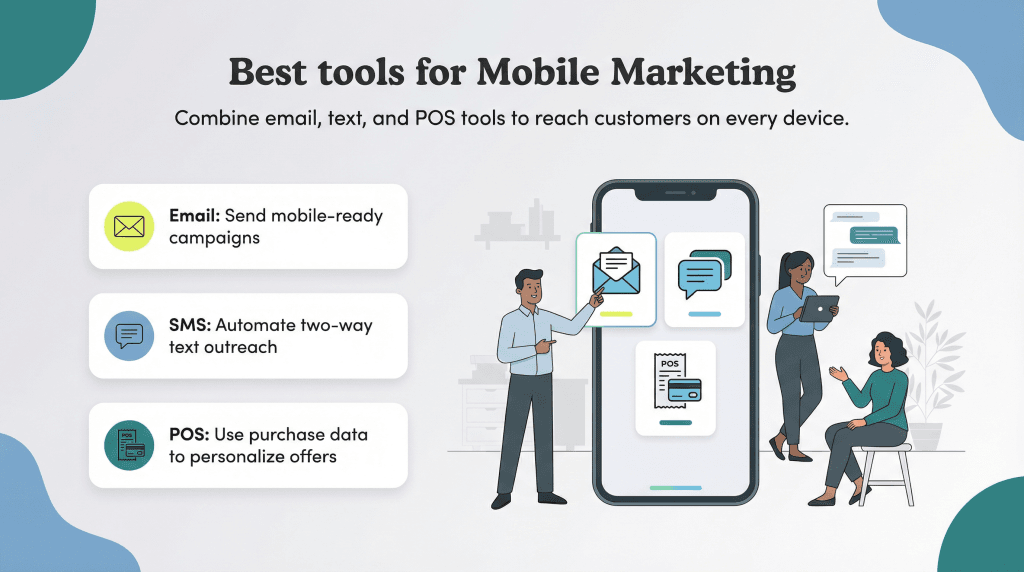
Various tools and software have mobile-ready marketing capabilities. Some tools that can jump-start your mobile marketing strategy include the following.
The best email marketing services include mobile-ready campaign functionality. For example, as we explain in our Constant Contact review, every email template on this platform is mobile responsive (it also provides robust SMS capabilities). When designing your email, you can easily preview how it will look on different devices. Constant Contact integrates with Squarespace, Shopify and WooCommerce, among others, to drive sales from your mobile-responsive website.
All text message marketing services are meant to reach out to mobile users. However, the best text message marketing services offer robust functionality for a low price. For example, as we explain in our Textedly review, the platform has one of the lowest per-text costs, supports two-way communication, allows you to send bulk campaigns and integrates with numerous apps. It even supports conversations via Facebook, WhatsApp and website chatbots.
You might not think of your POS system when you consider mobile marketing. However, many of the best POS systems have a built-in marketing module that can help you reach customers in various ways. For example, Clover and Square both have customer loyalty functionality and allow you to store customer data for personalization. You can even use these systems to communicate directly with customers. Check out our Clover POS review and our review of Square to learn more.
As mobile devices become increasingly central to how consumers discover, research and purchase products, mobile marketing has evolved from a nice-to-have to an essential business strategy. The businesses that succeed will be those that understand mobile isn’t just another channel — it’s often the primary way customers interact with brands. By implementing these 10 strategies, small businesses can effectively compete for attention and sales in an increasingly mobile-first marketplace.
Jennifer Dublino contributed to the reporting and writing in this article.