Business.com aims to help business owners make informed decisions to support and grow their companies. We research and recommend products and services suitable for various business types, investing thousands of hours each year in this process.
As a business, we need to generate revenue to sustain our content. We have financial relationships with some companies we cover, earning commissions when readers purchase from our partners or share information about their needs. These relationships do not dictate our advice and recommendations. Our editorial team independently evaluates and recommends products and services based on their research and expertise. Learn more about our process and partners here.
Although you may not be legally required to offer paid time off, it tends to be a standard employee benefit. Learn how offering paid leave can benefit not only your employees but also your business.


Although you may not be legally required to offer paid time off, it has become a standard employee benefit. Learn how offering paid leave can benefit not only your employees but also your business.
Paid leave policies may represent an additional cost, but the benefits they provide can pay for themselves and then some. For many employers, paid leave is less about generosity and more about smart workforce management. While budget-conscious business owners may initially hesitate at the added expense, paid leave often delivers measurable returns in areas like retention, productivity and morale. If you’re on the fence about offering paid leave, here are some of the business advantages you may gain by doing so.
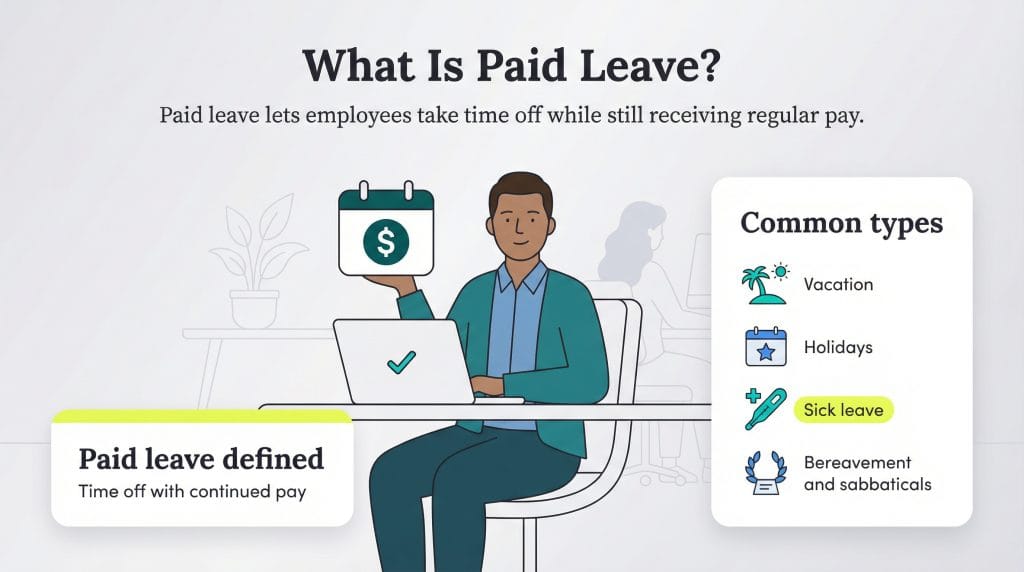
Paid leave is when an employee takes time off work while continuing to receive pay. There are several types of paid leave, including vacation time, holidays, sick leave, bereavement leave and sabbaticals.
Whether employees receive pay for time off — and which activities qualify as paid leave — is often left to the employer’s discretion. However, employers must apply paid leave policies consistently and fairly, in line with applicable employment and anti-discrimination laws in the workplace.
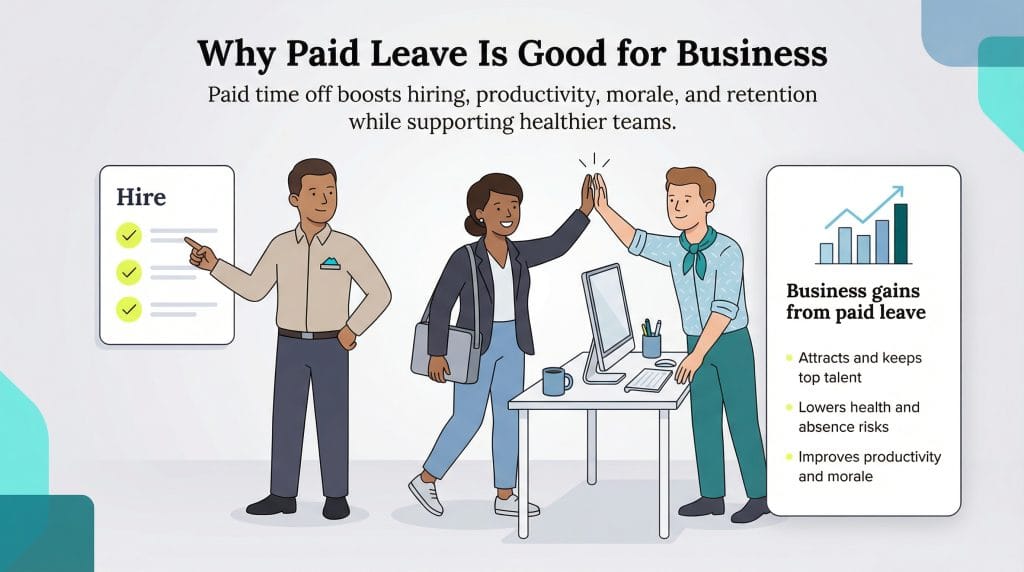
While offering paid leave represents an upfront investment, the return can show up quickly in areas that directly affect your bottom line, particularly employee recruitment and retention. Here are a few reasons paid leave makes business sense.
Expectations surrounding employee benefits have shifted, especially among younger workers. Flexible policies — including remote work plans, paid time off (PTO) and flexible schedules — now play a central role in how candidates evaluate job opportunities. At a minimum, offering some form of paid leave helps businesses remain competitive in today’s hiring market.
“We’re in a time where workplace policies need to keep up with the realities of workers and their families,” said Karen White, former director of public policy and analysis and community engagement at the Center for Women and Work at Rutgers University. “Workers are paying attention to the kinds of benefits they’re being offered when they consider new jobs.”
That attention shows up clearly in hiring data. According to Indeed Hiring Lab, as of June 2025, only 2.9 percent of U.S. job postings on Indeed offered unlimited paid time off, down from 8.8 percent in March 2022. Although unlimited PTO remains relatively uncommon, it clearly influences how candidates evaluate job offers. In a 2025 survey by Empower, 26 percent of workers said they would consider a lower-paying job if it included unlimited PTO, and nearly one in five said they wouldn’t accept a new role without it.
For employers, that gap between supply and demand creates an opportunity. Offering generous paid leave, whether through a traditional PTO structure or an unlimited model, can help your job postings stand out in a crowded market, especially when competing for experienced or in-demand talent.
Unlimited PTO, in particular, often sounds riskier than it is. In practice, the policy isn’t literal; time off still requires coordination and approval to ensure business needs are met. When implemented thoughtfully, it gives employees a coveted flexible benefit without sacrificing accountability.
Paid leave helps address two common and costly challenges: workplace absenteeism and presenteeism.
By giving employees the ability to take time off without losing income, paid leave helps reduce both absenteeism and presenteeism. For employers, that can mean healthier teams, safer workplaces and more consistent performance over time.
Paid leave can support improved productivity in several practical ways. When employees are able to take time off without losing income, they’re less likely to work while sick or distracted, reducing the spread of illness and helping teams function more consistently.
Paid family leave can have a similar effect. When employees don’t have to worry about losing pay while caring for a newborn or family member, they’re better able to focus on their work when they’re on the job. Lower stress and greater stability often translate into stronger day-to-day performance.
That connection shows up in firm-level research. An academic study published through ECGI and SSRN found that companies operating in states with paid family leave laws experienced about a 5 percent increase in productivity, along with reduced employee turnover and measurable gains in operating performance following implementation. The findings suggest that paid leave can support productivity not by increasing hours worked, but by helping employees work more effectively when they return.
“A happy, more satisfied employee who is not stressed out about family care issues is much more able to focus on doing a better job,” White noted.
Paid leave supports employee morale by giving workers the flexibility they need to manage their lives outside of work. When employees can step away to rest, recover or care for family members without worrying about lost income, they’re more likely to return feeling focused, positive and supported.
Morale matters because it’s closely tied to engagement and well-being. According to Gallup’s 2025 State of the Global Workplace report, only 21 percent of employees worldwide are engaged at work, while stress and burnout remain widespread. Gallup consistently finds that employees who feel supported by their employer are more likely to be engaged and less likely to experience daily stress.
Paid leave can help relieve some of that pressure. By allowing employees to take time off when they need it — without stigma or financial strain — businesses signal that employee well-being is a priority, not an afterthought. That sense of support can have a direct impact on morale, shaping how employees feel about their work, their manager and the organization as a whole.
Additionally, paid leave sends a clear message that your company values balance and trust. Over time, that message can help create a stronger workplace culture where employees feel respected and motivated to do their best work.
Paid leave doesn’t just help attract talent: It also plays a key role in keeping experienced employees from walking out the door. When workers feel supported during major life events, they’re more likely to stay with an employer they already know, trust and have invested time in.
That point is especially clear in professions where training is time-intensive and costly. “We did research on women in law firms, and what we found was that firms invest an enormous amount of time and resources in hiring and training new attorneys,” White shared. “But if they don’t provide paid family leave, when female attorneys go off on maternity leave, they are less likely to return. All of those training dollars, time and resources are lost.”
Employee turnover can be prohibitively expensive for a business, even before you factor in lost productivity and knowledge. According to the Work Institute’s 2025 Retention Report, replacing an employee typically costs about 33 percent of their annual salary. So, for a company with 100 employees earning an average of $50,000 a year, reducing turnover by even just 10 percent could mean saving $165,000 annually in avoided replacement costs, not including the time needed for onboarding and ramping up a new worker’s performance.
By helping employees stay connected to their jobs during critical moments, paid leave can reduce unnecessary exits and protect the investments businesses make in their people.
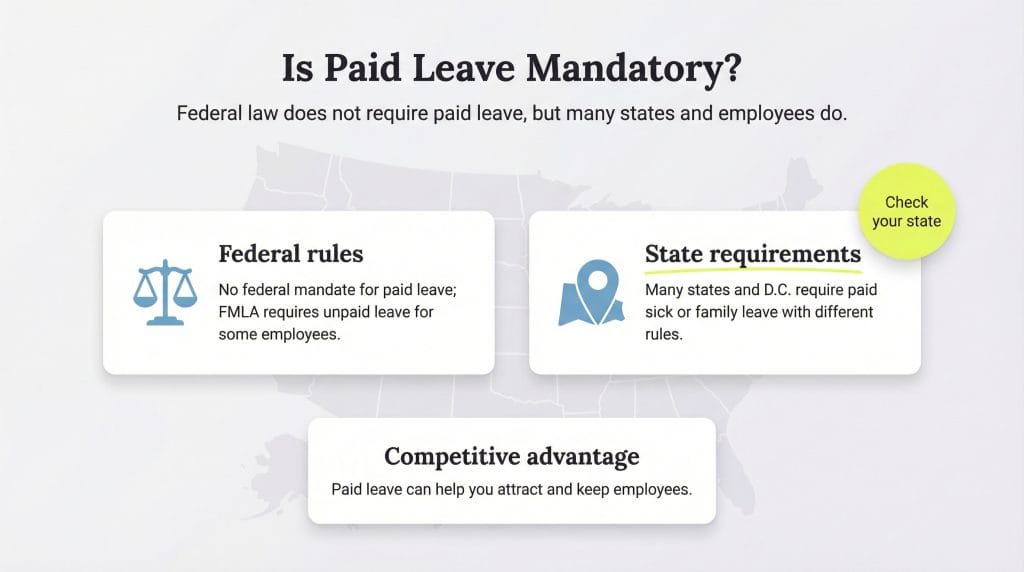
At the federal level in the United States, there is currently no mandate requiring private employers to provide paid leave for sickness, vacation, family leave or other personal reasons. The Family and Medical Leave Act (FMLA) does require unpaid, job-protected leave for eligible employees in certain situations, but it does not require paid time off. Still, there are a few things to be aware of:
As of 2025, 18 states plus Washington, D.C. require private employers to provide paid sick leave to eligible employees. The states with active paid sick leave laws include Alaska, Arizona, California, Colorado, Connecticut, Maryland, Massachusetts, Michigan, Minnesota, Missouri, Nebraska, New Jersey, New Mexico, New York, Oregon, Rhode Island, Vermont, Washington and Washington, D.C.
These laws vary in scope and accrual rules, with specific definitions around eligibility, accrual rates and approved uses of leave. Because state and local laws continue to evolve, employers with workers in multiple jurisdictions should review current requirements carefully.
Separate from sick leave, a growing number of states have established paid family and medical leave (PFML) programs. Multiple states and Washington, D.C., now offer or are phasing in PFML benefits that provide partial wage replacement for longer-term leave needs, such as bonding with a new child or caring for a seriously ill family member.
Because PFML laws differ widely in eligibility, benefit levels and funding mechanisms, employers should understand the specific rules that apply in each state where they operate.
Even without a federal mandate, paid leave is already common. According to the U.S. Bureau of Labor Statistics, about 80 percent of private industry workers had access to paid sick leave as of March 2025.
Although federal law doesn’t require paid time off, many states do, and paid leave benefits are increasingly expected by employees. For that reason, employers should familiarize themselves with applicable state and local mandates and weigh the competitive advantage of offering paid leave even where it isn’t legally required.
Kimberlee Leonard contributed to this article. Source interviews were conducted for a previous version of this article.