Table of Contents
Running a profitable business is hard. Running a profitable business that is carbon-accountable is even more difficult. However, while becoming a sustainable operation can be challenging, reducing your business’s carbon footprint is worthwhile — from both a humanitarian and a business standpoint. We’ll explain more about a business’s carbon footprint. Also, we’ll share why and how you can and should reduce it.
Carbon footprint explained
Before you can reduce it, you must understand precisely what a business’s “carbon footprint” entails.
“A company’s carbon footprint is all the greenhouse gas (GHG) emissions generated from the company’s operations,” explained Chris Bolman, CEO of sustainability management company Brightest. “That includes office energy consumption, vehicle fuel usage, receiving materials from suppliers, shipping customer orders, as well as other emissions sources, depending on the business model. This is commonly called an emissions or carbon ‘inventory.’”
How to reduce your business’s carbon footprint
Your company will undoubtedly generate emissions. Still, specific strategies will help you reduce your business’s carbon footprint and become more carbon-accountable.
1. Move toward zero waste.
Industry — including typical business operations such as materials production, transportation, consumption and disposal — account for approximately 30 percent of total U.S. greenhouse gas emissions according to the EPA. Implementing a zero-waste approach is a short-term, powerful action that can pay off immediately for the climate.
Here’s how to move toward zero waste:
- Gather data on your business’s current waste generation, management and disposal.
- Identify where waste is being generated, how often and where it goes.
- Set waste diversion, prevention and reduction goals. Then, institute policies to achieve them. Focus your efforts on reducing, reusing and recycling — in that order.
A zero-waste approach can apply to numerous aspects of your business. Consider the following tips:
- Go paperless whenever possible
- Donate old electronics and office furniture
- Commit to eco-friendly packaging that’s reusable, compostable or recyclable
- Refill and recycle ink and toner cartridges
- Implement composting programs for organic waste
Collaborate with nonprofits, foundations, regional and community projects and others to reduce waste and repurpose materials
2. Harness renewable energy sources.
Renewable fuels have become more prevalent over the last several years. This is largely due to climbing oil and gas prices and growing concerns about climate change. Given the finite nature of fossil fuels and the growing volume of international climate change regulations, companies should start measuring and reducing their energy consumption immediately. You’ll help create environmental benefits while giving your business a competitive edge as new climate policies are enacted.
While taking action may require an initial investment, harnessing green energy sources will save your company money in the long term.
Here are some ideas for harnessing renewable energy sources:
- Solar panels: Solar panels are a great option if you’re seeking to buy or lease renewable energy equipment for workplace installation. Installing solar panels will provide your business with clean, sustainable power and may qualify your business for a federal tax credit.
- Purchase renewable energy: If you don’t own your property or have limited space, consider purchasing renewable energy from your power supplier. Many utilities now offer green power programs where businesses can purchase renewable energy certificates (RECs) to offset their electricity use.
- Choose an electricity supplier with renewable options: Depending on your location, you may be able to choose your electricity supplier. In states that allow competition among electricity generators, select a supplier that specializes in producing energy from renewable sources.
- Consider power purchase agreements (PPAs): These long-term contracts with renewable energy developers can provide stable, predictable energy costs while supporting clean energy projects.
3. Cut business travel emissions.
Modern transportation modes are among the biggest sources of GHG emissions. According to the Energy Information Administration, the transportation sector accounted for about 30 percent of total GHG emissions in the U.S. Reducing emissions and expenses related to business travel can minimize your company’s environmental impact while potentially increasing your bottom line.
Consider the following ways to cut business travel emissions:
- Support bike-to-work initiatives: Encourage your employees to bike to work by providing a space to change and shower. Also, reward them with a valued perk, like extra PTO.
- Facilitate carpooling: Implement commuter-matching programs and incentives like preferred parking spots to encourage employees to carpool.
- Invest in electric vehicle charging infrastructure: Installing EV charging stations can encourage employees to switch to electric vehicles while potentially qualifying for federal and state tax incentives.
- Book direct flights: When flying for business travel is necessary, book more fuel-efficient economy seats on direct flights.
- Implement a work-from-home plan: Consider creating a remote work plan or transitioning to long-term work-from-home arrangements when possible.
- Opt for virtual meetings: The best way to reduce business travel emissions is to avoid traveling. Whenever possible, hold virtual meetings and training sessions instead of traveling to in-person events. As a bonus, you may save money by avoiding the costs of sending multiple people off-site for training.
If your business works to reduce business travel emissions, it will be in good company. The GHG Protocol supplies highly regarded GHG accounting standards and guidance. Large corporations like IBM and many Fortune 500 companies have adopted its standards to help measure their carbon footprint.
4. Educate and engage employees.
Actively engaging your employees is one of the most impactful ways to make your business more carbon-accountable. Individuals may feel powerless about seemingly insurmountable environmental issues, but businesses can help empower them to enact positive changes.
Here are a few ways to educate and engage employees in your efforts to reduce your business’s carbon footprint:
- Educate your team: Make carbon accountability personal by educating your team. When employees understand why they’re being asked to change long-term habits, they’re less likely to resist new eco-conscious policies.
- Brainstorm energy-saving ideas: Encourage input on workplace energy-saving ideas at staff meetings and by setting up suggestion boxes.
- Create green teams: Establish employee-led sustainability committees that can champion initiatives and track progress across departments.
- Support employee donations: Consider instituting a corporate matching program where you financially replicate employee donations to eco-friendly nonprofits.
- Gamify sustainability: Use apps and platforms that track individual and team carbon reduction efforts, creating friendly competition and recognition programs for top performers.
- Invest in carbon accountability tools: Enroll your team in an environmental subscription service like Forest Founders. This service provides users with a personal dashboard to track and negate their carbon footprint by planting trees through a network of nonprofits like the National Forest Foundation. Such services can help employees witness the power of their own environmental impact firsthand.
5. Weatherize your space.
Another way to reduce your business’s carbon footprint is to account for changing weather and seasons.
“Implement temperature controls to make sure heating and cooling are timed properly and in accordance with the air temperature outside,” advised Rene Delgado, founder and president of The Indoor Golf Shop. “By doing so, overheating or cooling can be reduced.” Delgado said it’s particularly important to maintain a cool nighttime temperature.
Tips for weatherizing your space include the following:
- Program locally controlled thermostats or replace them with more advanced options.
- Install smart building management systems that use AI to optimize HVAC operations based on occupancy patterns and weather forecasts.
- Ensure your boiler receives regular maintenance so it can run as effectively as possible.
- Install window film — it lets light in but deflects heat during the summer — to help control your office’s temperature.
- Add proper insulation and seal air leaks, which can reduce heating and cooling costs by up to 20 percent according to the Department of Energy.
Consider cool roofing materials that reflect more sunlight and absorb less heat than standard roofs.
Why you should reduce your business’s carbon footprint
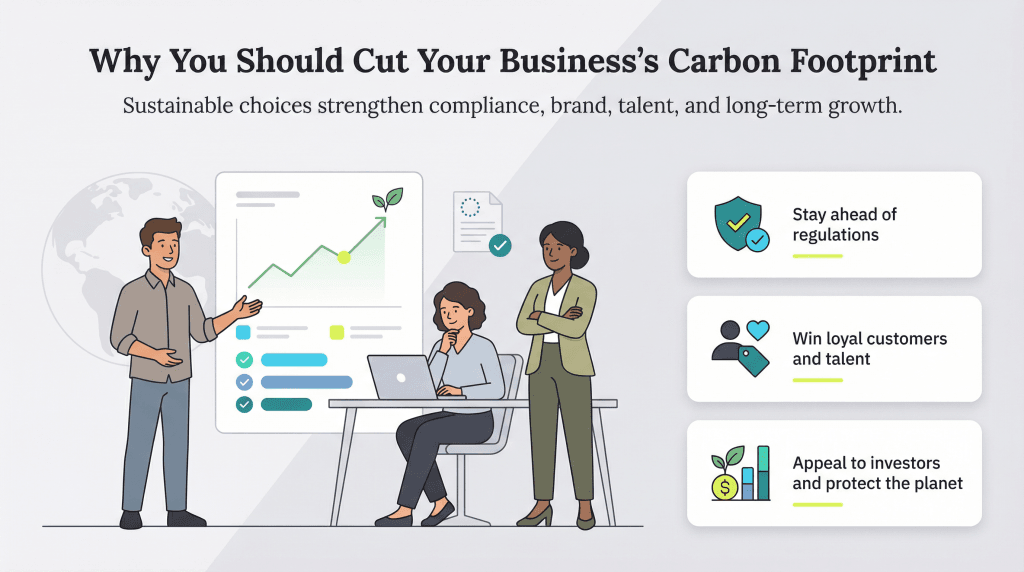
Reducing your business’s carbon footprint is the right thing to do for several reasons, both practical and moral.
- Stay ahead of regulations: As the climate emergency escalates, governments will continue introducing more stringent environmental policies. Neutralizing your carbon footprint now will help you navigate these changes. For example, the EU’s Corporate Sustainability Due Diligence Directive requires companies with more than 1,000 employees on average to disclose climate change data as well as report on human rights matters. “Getting ahead of [new laws] is good for your brand and can save costs, but also de-risk potential investor or regulatory issues,” Bolman noted.
- Appeal to eco-conscious customers: Customers prefer eco-friendly brands, so marketing your reduced carbon footprint can help connect you to like-minded consumers. “Consumers are more likely to pay a premium for sustainable products,” Bolman said.
- Attract top talent: According to a 2025 Deloitte survey, millennials (92 percent) and Gen Z (89 percent) workers want to find purpose in their job, including having a positive impact on their community.
- Join business leaders: Major corporations like Google, Lyft and Salesforce are already committed to going carbon neutral; Microsoft has pledged to be carbon negative by 2030 and remove all historical emissions by 2050. Smaller companies like Burt’s Bees and Diamond Foundry are doing so as well. Joining them as a pioneer toward sustainability can benefit your bottom line.
- Impress investors: Like consumers, investors want to work with enlightened companies that care about the environment. According to a study from PwC, 49 percent of institutional investors said they’re divesting from companies with poor environmental, social and governance (ESG) track records, up from 42 percent in 2023.
- Slow down the climate crisis: Businesses should reduce their carbon footprint because slowing down the climate crisis is the right thing to do.
Reducing your carbon footprint is a win-win
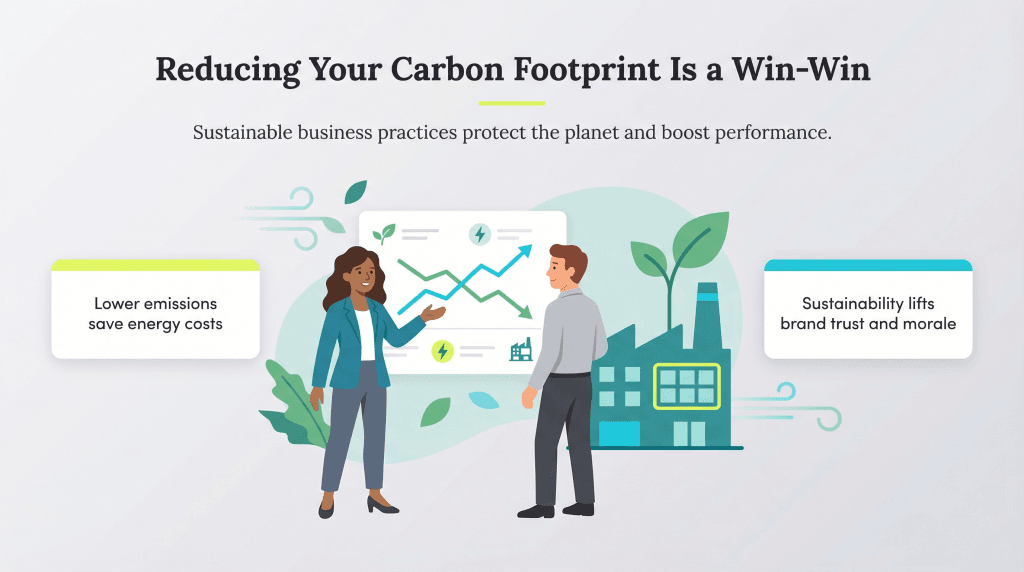
George Mazzella agreed that if companies can effectively reduce their carbon footprints, they will help slow down the current climate crisis we face today. “Aside from the obvious ‘because it’s the right thing to do’ argument, businesses can also see an increase in their financial performance by adopting more sustainable practices,” said Mazzella, executive vice president of HGX Global Commercial at Holganix.
Nature and capitalism don’t have to be at odds. By minimizing your business’s carbon footprint, you can cut energy costs. You can also improve employee morale, strengthen your company’s reputation as a leader in sustainability and even increase your revenue — all while protecting the resources and planet we need to operate and thrive.
Mark Fairlie contributed to the reporting and writing in this article. Source interviews were conducted for a previous version of this article.


- How Businesses Are Marketing Green Innovation

- The UN’s Sustainable Development Goals for Small Businesses

- Can You Make a Profit and Be Socially Responsible?
- Emojis at work: Should you use emojis in business communications?

- How to Make Money in Retirement: A Guide to Turning a Hobby Into a Side Business