Business.com aims to help business owners make informed decisions to support and grow their companies. We research and recommend products and services suitable for various business types, investing thousands of hours each year in this process.
As a business, we need to generate revenue to sustain our content. We have financial relationships with some companies we cover, earning commissions when readers purchase from our partners or share information about their needs. These relationships do not dictate our advice and recommendations. Our editorial team independently evaluates and recommends products and services based on their research and expertise. Learn more about our process and partners here.
Workplaces are full of givers, takers and matchers. What are the pros and cons of each leadership style?


Are you a giver, a taker or something in between called a matcher? For years, leadership has been associated with a hard-charging climb to the top, where success comes from outpacing colleagues and competing for influence. But that traditional view is fading. In practice, a win-at-all-costs approach often hurts long-term success.
Below, we’ll break down each leadership style, explore their strengths and limitations, and explain how finding the right balance can lead to healthier teams and more sustainable leadership.
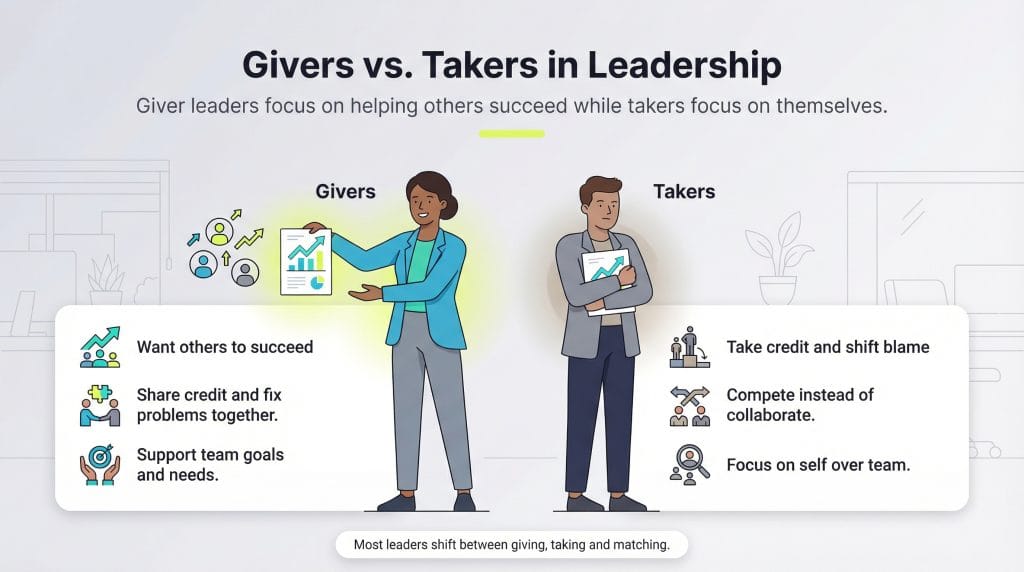
In Give and Take, Wharton professor Adam Grant challenges the idea that the most successful leaders are those who take the most. Instead, he argues that modern workplaces increasingly reward givers — people who contribute to others without keeping score. That stands in contrast to takers, who focus on advancing their own goals with little investment in others, and matchers, who aim to keep exchanges balanced.
To understand which category best describes your leadership style, consider these common characteristics of givers and takers.
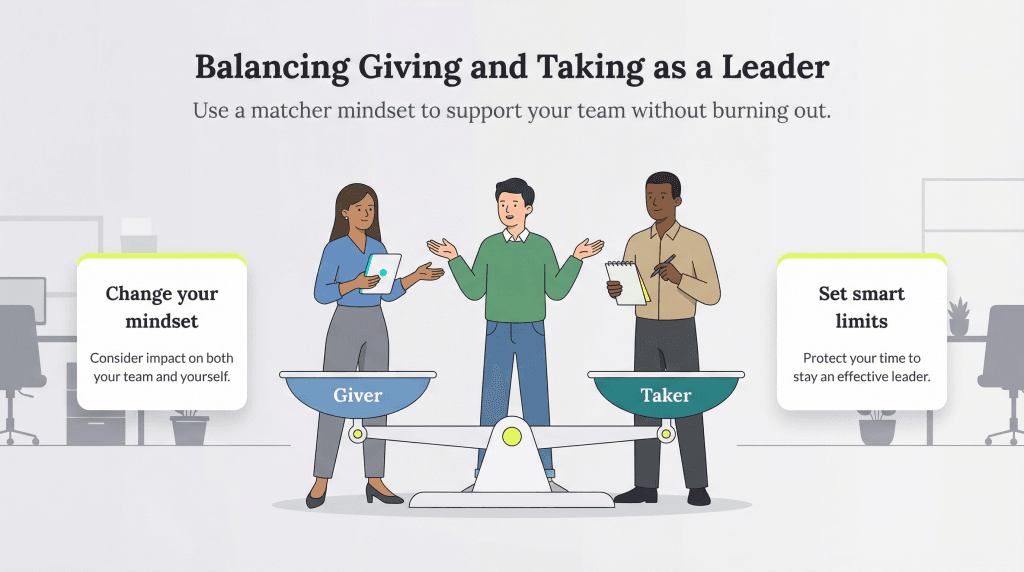
Dr. Beth Kaplan, author of Braving the Workplace, notes that effective leadership isn’t about choosing one style over the other. Instead, it’s about creating an environment where leaders support growth without burning themselves out or creating unhealthy dependence.
Here are a few ways to balance giver and taker leadership styles in practice.
Most leaders don’t operate strictly as givers or takers. Instead, they act as “matchers,” adjusting their approach based on fairness, context and reciprocity. That kind of balance requires emotional intelligence, which is the ability to read situations, understand others’ needs and recognize your own limits. Becoming a “smart giver” means regularly checking whether your actions are helping the team and remaining sustainable for you.
That balance often comes down to two things:
Giving too much can lead to poor outcomes for managers and their organizations, including the following:
To avoid the downsides of overgiving, leaders can take a more intentional approach:
In an interview with Knowledge at Wharton, Adam Grant notes that givers tend to land at both extremes of the corporate ladder. Some rise quickly, while others burn out. The difference usually isn’t skill or effort; it comes down to how they decide when to give and when to hold back.
To help givers strike that balance, Grant points to a simple guideline known as the five-minute rule. The idea is straightforward: If you can help someone in five minutes or less, do it. That might mean making a quick introduction, sharing a useful resource or offering brief feedback. These small actions don’t take much time, but over time they build trust, goodwill and strong working relationships.
For leaders, the five-minute rule offers a practical way to stay helpful without overextending. It encourages generosity that’s intentional and sustainable, allowing leaders to support growth without losing focus on their own responsibilities.
Being a leader doesn’t mean doing everything yourself. Asking for help, even from direct reports, can build trust, improve manager-employee relationships and reinforce a sense of shared ownership. While it may feel counterintuitive, it sends a clear message that everyone’s input matters.
That idea has long roots in leadership thinking, including the following:
“Building on Adam Grant’s work on givers and takers, leaders can establish practical boundaries while sustaining team morale by creating clear expectations around contributions,” Kaplan explained. “Making both giving and asking for help part of team routines prevents any one person from carrying too much of the load.”
Being generous doesn’t mean trying to help with everything. When leaders stretch themselves too thin, giving quickly becomes exhausting and unsustainable. A better approach is to focus on one or two areas where you genuinely add the most value.
When people know what you’re good at, they’re more likely to come to you with the right kinds of requests. Over time, this helps you build a reputation as someone who’s helpful and effective without having to be the go-to person for every problem. For example, if you’re known for your accounting skills, people are far more likely to ask for financial guidance than for help editing marketing copy.
Every organization includes a mix of givers, matchers and takers. The challenge for leaders is learning how to give without letting takers drain their time, energy or team momentum. Here are a few strategies that can help.
Givers naturally want to help others, but that instinct can sometimes drift into people-pleasing. Giving doesn’t mean always saying yes or trying to keep everyone happy. Leadership comes with hard choices, and not every decision will be popular.
Rather than aiming to be liked, givers are better served by earning respect. When leaders are clear about their values and priorities, they’re more likely to make decisions based on what’s best for the organization, even when those decisions are uncomfortable.
For example, if layoffs are truly in the company’s best interest, a giving leader will move forward thoughtfully and responsibly, even knowing the decision won’t be well received. In moments like these, leadership isn’t about avoiding disappointment; it’s about acting with fairness, clarity and long-term responsibility.
Encouraging a culture of giving does more than feel good: It strengthens how teams work together and supports better business outcomes like the following:
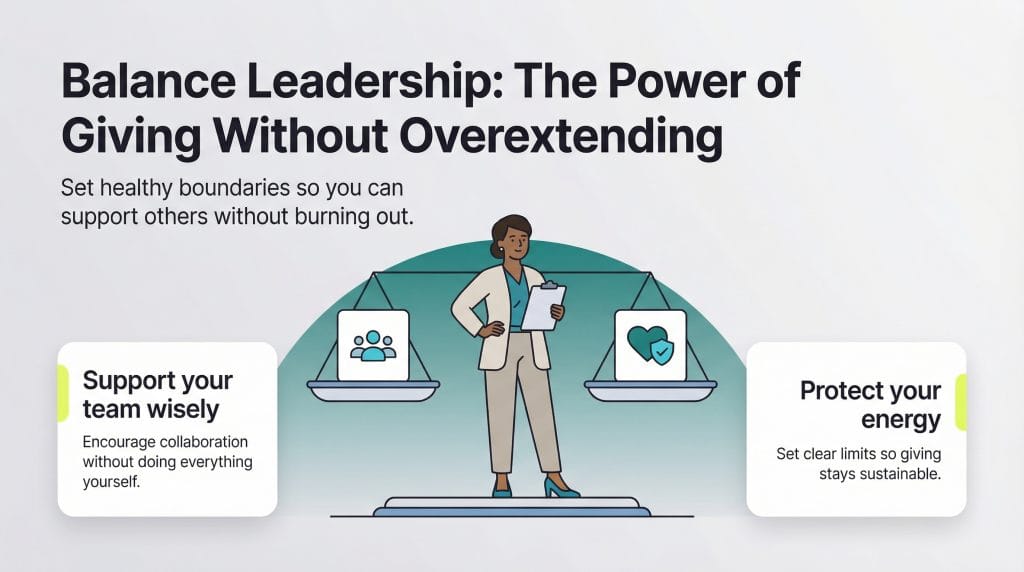
Effective and even inspirational leadership today isn’t about going it alone. It’s about knowing when to give, when to set boundaries and how to support others without burning yourself out. Leaders who strike that balance tend to build stronger teams, higher trust and better long-term results.
By combining the generosity of givers with the fairness of matchers, leaders can encourage collaboration and shared growth while still protecting their own well-being. When giving is thoughtful and sustainable, teams are better positioned to succeed together, and organizations are set up for lasting success.
Amanda Clark contributed to this article. Source interviews were conducted for a previous version of this article.