Business.com aims to help business owners make informed decisions to support and grow their companies. We research and recommend products and services suitable for various business types, investing thousands of hours each year in this process.
As a business, we need to generate revenue to sustain our content. We have financial relationships with some companies we cover, earning commissions when readers purchase from our partners or share information about their needs. These relationships do not dictate our advice and recommendations. Our editorial team independently evaluates and recommends products and services based on their research and expertise. Learn more about our process and partners here.
Learning the psychology of sales can help you understand and reach your customers.

To succeed in selling, it is vital to understand who your customers are and what motivates them to spend their money. Psychology in selling involves zeroing in on customers’ emotional needs. Putting yourself in a customer’s shoes helps manage your sales pitch. Most individuals buy based on emotion rather than logic. There are six typical emotional responses to a sale and understanding these psychological attitudes relates directly to your marketing efforts.
Sales psychology is a type of process that involves considering the psyche of your target market to increase your sales. Instead of convincing customers they need your product or service, you find a way to market to their current wants and needs. Individuals purchase in different ways. Some customers buy impulsively; others use logic and reason over emotion.
“Sales isn’t rational,” said Reilly Newman, brand strategist and founder of Motif Brands. “It’s a relational interaction that is rooted in human psychology. Understanding the behavior of humans and our decision-making process makes selling more effective.”
Sales professionals can tap into a customer’s emotions as a way to close a sale. A common mistake in sales pitches is focusing on price. When a sales associate understands the values of their target audience, they can use strategies to demonstrate how a product or service aligns with what their customers care about.
“Sales is not about pushing products — it’s about understanding people,” said Sabir Naghiyev, founder and CEO of Chrysales. “Every buying decision is emotional before it becomes logical. The best salespeople don’t convince; they connect.”
In his book “Influence: The Psychology of Persuasion,” psychologist Dr. Robert Cialdini outlined six fundamental principles behind the psychology of sales:
“The majority of these are what I would categorize as trust-building activities,” Newman said. “Trust is key to sales because it is only truly earned via the experience after the sale. However, Cialdini’s six principles assist with this because they increase the probability of the counterpart ‘lending’ their trust before the experience, which leads to the sale.”
Each of these principles delves into a person’s psychological responses in a sales setting. Here is more about each one.
For reciprocity, the focus is on the emotional need to give something back after receiving something. Think of it like returning a favor: If your company goes out of its way to do something nice for a customer, the customer may feel compelled to make a purchase in return. For example, if you’re given a free sample of a product, you’re more inclined to buy it to reciprocate.
Commitment refers to the need to make a change in your life. The person may want to quit smoking or lose weight. Marketing efforts would tap into the person’s need to prove that they can remain committed to their goals. This approach is effective because, for a person to stay committed, they might need to use your products consistently. Emphasize this consistency in your marketing to encourage repeat purchases.
Social proof is linked to our innate need to like the same things as our peers. A large percentage of buyers rely on recommendations from friends, family members and online reviewers before making a purchase. Influencer marketing taps into this psychological need. The testimonials or reviews section of your company’s website can serve the same purpose. When customers see praise from people like themselves, they’ll feel confident that you can meet their needs.
Liking refers to purchasing a product due to a positive emotional response to the person selling it. This is the reason many marketing campaigns use celebrities or influencers in their ads. It’s also a good reason to ensure that your sales and customer service associates and reps are friendly.
When it comes to the psychology of choice, less is more. With scarcity, the key motivator for the buyer is the fear that they will miss out on a unique opportunity. This is why ads often use phrases like “limited-time offer.” A person who misses out on this offer may regret having to pay a higher price later, meaning limited-time offers can lead to a spike in sales.
For authority, the buyer is persuaded by individuals who are known as industry experts or authorities. For instance, many advertisements for toothpaste state that the product is endorsed by dental associations and is a brand “trusted by dentists.”
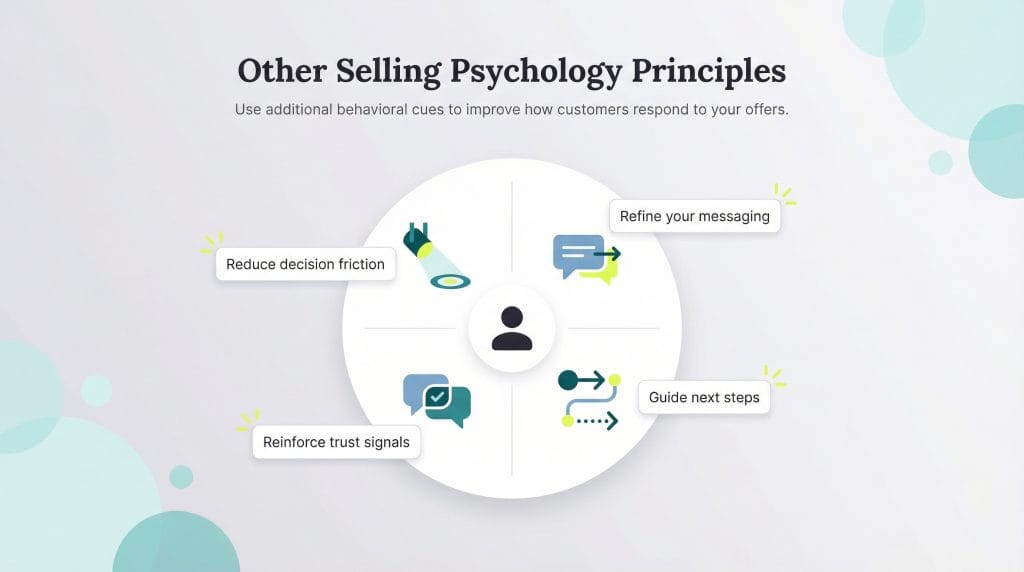
Beyond the six core sales psychology principles, several additional tactics can improve your chances of closing a sale and building lasting customer relationships.
Try complimenting your buyer. People rarely take the time to compliment someone else and yet, everyone loves a compliment. Complimenting your buyer can surprise them and make their day in ways that can increase the likelihood of a sale. This can be seen as part of the reciprocity principle and it can also make them like you more, which plays into the liking principle.
“Compliments are big because it is a vulnerable signal that also makes the counterpart feel good,” Newman said. “[It] shows we agree on something and align. This increases trustworthiness.”
Stay in front of your buyer through email marketing campaigns, newsletters, text message marketing and any other means you can. Do not spam them; nobody likes a ton of junk mail and it will send you to spam land if you are not careful. Be measured about the time, content and value of the messaging. If the user receives information that they can use, it is valuable.
Unity-driven marketing taps into people’s desire to belong. Campaigns built around shared identity — whether that’s a sports team, a cultural background or a lifestyle — can forge an emotional connection between your brand and your audience. A gym promoting its group fitness classes as a social community, not just a workout, is an example. When customers feel like they are part of something larger than a transaction, loyalty often follows.
Amanda Hoffman contributed to the reporting and writing in this article. Source interviews were conducted for a previous version of this article.