Business.com aims to help business owners make informed decisions to support and grow their companies. We research and recommend products and services suitable for various business types, investing thousands of hours each year in this process.
As a business, we need to generate revenue to sustain our content. We have financial relationships with some companies we cover, earning commissions when readers purchase from our partners or share information about their needs. These relationships do not dictate our advice and recommendations. Our editorial team independently evaluates and recommends products and services based on their research and expertise. Learn more about our process and partners here.


Azuga’s user-friendly interface, plug-and-play hardware and around-the-clock customer service make it our choice for the best GPS fleet tracking software for ease of use. Business owners can view vehicle locations, driver behavior and fleet performance data in near-real time from a centralized dashboard. The platform’s robust functionality and ease of use combine to reduce the learning curve for businesses looking to enhance driver safety, minimize vehicle maintenance expenses and lower fuel costs.
Businesses that need to monitor their fleets require technology that’s simple to install, intuitive to navigate and backed by responsive customer service. Azuga delivers on all three fronts. Its plug-and-play hardware can be installed in seconds, while its desktop and mobile dashboards make everyday fleet management tasks straightforward. We also like that Azuga provides extensive online resources to help users get the most out of the platform. If you need additional assistance, customer support is available 24/7 by phone, email and online ticketing.
We were also impressed by how easy it is to generate reports from Azuga’s vehicle and driver data. The platform helps fleet managers identify cost-saving opportunities, improve driver performance and stay on top of vehicle maintenance. That combination has found a wide audience: Azuga says its software now powers more than 14,000 commercial fleets, ranging from small businesses to large enterprises. With its intuitive tools and around-the-clock support, Azuga is our top choice for the best GPS fleet tracking software for ease of use.
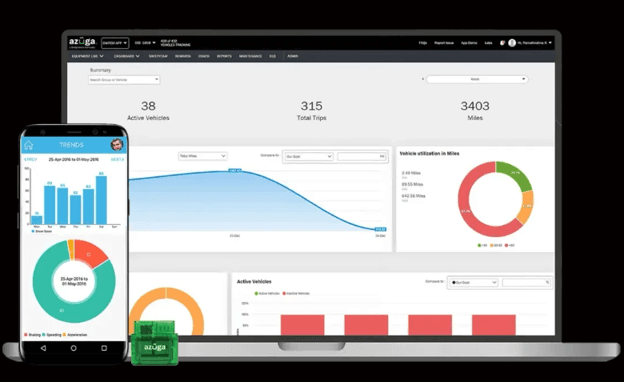
We chose Azuga as the best fleet management system for ease of use, so this is where the platform shines. When you log in to Azuga’s cloud-based app, the dashboard is clear and intuitive. You can monitor drivers and vehicles in real time using the Live tab, run detailed reports and stay on top of maintenance tasks across your fleet. You can’t customize the dashboard, but you can replace the Azuga logo with your own to personalize the system’s appearance.
We were impressed by Azuga’s substantial collection of guides and support resources. Its online help center is among the best of the GPS fleet tracking services we reviewed, on par with rivals Verizon Connect and FleetUp. We also appreciate that users can reach a live support representative 24/7 and access assistance through email and an online ticketing system.
We also like how easy Azuga makes it to share data. For example, you can automatically share vehicle identification numbers, odometer readings, driving distances, hours driven and diagnostic information with fleet management company partners.
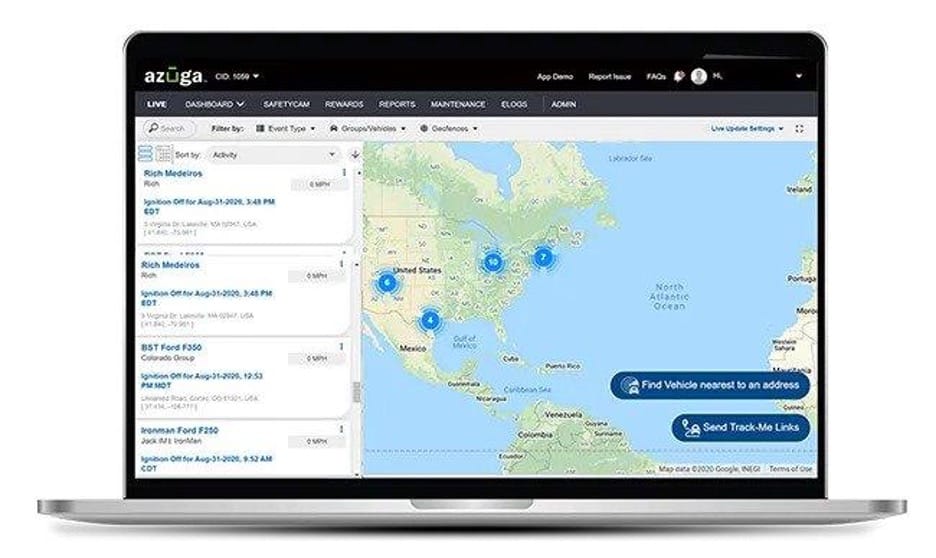
Azuga is a feature-rich GPS tracking and fleet management platform that supports more than 110 integrations and partners. Here’s an overview of some tools and features that stood out to us.
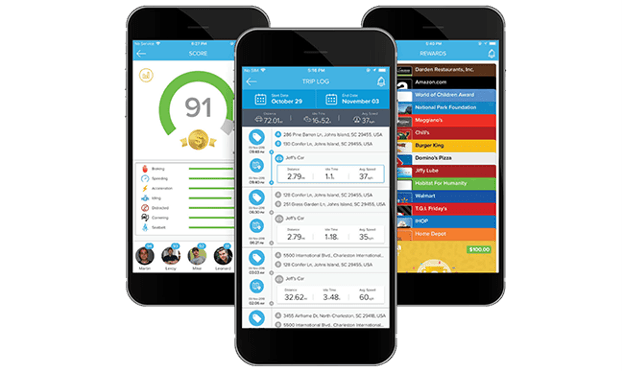
We like that Azuga combines driver monitoring with training and rewards through the following features:
Azuga overhauled its dashcam lineup in 2025, and the platform now offers two dual-facing AI cameras: SafetyCam Pro and SafetyCam Plus. Both detect and analyze poor driving behaviors and report the information back to your dashboard to help you implement fleet safety measures. We like that the choice between them is a genuine one rather than a good-better upsell — Pro is the heavier-duty option, supporting up to four exterior auxiliary cameras and considerably more onboard storage, while Plus supports one interior auxiliary camera and suits fleets that don’t need surround coverage. Both record at up to 1080p and are rated to operate between -40 and 140 degrees Fahrenheit.
The cameras organize what they capture into three event types, which we found makes the dashboard far easier to triage than an undifferentiated video feed:
We like that Azuga combines these real-time alerts with interactive coaching. Fleet managers can review flagged videos, track coaching feedback and send drivers personalized guidance based on specific events. This gives businesses a way to address risky behavior when it happens and follow up with targeted coaching afterward.
Azuga’s collision reports also impressed us. Whenever a driver reports a collision or the AI system detects one, fleet managers can pull a full report directly from the platform. The report includes driver and vehicle details, the incident’s location, the force of impact and more. Managers can also view video footage of the accident and have the evidence they need to exonerate their drivers. (Note that collision reconstruction, which pairs that footage with Azuga’s AI analysis to resolve claims, is a CompleteFleet feature.)
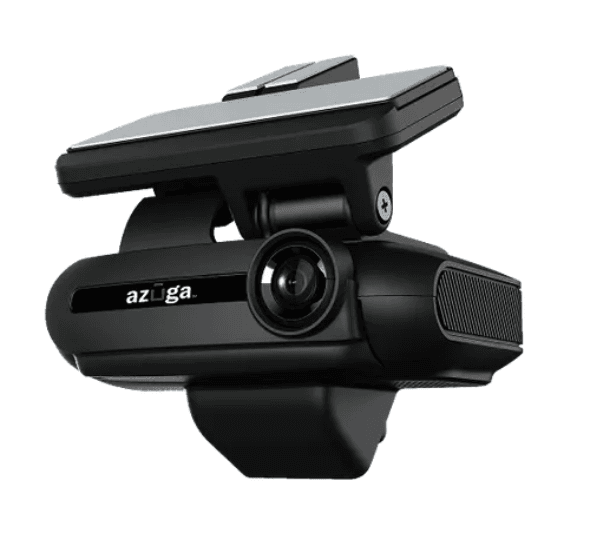
Azuga’s notable fleet maintenance features include the following:
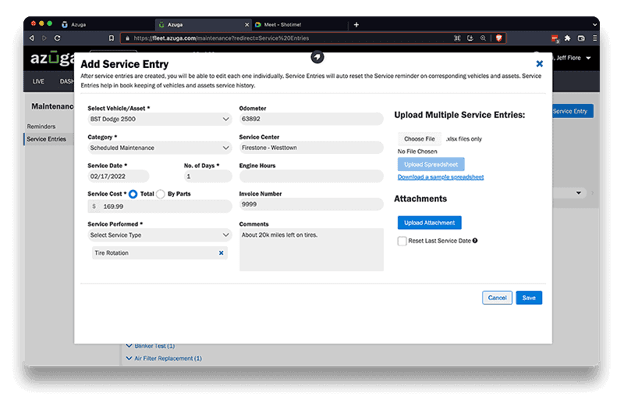
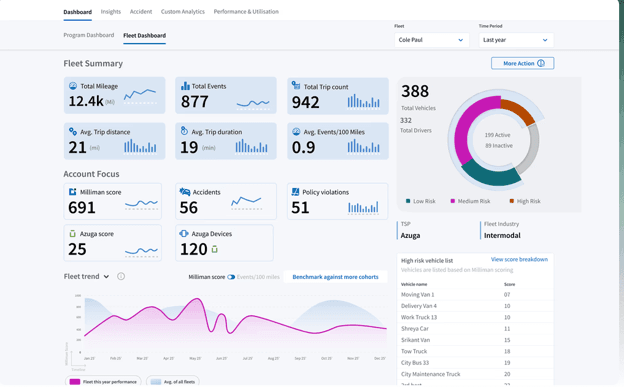
SafetyIQ is a newer addition that we think deserves more attention than Azuga gives it. It lets you oversee fleets running on different telematics providers from a single account, aggregating and normalizing their data into one dashboard. Azuga says SafetyIQ connects with more than 300 telematics service providers, including Samsara, Verizon Connect, Motive, Geotab and Lytx. For businesses that have grown by acquisition or run regional fleets on different systems, this solves a real headache — and it’s not something we saw offered by most competitors we reviewed, which generally assume you’ve standardized on their hardware.
We were also impressed by how much SafetyIQ does with that combined data. Fleet managers can track accidents, policy violations, mileage, trips and other performance metrics, use predictive analytics and Milliman vehicle risk scores to identify risk and benchmark their fleet against comparable groups based on factors such as fleet size. The platform also includes trip history, event analysis, scheduled and historical reports, custom reporting and accident reconstruction. That makes SafetyIQ useful for more than consolidating data; it gives larger and more complex fleets a way to compare performance and spot risk across systems that would otherwise remain siloed.
Azuga’s asset trackers make it easy to keep tabs on trailers, containers, heavy equipment and other valuable assets beyond your fleet vehicles. We like that managers can see where equipment is in real time from the same tracking dashboard they use for their fleet, making it easier to coordinate deliveries, pickups and maintenance.
Azuga offers rechargeable and long-life GPS asset trackers, with both options providing up to five years of battery life depending on the device and use. The rechargeable model can be used with vehicles, generators, mobile lights and heavy equipment, while Azuga recommends its long-life tracker for assets such as trailers, shipping containers, signs and mobile storage units.
The asset management system also includes geofencing and movement alerts, so managers can be notified when equipment starts moving, enters or leaves a designated area or makes a lengthy stop. We think those tools are particularly useful for businesses with expensive equipment spread across jobsites or yards, where knowing an asset has moved unexpectedly can help prevent theft or unauthorized use. Managers can also access asset location and historical tracking data through Azuga’s dashboard and mobile apps.
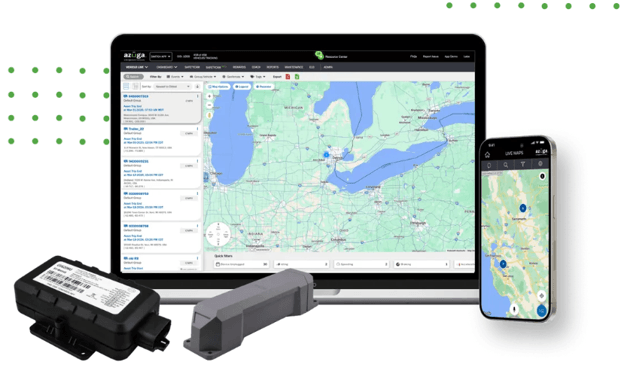
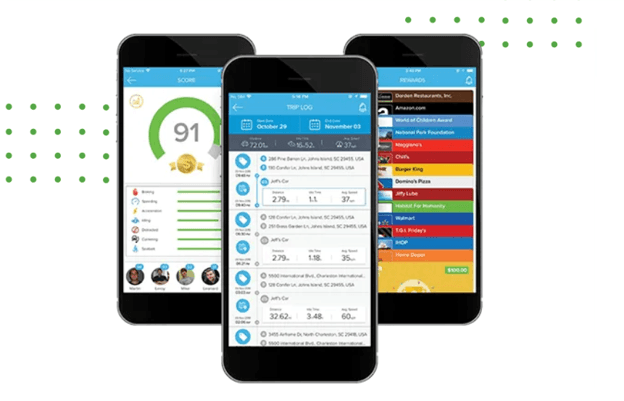
Azuga’s FleetMobile app, available for iOS and Android devices, gives administrators and drivers separate mobile views and is included with every fleet subscription. The app brings many fleet management tools onto a phone, so managers can keep tabs on operations while drivers have access to the features they need on the road.
Here’s what stood out to us:
Azuga’s app marketplace includes over 110 partners and integrations spanning routing and dispatch, maintenance, fuel cards, field service management and other business needs. It isn’t the deepest marketplace in the category — Samsara, for example, offers more than 300 integrations — but there’s a good variety of options for connecting Azuga with other systems a fleet already uses.
The marketplace includes field service platforms such as BuildOps, ServiceTitan and FieldPulse; transportation and dispatch tools such as Descartes and DispatchMVP; and fuel card integrations such as Comdata. Businesses can filter the marketplace by solution type and industry, which makes it easier to narrow down the options that apply to their operations.
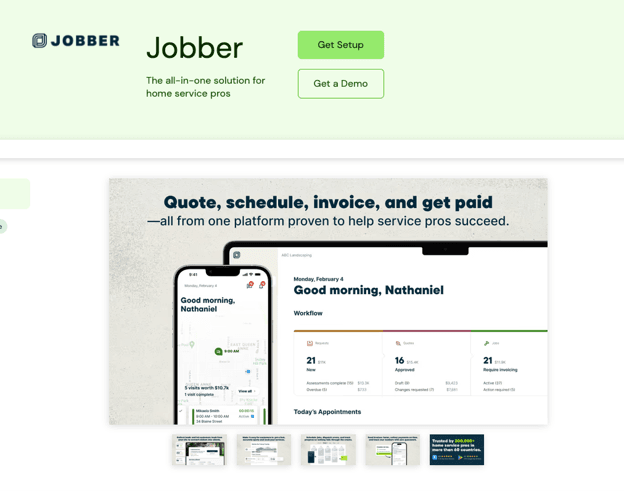
One addition that stood out to us is Azuga’s Jobber integration, launched in March 2026. It brings live vehicle and crew locations into Jobber’s scheduling and dispatch screens, saving home service businesses such as plumbing, HVAC and lawn care companies from switching between systems just to see where their crews are.
Azuga lists starting prices on its website; however, to obtain an exact quote, you’ll need to submit an online form with additional information about your business and its specific needs.
Plan | Starting price | Key features |
|---|---|---|
BasicFleet | $25 per vehicle, per month |
|
SafeFleet | $30 per vehicle, per month | Everything in BasicFleet, plus:
|
CompleteFleet | $35 per vehicle, per month | Everything in SafeFleet, plus:
|
Additional pricing considerations:
Azuga is relatively easy to get up and running, thanks largely to its plug-in hardware and straightforward setup process. Here’s how to get started:
Azuga also provides an API for businesses that want to connect fleet data with other applications they use. API integration starts with the SafeFleet plan, so businesses that need this capability should factor the higher-tier subscription into their budget. Azuga also provides a developer portal with API documentation and authentication resources for businesses building their own integrations.
Azuga provides excellent customer service, with expert assistance available 24/7 via email, phone or online ticketing. Additionally, Azuga’s online knowledge base is one of the most extensive we came across in this category, with self-service documentation covering the platform in real depth. You can also access a regularly updated blog, webinars and even a return-on-investment calculator to see how GPS fleet management can save your business money.
Customers on the CompleteFleet plan also receive white-glove onboarding and ongoing support. That tier assigns a dedicated customer success manager under Azuga’s concierge support option and includes a quarterly fleet review, where you sit down with that manager to go through driver scores, idling, utilization and vehicle health. We think that level of hands-on support adds considerable value to the $35-per-vehicle plan, particularly for businesses that want help making sense of their fleet data.
Azuga has numerous helpful functions, but we did identify several limitations:
Choosing a GPS fleet management service can be tough, so we did some of the heavy lifting for you. We spent hours researching and analyzing the best GPS fleet tracking systems to identify the top solutions on the market. We examined hardware, features, pricing, contracts, usability, refresh rates and customer support and gained hands-on experience with demos and product videos whenever possible.
When looking for the best GPS fleet tracking service for ease of use specifically, we prioritized plug-and-play hardware, straightforward setup, intuitive dashboards and a high level of customer support.
We recommend Azuga for …
We don’t recommend Azuga for …