Business.com aims to help business owners make informed decisions to support and grow their companies. We research and recommend products and services suitable for various business types, investing thousands of hours each year in this process.
As a business, we need to generate revenue to sustain our content. We have financial relationships with some companies we cover, earning commissions when readers purchase from our partners or share information about their needs. These relationships do not dictate our advice and recommendations. Our editorial team independently evaluates and recommends products and services based on their research and expertise. Learn more about our process and partners here.
If you want to improve employee ROI, ensure your company and team members embrace these soft skills.


Hiring managers know that technical and academic skills can become outdated. However, soft skills — such as creativity, collaboration and adaptability — remain valuable throughout an employee’s career and are always in high demand. Still, many business owners and managers don’t realize they can develop and reinforce soft skills internally to yield even better results. Doing so helps create a cohesive, high-performing work environment that boosts productivity and, ultimately, profits.
We’ll share how to identify and strengthen soft skills in your workplace to increase employee return on investment (ROI). After all, wages account for a significant portion of your business’s expenses, so improving employee ROI is essential.
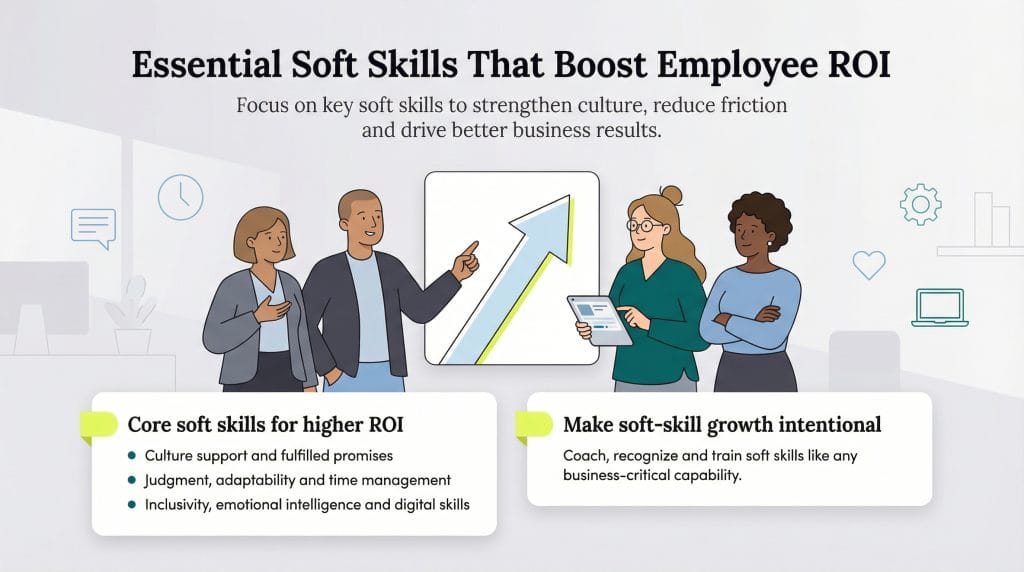
Employees who struggle with key soft skills can create workplace friction that distracts your team from your company’s mission and goals. In contrast, encouraging and cultivating these skills can strengthen your workplace culture and increase your organization’s chances of success and growth.
Below are the essential soft skills that, when supported and developed, can boost employee ROI and help create a more cohesive, high-performing work environment.
Every business owner and manager wants a strong company culture where employees believe in the organization’s goals and see the business as more than a paycheck. When employees are aligned with your mission and values, they’re more likely to go above and beyond to contribute positively to the workplace.
As a business owner, creating a culture that keeps employees motivated and engaged is crucial — and it can pay off. Research shows that companies with highly engaged employees experience 23 percent higher profitability than those with low engagement. When team members feel connected to the company’s mission, they spend less time on distractions and more time focused on work that supports the organization’s purpose.
If a worker simply fulfills their responsibilities, that’s good — but employees who actively support your culture will deliver an even greater return on investment.
Trust flourishes in companies where employees’ and leaders’ words and actions match. They make and keep promises and follow through on commitments. And there’s a strong business case for this: 93 percent of business executives agree that building and maintaining trust improves the bottom line, according to PwC’s 2024 Trust Survey. When trust is present, team members stay focused, collaborate more effectively and show genuine dedication to the company’s culture and goals, all of which contribute to a higher employee ROI.
However, trust starts to break down when promises aren’t kept, creating a disconnect. For example, if an employee promises to complete a project by Monday but doesn’t finish it until Wednesday, the team will likely grow wary — and if it happens repeatedly, that impact only grows.
Unfulfilled promises create cracks within teams that ultimately weaken the company, with potentially serious consequences.
Some employees get hung up on how they think things ought to be done, which can cause frustration and distractions. For example, if they feel a co-worker isn’t handling a task the “right” way, they may start paying more attention to that than to their own work.
In contrast, employees who exercise sound judgment stay focused on what matters and contribute to a healthier team dynamic. They manage their emotions when challenges arise — whether work-related or personal — which leads to better communication, clearer decision-making and a more positive workplace environment. This soft skill has a direct impact on team performance and should be recognized, encouraged and nurtured.
No matter your industry, advances will occur, unexpected challenges will arise, new technology will present itself, and other changes will impact operations at some point. And the pace is only accelerating. According to a McKinsey report, the average life span of a company on the S&P 500 is now just 18 years, down from 61 years in 1958. The takeaway? Adaptability isn’t a “nice-to-have” anymore: It’s a core skill that helps companies stay competitive.
Employees who are set in their ways can hold your business back and stifle creativity and team innovation. Likewise, team members who can’t pivot when a project hits a roadblock can cost your organization valuable time and money.
On the other hand, adaptable employees bring enormous value. They’re willing to embrace new technology, explore fresh ideas, adjust strategies when needed and help the team innovate to meet evolving demands.
The good news is that adaptability skills can be strengthened. Teaching employees the benefits of staying flexible and giving them opportunities to practice can prepare them to work through less-than-ideal conditions, navigate organizational change such as downsizing, and learn new skills to keep pace with technology.
Some professionals work hard but still struggle to meet deadlines and take care of obligations due to poor time management skills. Wasted time isn’t just a productivity issue: It’s a financial drain. According to Wrike’s 2024 Impactful Work Report, organizations waste an average of $15,138 per employee per year on unnecessary work, and nearly half of all work (46 percent) is considered low-impact, equal to 18.4 hours every week.
In contrast, team members who have mastered time management are invaluable assets. They consistently meet their goals and deadlines and use critical thinking skills to prioritize tasks.
Continuously improving your team’s time management leads to more money in the bank and less time on the clock. It can also boost creativity as colleagues brainstorm more efficient ways to work, increasing job fulfillment and collaboration across teams.
Diversity, equity and inclusion (DEI) remain top priorities in business today, but improving workplace diversity and inclusion takes more than policies and training. It requires team members who embrace inclusivity and actively participate in efforts that make everyone feel respected and valued. DEI initiatives can include mentorship programs, celebrating diverse holidays as a team, and regularly seeking (and acting on) honest feedback from a variety of voices.
Creating a culture of inclusivity starts early, including in hiring. Instead of hiring for “culture fit,” aim to hire team members who add to your culture and help broaden perspectives. This builds a diverse team that models inclusion and sets the tone for the rest of the organization.
Emotional intelligence (EQ) remains one of the most valuable soft skills in today’s workplace. Team members with high EQ can read the room, manage their emotions, understand others’ perspectives and respond thoughtfully, all of which are essential for collaboration, leadership and customer-facing roles.
The World Economic Forum’s Future of Jobs 2025 report highlights several EQ-driven competencies as core skills for the future workforce. These include leadership and social influence (61 percent of employers), motivation and self-awareness (52 percent) and empathy and active listening (50 percent). Together, these skills reflect the increasing importance of emotionally intelligent employees.
Strong EQ contributes to healthier team dynamics, better communication and more effective conflict resolution. Employees with high emotional intelligence are more resilient during challenges and help maintain a positive, supportive work environment, ultimately improving productivity and employee ROI.
Digital literacy has become a crucial workplace skill that draws on adaptability, curiosity and problem-solving. According to the National Skills Coalition, 92 percent of jobs now require digital skills, yet one-third of workers lack even basic digital proficiency. As businesses rely more on digital tools in daily operations, employees who learn new technology quickly and use it with confidence add real value to their teams.
Team members who keep up with evolving tools and trends can improve workflows, support co-workers who are less tech-confident and help move digital initiatives forward. Strengthening digital fluency across your team doesn’t just boost efficiency — it helps future-proof your workforce.
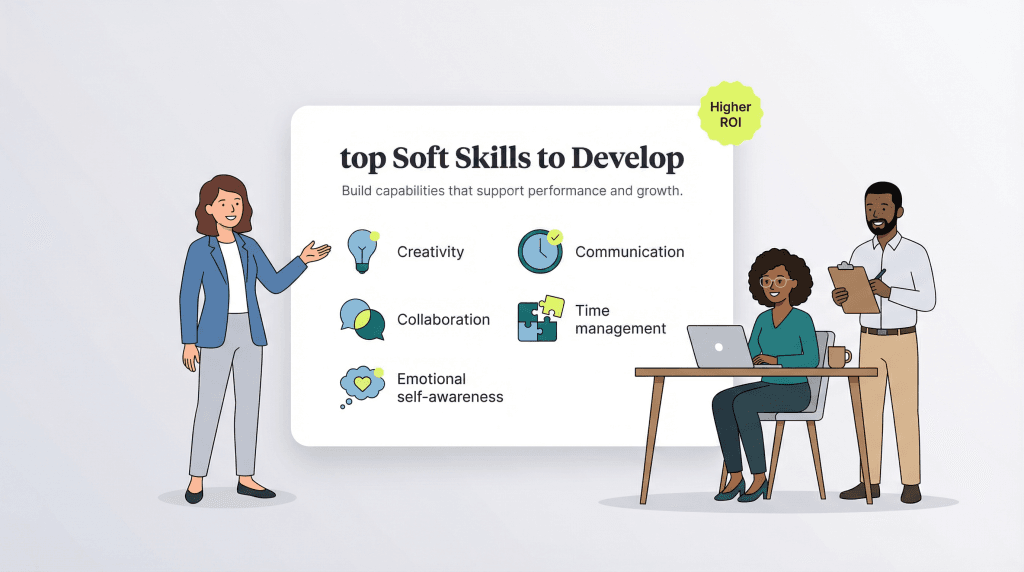
While some employees naturally excel at soft skills, others may need help. Businesses can invest in employee training to teach soft skills and help team members become more well-rounded. The time you dedicate to soft skills training can dramatically increase employees’ ROI.
Consider the following tips for fostering your team’s soft skills:
Creative thinking can improve profits and business growth. When employees are encouraged to think outside the box, they’re more likely to develop innovative solutions for customer service issues, product troubleshooting and marketing initiatives.
Give your team room to experiment and brainstorm, and facilitate creative thinking exercises that allow this skill to flourish.
When productivity hits a standstill, persuasion can move a project from stagnation to completion. And it doesn’t have to come from executives; any employee with the right skills can positively influence colleagues to try a new tactic, complete a project or perform at their best.
Teaching persuasion skills also helps build stronger, more confident leadership and sales teams. Helping employees develop persuasive negotiation tactics is a win-win for soft skills building and organizational outcomes.
Working as a team isn’t always as easy as it sounds. It requires open-mindedness and a willingness to come together for the greater good. Still, fostering collaboration is well worth the effort, and improving teamwork benefits both your business and your employees.
Collaboration helps employees bring out the best in each other, learn new skills faster and share ideas to solve complex problems. It strengthens morale and creates a sense of unity.
While some employees naturally gravitate toward teamwork, encouraging those who prefer working solo to collaborate can help elevate everyone’s soft skills. Identify opportunities where a team can succeed more effectively together than individually and promote group efforts.
Workplace challenges come up every day, and how employees handle them has a direct impact on productivity. Resilience and adaptability are important in every role. Encourage employees to tackle issues through guided problem-solving sessions. Sharing practical strategies for working through challenges can help strengthen everyone’s soft skills.
Workplace communication can make or break your business. Clear, transparent communication helps prevent misunderstandings, resolve conflicts and keep morale high.
To strengthen this essential soft skill, make a habit of checking in with your team, whether in person or through internal communication apps like Slack or Microsoft Teams, to understand what’s working and what isn’t. This is crucial because when employees learn how to communicate clearly and confidently, it directly benefits the business. According to the 2024 State of Business Communication report by Grammarly, 64 percent of business leaders say effective communication has increased productivity in their organization.
By modeling strong communication skills yourself and providing guidance to your team, you’ll help employees build this capability — improving alignment, collaboration and overall performance.
Employees who regulate their emotions are more efficient and resilient during challenges and conflicts. To help employees learn to keep their emotions in check, consider offering educational sessions on embracing mindfulness, practicing self-care and prioritizing mental health. These strategies can help your team learn how to handle emotional fluctuations better. Employees who demonstrate this soft skill are better critical thinkers, have more mental space for creativity, and are prime candidates for leadership positions.
While “time management” is a popular résumé bullet point, fewer employees truly excel at it. Yet this skill is essential for productivity, work-life balance and overall well-being. Teaching your staff practical time management strategies — and respecting their time off — can boost morale, reduce burnout, help lower workplace absenteeism and increase efficiency.
Consider implementing time-blocking techniques, project management tools and regular check-ins to help employees build stronger time management habits. When employees learn to manage their time well, they stay focused on what matters most and deliver their best work without sacrificing balance.