Your free business.com+ membership unlocks exclusive tech deals and advisor support
Join Free
BDC Hamburger Icon

Menu

Close
BDC Logo with Name
Search Icon
Search Icon
Advertising Disclosure
Close
Advertising Disclosure

Business.com aims to help business owners make informed decisions to support and grow their companies. We research and recommend products and services suitable for various business types, investing thousands of hours each year in this process.

As a business, we need to generate revenue to sustain our content. We have financial relationships with some companies we cover, earning commissions when readers purchase from our partners or share information about their needs. These relationships do not dictate our advice and recommendations. Our editorial team independently evaluates and recommends products and services based on their research and expertise. Learn more about our process and partners here.

Business Decision-Making: Gut Instinct or Hard Data?

In business, decisions matter. Should you trust your gut or rely on hard data?

author image
Written by: Sean Peek, Senior AnalystUpdated Jan 30, 2026
Gretchen Grunburg,Senior Editor
Business.com earns commissions from some listed providers. Editorial Guidelines.
Table Of Contents Icon

Table of Contents

Open row

Decisions play a massive role in the life cycle of every business, no matter the company’s size or the stakes involved. As Apple’s late CEO Steve Jobs once said, “You have to trust in something — your gut, destiny, life, karma, whatever. This approach has never let me down, and it has made all the difference in my life.”

Thanks to today’s technological advances and the rise of artificial intelligence, businesses now have unprecedented access to data that can inform decision-making. Yet, despite having more information at their fingertips than ever before, many companies still rely on instinct and intuition rather than facts when making critical business decisions. So which approach works better — trusting your gut or relying on data? Let’s find out.

Making business decisions based on gut instincts

Over time, many business owners develop a sixth sense about decision-making. It grows out of experience — making calls, watching outcomes and adjusting along the way. When you trust your gut, you’re often responding to patterns you’ve seen before, even if you don’t consciously connect all the dots in the moment.

Rather than analyzing every decision solely through objective data, experienced professionals often rely on intuition when decisions involve ambiguity, time constraints or incomplete information, such as evaluating business deals, projects or customers. This instinctive understanding comes from repeated exposure to similar situations, time spent in the field and deep familiarity with their industry. In these cases, layering in external opinions, facts and large volumes of big data can muddy the waters and ultimately waste time and energy.

Some practical ways to rely on your intuition include the following:

  • When you first meet someone, take a moment to notice how you feel while talking with them. If something feels off, it’s often worth paying attention.
  • Instead of immediately searching for obvious data points or signals, pause briefly to assess how you feel about a situation.
  • Pay attention to physical reactions; tension, unease or excitement can all signal how comfortable you are with a potential decision.
  • If you’re ready to follow your instincts but need buy-in from others, frame your reasoning clearly so stakeholders understand your direction.

Pros of basing decisions on gut instincts

In an age of information overload, relying on gut instincts can feel counterintuitive. Yet in certain situations, intuition can support faster, more confident decision-making, particularly when it’s grounded in experience rather than impulse.

Here are some of the top pros of relying on gut instincts in business decision-making:
  • What you’ve learned from past experiences helps guide your decisions. Research on “implicit learning” shows that people often gain a more intuitive sense of understanding as they gain experience with repeated situational patterns. In fact, research published in Cognition found that intuitive judgments and explicit knowledge often develop together, with experience shaping how people recognize situations and make decisions, even when they can’t fully articulate their reasoning.
  • Gut instincts can help when information is incomplete or unclear. In business, data is often unavailable, conflicting or still emerging. Well-developed intuition allows experienced professionals to interpret situations and move forward without waiting for perfect information.
  • Trusting your instincts can encourage smarter risk-taking. Gut-based decisions may push you to explore new ideas, pursue unfamiliar opportunities or act on insights that excessive analysis might otherwise stall.
  • Relying on intuition can reduce stress and decision fatigue. When you trust your instincts, you’re less likely to overanalyze every option or second-guess yourself afterward. This makes it easier to move forward with confidence and reduce productivity-killing stress.
Did You Know?Did you know
Many high-stakes professions, including emergency medicine, aviation and elite sports, train practitioners to rely on experience-based intuition when time or information is limited.

Cons of basing decisions on gut instincts

cons of basing decisions on instinct

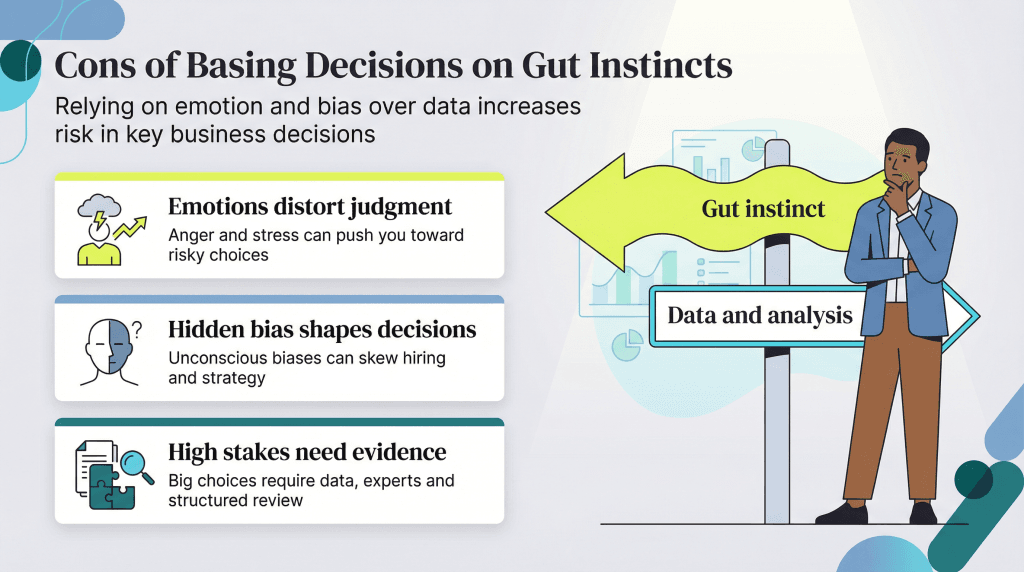
Gut instincts can be useful in the right context, but relying on them too heavily can lead to poor outcomes, especially when emotions, bias or complexity are involved.

Here are some of the key drawbacks of basing business decisions primarily on gut instincts:

  • Strong emotions can distort judgment. Emotions such as anger, stress or excitement can interfere with rational thinking and influence decisions in ways that affect your team, your organization and key business relationships. Distinguishing between calm intuition and emotional reactions is critical to making sound choices.
  • Unconscious biases can influence decisions without you realizing it. Research shows that even experienced professionals are susceptible to cognitive biases — mental shortcuts that shape how information is interpreted. A review published in Frontiers in Psychology found that biases such as overconfidence, framing and confirmation bias affect professional decision-making across fields, including management, finance, medicine and law, with real implications for the hiring process, investment decisions and strategic planning.
  • Fear can be mistaken for intuition. Physical reactions like tension or unease often show up in both cases, which makes it easy to mistake anxiety for a gut warning and walk away from opportunities that deserve a closer look.
  • Some decisions require more than instinct alone. High-stakes choices, such as human resources decisions that involve multiple stakeholders, legal considerations or long-term consequences, often demand data analysis, outside expertise and careful evaluation. In these cases, relying solely on gut instinct can overlook critical details.
  • Instinct doesn’t guarantee good outcomes. Gut decisions can go wrong, especially when customer emotions or quick reactions cloud judgment. Without some guardrails, relying on instinct alone can raise risk instead of lowering it.

Making business decisions based on hard data

Today’s businesses have access to more information than ever before. From customer behavior and sales performance to market trends and operational metrics, data makes it possible to evaluate decisions based on evidence rather than instinct alone. As data analytics tools have become more accessible and affordable, many organizations now turn to facts and measurable insights to validate ideas, test assumptions and guide strategy.

Using data to guide decisions can take much of the guesswork out of running a business. While instinct still has its place, most decisions are stronger when they’re backed by relevant numbers and real-world insight. Hard data helps you see what’s actually working, where things are falling short and whether your choices support your larger goals.

Relying on data can also make it easier to gain buy-in. Whether you’re presenting ideas to investors, board members or internal stakeholders, evidence-based reasoning strengthens your case and helps others understand the logic behind your decisions.

TipBottom line
Invest in business intelligence software to help collect, analyze and report insights across your organization in a consistent, reliable way.

Pros of basing decisions on data

Because instincts aren’t always reliable, many professionals turn to hard data to guide their decisions. When choices are backed by evidence, leaders can explain the reasoning behind them more clearly and move forward with greater confidence.

Here are some of the key advantages of basing business decisions on data:
  • Data helps you make decisions you can clearly justify. Using statistics, performance metrics and insights into industry trends makes it easier to explain why a decision makes sense. Data-backed reasoning is especially valuable when decisions need approval from leadership, investors or other stakeholders.
  • Data-driven organizations are better positioned to create value. McKinsey’s 2024 research on data- and AI-driven enterprises points out that companies that regularly use data in day-to-day decisions are more likely to improve performance and spot new opportunities as markets change. Instead of treating data as a one-off insight, these businesses use it across teams to inform strategy and execution.
  • Shared data improves collaboration and communication. When teams work from the same data, conversations shift from opinion to evidence. A data-driven culture helps employees learn from past results, spot areas for improvement and coordinate more effectively across departments via better workplace collaboration.
  • Data provides a clearer picture of how your business operates. “It’s crucial to consistently monitor and analyze data to gain a comprehensive understanding of your business model,” explained Fredrik Jansson, chief commercial officer at Configura. “By doing so, you can identify how your business operates, which actions are driving results and anticipate future trends.”

Cons of basing decisions on data

cons of basing decisions on data

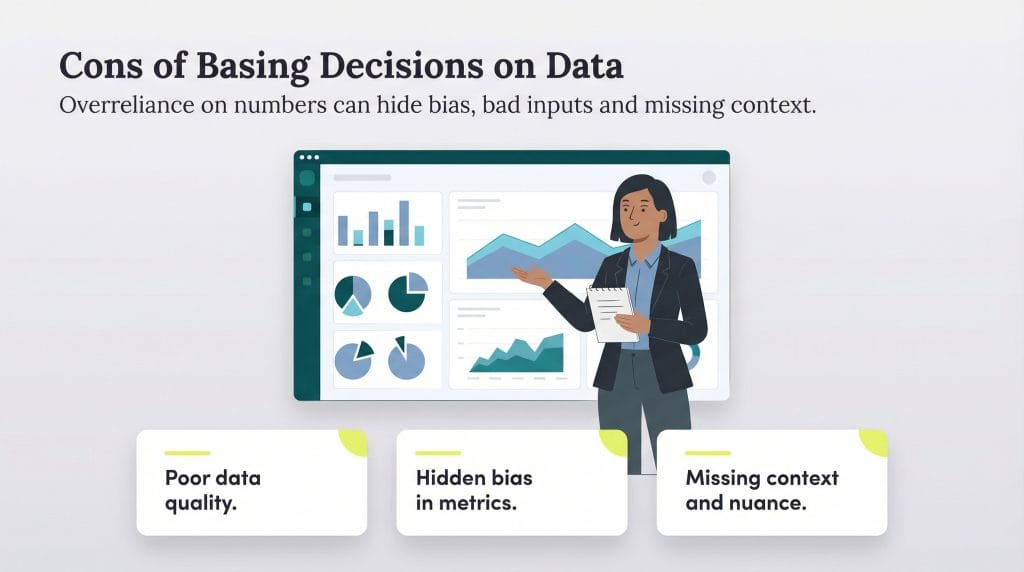
Data can make decision-making feel more objective, but relying on it too heavily (or without proper safeguards) can still lead to poor outcomes.

Here are some of the key drawbacks of basing business decisions primarily on data:

  • Poor data quality can lead you in the wrong direction. Every industry deals with bad data, whether it’s outdated, inaccurate, duplicate, incomplete or poorly formatted information. In fact, a 2025 industry survey by Melissa found that 84 percent of organizations struggle with inaccurate or duplicate data, creating data integrity risks for operations, compliance and the customer experience. Without clear processes to validate, clean and update your data, flawed inputs can undermine even the most well-intentioned decisions.
  • Data can reflect bias just as easily as people can. Business data isn’t automatically neutral. Technical issues, human input errors and flawed methodologies can all introduce bias that skews results. Without proper training, oversight and data minimization practices, teams may draw confident conclusions from data that doesn’t tell the full or accurate story.
  • Numbers don’t always capture the full context. Data alone may miss qualitative factors like customer sentiment, employee morale or emerging shifts that aren’t measurable (or aren’t yet measurable). “While data provides a solid foundation for informed choices, relying solely on numbers can sometimes lead to overlooking important qualitative factors,” Jansson explained. “Intuition, based on experience and knowledge, can help identify trends and patterns that might not be immediately apparent from the data.”
Bottom LineBottom line
Good business decisions don't rely on instinct or data alone. They work best when judgment is backed by reliable information and strong data management without letting either side take over.

Informed decision-making: How to blend data and intuition

Making business decisions is rarely simple. Most choices involve a mix of reasoning, data, experience and emotion. The most effective leaders understand that good decision-making isn’t about choosing between gut instinct and hard data: It’s about knowing when each one deserves a seat at the table.

  • If you lean toward data: For leaders who lean heavily on data, bringing intuition into the process can feel uncomfortable. But that stretch is often worthwhile. According to Jansson, qualitative inputs like customer feedback, industry trends and conversations with team members can be just as valuable as quantitative metrics. “By exposing themselves to a wider range of perspectives, [business leaders] can develop a stronger sense of intuition,” Jansson explained.
  • If you rely on instinct: The same balance applies in the other direction. Leaders who rely primarily on gut instinct can benefit from slowing down and looking more closely at the data. “By visualizing data and identifying trends, [leaders] can gain a deeper understanding of their business and make more informed decisions,” Jansson said. He also noted that intuition isn’t immune to bias, which is why data can play an important role in grounding judgment and challenging assumptions.

Ultimately, the goal is to develop what many researchers refer to as informed intuition: instincts shaped by experience, reinforced by data and refined through ongoing learning. This approach helps leaders navigate the tension between facts vs. emotions, allowing them to move quickly when circumstances demand it without losing sight of the evidence. Data may highlight an opportunity, but intuition often helps determine the right timing and approach for acting on it.

Kaytlyn Smith contributed to this article. Source interviews were conducted for a previous version of this article. 

Did you find this content helpful?
Verified CheckThank you for your feedback!
author image
Written by: Sean Peek, Senior Analyst
Sean Peek co-founded and self-funded a small business that's grown to include more than a dozen dedicated team members. Over the years, he's become adept at navigating the intricacies of bootstrapping a new business, overseeing day-to-day operations, utilizing process automation to increase efficiencies and cut costs, and leading a small workforce. This journey has afforded him a profound understanding of the B2B landscape and the critical challenges business owners face as they start and grow their enterprises today. At business.com, Peek covers technology solutions like document management, POS systems and email marketing services, along with topics like management theories and company culture. In addition to running his own business, Peek shares his firsthand experiences and vast knowledge to support fellow entrepreneurs, offering guidance on everything from business software to marketing strategies to HR management. In fact, his expertise has been featured in Entrepreneur, Inc. and Forbes and with the U.S. Chamber of Commerce.
Related Tips & Topics
More Related articles
Arrow