Mergers and acquisitions are major transitions for organizations that often come with uncertainty and stress for employees. How leaders communicate during this time can either keep things steady — or quietly create chaos. When communication is vague or delayed, employees tend to fill in the gaps themselves. That’s when rumors spread, morale slips and productivity takes a hit. However, clear, timely messaging spreads understanding, helps prevent confusion and keeps everyone focused on their work instead of worrying about what’s coming next.
Despite shifting market conditions, mergers and acquisitions remain a common growth strategy, particularly in industries like technology and healthcare. Deal volume may rise and fall, but the need for strong internal communication doesn’t change. Business owners and executives who prioritize honest, consistent messaging are better positioned to preserve company culture and protect their brand’s reputation during the transition.
Human resources plays a key role in merger communications. HR teams from both organizations typically collaborate on policy alignment, employee retention or reductions, and changes to
employee benefits and compliance requirements.
How to internally announce mergers and acquisitions
If you’re preparing for a merger or acquisition, how you announce it internally matters just as much as the deal itself. A rushed or poorly timed message can create unnecessary anxiety, while a thoughtful rollout helps employees stay focused and grounded. That’s why careful planning and clear execution matter.
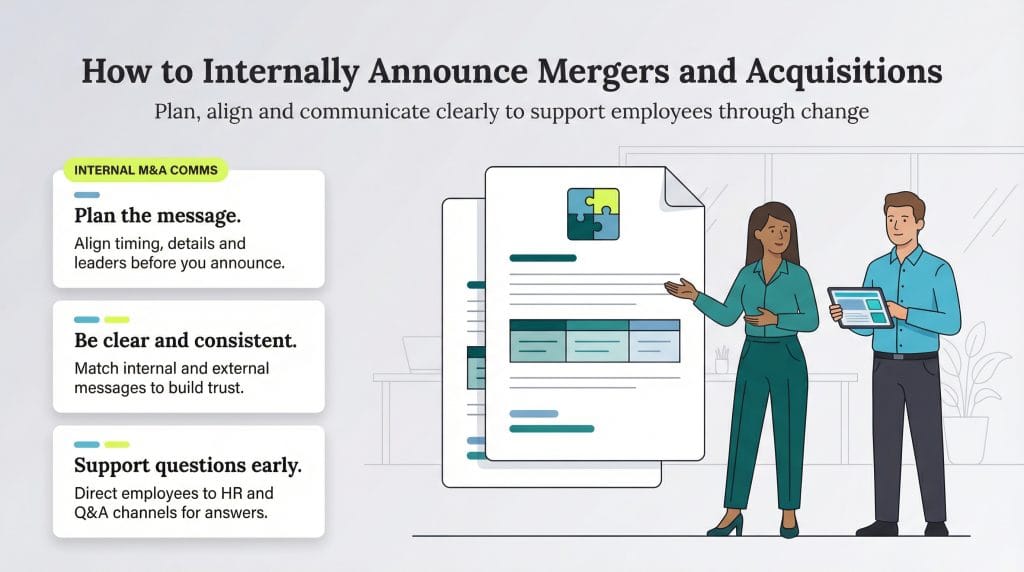
- Plan your messaging: David Olsson, managing director at the Institute for Mergers, Acquisitions and Alliances (IMAA), emphasized the importance of planning well in advance. Before anything is shared company-wide, leadership should align on the timing of the announcement, who will deliver it and how much detail employees will receive. Just as important, Olsson notes, is having a clear integration plan in place. Employees will want to understand why the merger is happening, what the combined organization will look like and who will lead the transition. Those answers shape what employees hear. “You’ve got all of that pre-deal work … to think [about], ‘Why are we buying it? What’s it going to look like? What’s the plan? Who’s going to lead it?” Olsson said. “And then, out of that will come your content. And it’s up to your comms team, or whoever is leading that side of the process, to really wordsmith it carefully.”
- Deliver your messaging: Once the plan is finalized, execution becomes the priority, and clarity and consistency are key. “Whatever you’re saying externally has got to match what you’re saying internally,” Olsson stressed. While every organization’s approach will reflect its culture and circumstances, business transparency is essential. Most companies rely on a formal internal announcement — often a company-wide email or letter — to explain the change, set expectations and reduce uncertainty.
A strong internal M&A announcement typically follows a clear, employee-focused structure, as outlined below.
1. Announce the merger.
The first part of your letter should clearly announce the merger or acquisition. This is the core purpose of the message, so keep the language direct and easy to understand. Clear, unambiguous wording helps shut down rumors and reduce anxiety right away. You should also outline the anticipated timeline and explain what employees can expect next as the organizations begin to come together.
The announcement should come directly from the company’s top leader, Olsson said. “It should be the leader saying it because they’ve got to sponsor it,” Olsson explained. “There’s going to be so much change going on that they’ve got to own the challenge.”
2. Describe the reason for the merger.
Use this section to explain why the merger is happening. Employees want to understand the strategic purpose behind the business decision-making, whether that’s expanding your customer base, gaining new technology, entering new markets or diversifying operations. Sharing this context helps people see how the deal fits into the company’s long-term vision and where they fit into the future.
“There needs to be a compelling reason to purchase the company,” Olsson advised. “The ‘why’ is everything.”
3. Address anticipated questions and concerns.
Employees will immediately wonder how the merger affects them, starting with whether their jobs are secure and how their roles may change. It’s important to address these questions directly and as early as possible. If there are confirmed role changes, explain them clearly and honestly rather than leaving people to speculate.
Reassure employees where you can. For example, if employee benefits or popular creative perks will stay the same or improve, say so. If jobs are secure, make that explicit. Even when details are still evolving, outlining what you do know about workflows, reporting structures or timelines can help reduce anxiety and uncertainty.
There’s a common misconception that mergers and acquisitions always lead to job losses, which isn’t necessarily true, according to Christopher Kummer, founder and CEO of IMAA. When possible, leaders should highlight the opportunities and advantages the merger creates, such as opportunities for internal promotions.
However, if layoffs are expected, leadership must take responsibility for communicating that reality. “There are cases where it’s not so nice for some of the people, and we’ve seen lots of executives fail to communicate this themselves,” Kummer said. “They’d rather go through HR or legal. But I think it’s a matter of leadership to go there and deliver this message yourself, even if it’s not a nice one, as sad as it is.”
4. Direct further questions and concerns to HR or another point person.
Close the announcement by telling employees exactly where to take additional questions or concerns. This may be your internal HR department or a designated leader who’s prepared to handle follow-ups. If you’re planning an all-hands meeting or Q&A session, include the date and time so employees know when they’ll have another opportunity to hear more. “Make sure there are clear paths for employees to come back and ask questions,” Olsson advised. “Internally, you need to know who those people are.”
Making it clear how and where employees can ask questions helps people feel heard and supported during a period of change. It also prevents confusion and keeps important conversations from happening through unofficial channels.
Digital tools such as
internal communication apps can make it easier to gather questions, share updates and keep feedback flowing during a complex transition.
Why internal communications are important during mergers and acquisitions
Mergers and acquisitions can drive profitable growth, but they don’t always succeed. Poor internal communication, especially a lack of transparency before the merger and weak coordination afterward, is a common reason deals struggle.
During a transaction, employees look to leadership for clarity and reassurance. When communication is thoughtful and consistent, it helps stabilize teams and lays the groundwork for successful integration. Below are four key reasons why internal communications should be a priority during any merger or acquisition.
Employee loyalty and trust are at stake.
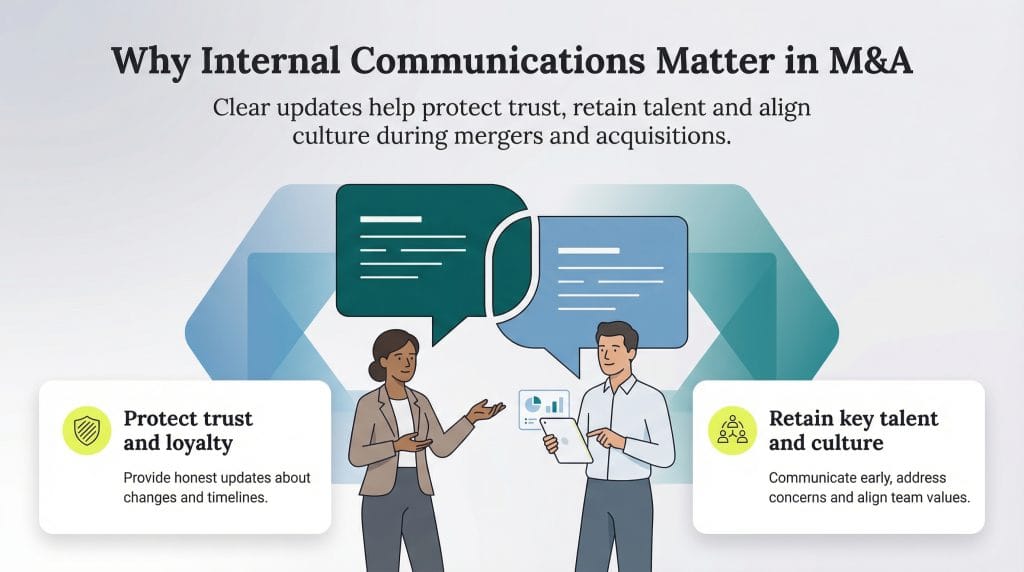
How a company communicates during a merger directly affects employee trust. When leadership messaging is unclear or inconsistent, credibility erodes quickly, especially if actions don’t align with what employees have been told.
Employees often feel vulnerable when a deal is announced. If managers don’t have answers or avoid difficult conversations, uncertainty takes over.
“If managers don’t know how to answer questions from workers, immediately you’ve got that vacuum,” Olsson said. “And as soon as you have a vacuum, gossip and rumors and everything else can come into play. That’s why having a clear plan — and a timeline for when communication will go out — is so important.”
A proactive communications strategy helps prevent that vacuum. Preparing clear messages, setting an announcement timeline and designating spokespeople can go a long way toward protecting trust and employee engagement, which are costly to lose.
Be as transparent as possible. Rather than offering vague assurances, provide specific answers to the questions employees care about most, including changes to schedules,
business locations, leadership and near-term priorities.
Your best employees can leave at any moment.
During a merger, employees at both organizations worry about job security and shifting responsibilities. While regulatory or legal constraints may limit full transparency, claiming that nothing will change when disruption is inevitable can seriously damage trust.
If employees feel misled, even unintentionally, many will start looking elsewhere, and this is dangerous because talent loss is one of the most common reasons mergers fail after the deal closes.
“If there is a plan for internal headcount reduction, and you’ve said there’s not, that’s really not a good look,” Olsson cautioned. “And so, the employees [who aren’t even] affected will look at that leader and think, ‘Well, I no longer trust you.'”
To retain top talent, communicate early and often. It’s better to admit when answers are still being worked out than to let rumors fill the void. An honest “we’re still working on that” is far more reassuring than silence.
Company culture is at risk.
Company culture will be affected during a merger, whether leaders plan for it or not. Cultural misalignment often acts as a hidden tax on a deal’s potential value, slowing collaboration and creating friction across teams.
Building a unified culture takes work. Communications teams help leaders explain a shared vision that makes sense to employees at both companies. Clear, consistent messaging from leadership is the first step toward bringing teams together.
Post-acquisition success is challenging to achieve.
Mergers and acquisitions are long, complex processes. The transaction period often heightens employee stress, but communication shouldn’t taper off once the deal is signed. In many ways, the real work begins after the deal closes.
According to Olsson, roughly 70 percent of M&A deals fail to fully achieve their intended goals, either falling apart or delivering mixed results for stakeholders. Only about 30 percent succeed in both execution and value creation.
Frequent, open internal communication is critical to overcoming those odds and cementing successful organizational performance. Communication efforts should intensify during post-deal integration, helping teams navigate change, reduce confusion and rebuild momentum.
Communication mistakes to avoid during mergers and acquisitions
When companies don’t communicate well during a merger or acquisition, the damage shows up quickly in the form of lost trust, higher employee turnover, cultural friction and weaker long-term results. For the best possible outcome, avoid these common communication mistakes as you guide employees through the transition:
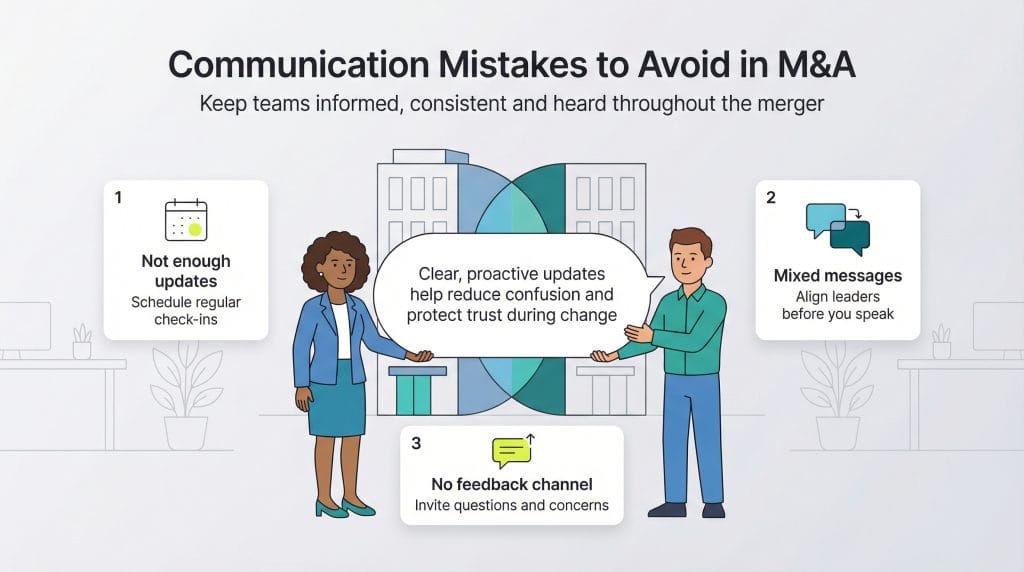
- Not communicating enough: Silence creates uncertainty. Even when there are no major updates, a regular flow of communication reassures employees that leadership hasn’t gone quiet.
- Waiting to react instead of planning ahead: Don’t let the rumor mill force your hand. Anticipate questions about job security, leadership changes and timelines, and address them before speculation takes over.
- Sending mixed messages: Inconsistent communication breeds confusion. Make sure leadership teams are aligned so employees hear the same message across departments and channels.
- Shutting down feedback: Communication shouldn’t flow in just one direction. Provide clear, safe ways for employees to ask questions, share concerns and offer informal feedback. When people feel heard, engagement and trust are easier to maintain.
Keeping employees informed throughout the process improves the odds that your merger or acquisition lands among the deals that actually succeed.
“You’re making sure that there is a consistent good news story going through,” Olsson said. “Quite a sweet way of thinking about it is to say, ‘Is there a better together story?’ And that’s quite a good thing to do, because otherwise, if you leave gaps in the comms, people make their own ideas up.”
Erin Donaghue and Sammi Caramela contributed to this article. Source interviews were conducted for a previous version of this article.