Business.com aims to help business owners make informed decisions to support and grow their companies. We research and recommend products and services suitable for various business types, investing thousands of hours each year in this process.
As a business, we need to generate revenue to sustain our content. We have financial relationships with some companies we cover, earning commissions when readers purchase from our partners or share information about their needs. These relationships do not dictate our advice and recommendations. Our editorial team independently evaluates and recommends products and services based on their research and expertise. Learn more about our process and partners here.
You can't market your products effectively until you know who needs them. Take these steps to determine your ideal clients.


Imagine you’re blindfolded in an archery contest. How likely are you to hit your target — or any target? Obviously, you’d be unlikely to succeed, and any accuracy would be pure luck. Like archery, marketing requires a clear view and a firm understanding of your target. In other words, you must know who’s likely to buy your products and services.
We’ll explain why pinpointing your brand’s target audience is crucial to your marketing plan and show you how to identify likely buyers so you can connect with them and drive more sales.
A target audience is the specific group of people most likely to buy your product or service. They share characteristics such as age, lifestyle, interests, income level or buying behavior — and they’re the people your marketing should speak to directly.
To qualify as a potential customer, someone in your target audience generally must have:
Knowing your target audience isn’t just a marketing exercise: It shapes business decisions, from the messages you craft to the channels where you invest your budget. When you know exactly who you’re trying to reach, your marketing becomes more efficient and your dollars go further.
A single product may have several target audiences. For example, LEGO sets appeal to multiple groups: parents shopping for school-age children, adult fans of LEGO (AFOLs) who enjoy complex builds and educators who use LEGO products in STEM classrooms.
“Target market” and “target audience” sound similar, but they serve different purposes in your marketing strategy. Here’s how:
Consumers respond to advertising that reflects their needs, concerns or desires, even when they’re not fully aware of them. Brands that understand these motivations can create far more effective campaigns and generate a higher marketing ROI, but that starts with identifying the right target audiences.
As you build your market research plan, use these five factors to segment your broader target market into meaningful target audiences:
The more data you collect, the more precisely you can define additional customer segments. For example:
A focused segmentation strategy allows brands to create more personal and relevant campaigns that speak directly to customer needs, often leading to stronger engagement and more qualified leads.
Let’s look at how a business-to-consumer (B2C) company and a business-to-business (B2B) company might segment their target markets into specific audiences — and how those audiences can shape their messaging and marketing strategies.
We’ll highlight two examples to demonstrate how a sportswear company’s marketing team might evaluate, segment and approach its target audiences.
Example 1: Athletic apparel
A key target audience for this sportswear company might be high-performance athletes ages 18 to 29 who want durable apparel, running shoes and training gear built to keep up with an active lifestyle.
Here’s how the marketing team might define the brand’s target audience:
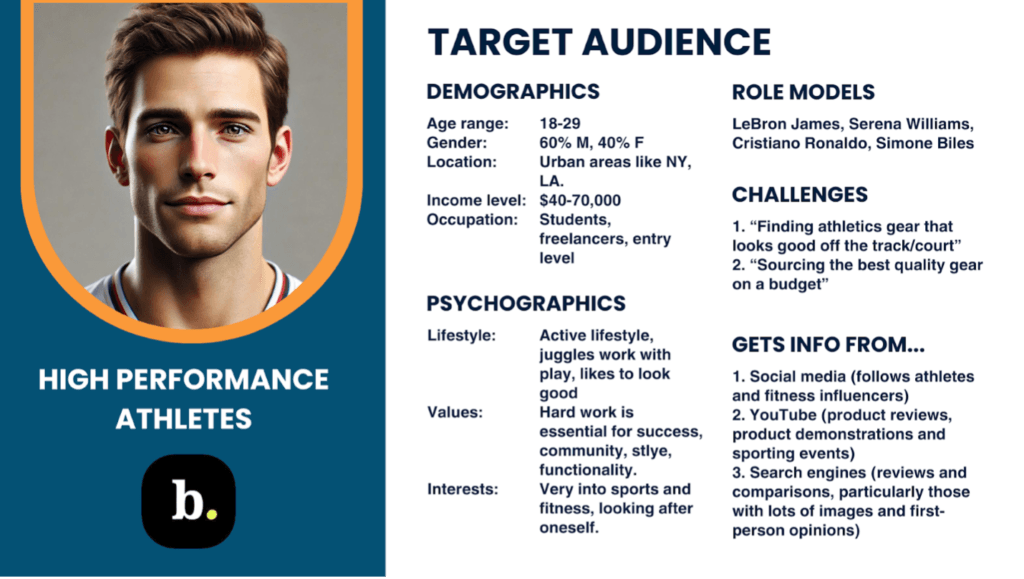
From this breakdown, the marketing team can see the following:
From there, the marketing team might take the following actions:
Example 2: Yoga apparel
Let’s say the same sportswear company also produces a range of yoga apparel. Here’s how the marketing and product development teams might profile this audience:
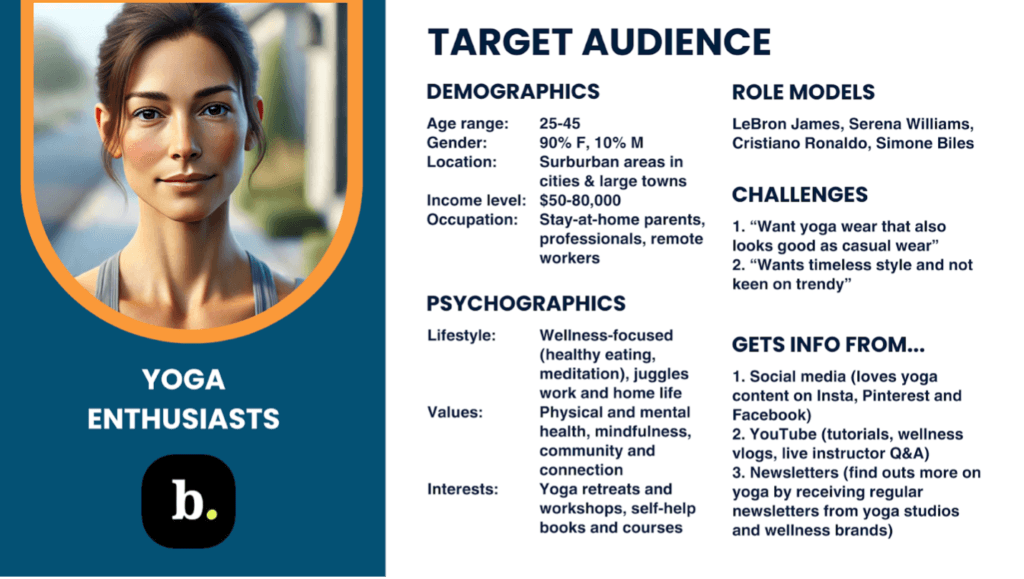
From this breakdown, the marketing team can see the following:
To connect with this audience, the marketing team could highlight the elegance and versatility of the clothing and show how the garments fit naturally into a variety of settings, from yoga class to brunch or weekend gatherings.
Now, let’s look at how a large bank might target two very different business audiences.
Example 1: Startups and small businesses
Many banks compete for the business checking accounts of startups and small companies looking for a reliable financial partner or one that may eventually offer one of the best business loans to help fuel growth.
Here’s how the bank’s marketing team might define this target audience:
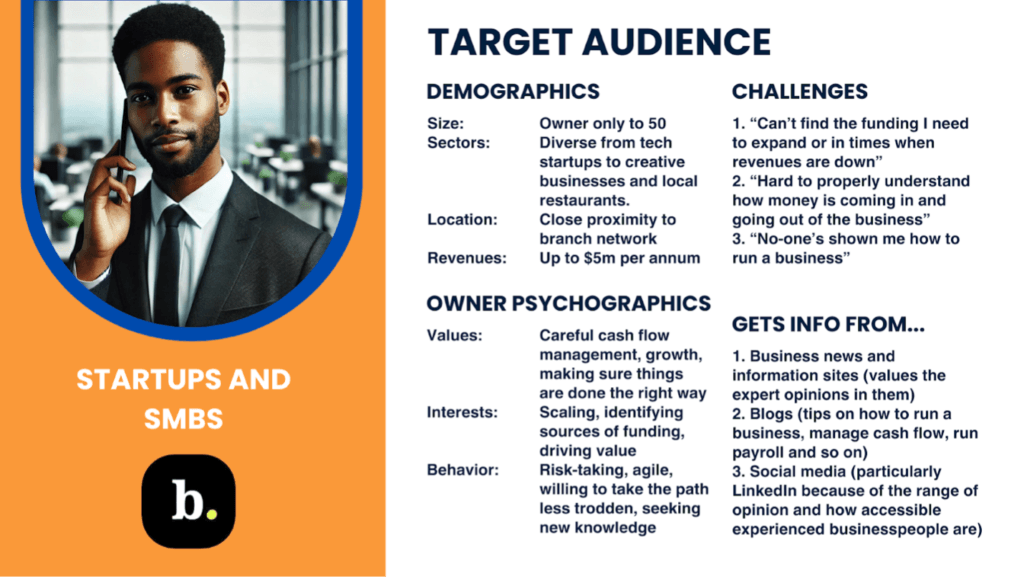
From this breakdown, the marketing team can see the following:
From there, the marketing team might take the following actions:
Example 2: Investor-funded scaleups
Now let’s look at how this same bank might define and target scaling tech companies that have already secured investor backing, even if they’re still in early funding rounds.
Here’s how the bank’s marketing team might define this audience:
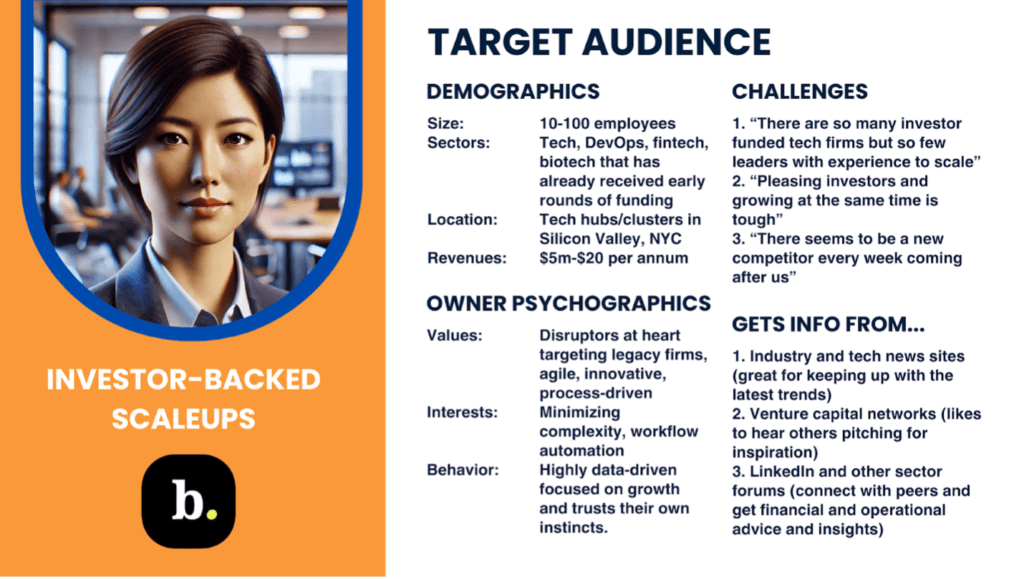
From this breakdown, the marketing team can see the following:
From there, the marketing team might take the following actions:
The cost per lead with campaigns like these will often be high, and the sales team may need to nurture prospects through a longer decision cycle. However, the long-term payoff can make the investment worthwhile.
Identifying your target audience starts with creating profiles of your ideal customers. These customer personas paint a picture of who needs your products and services, helping you market to them more effectively. Follow these steps to identify your target audience.
List the attributes of the people most likely to benefit from your product. For example, say you offer a moisturizing cream. Narrow your focus by identifying the qualities and characteristics of the people your product would appeal to. Ask questions like these:
Brainstorm as many attributes as possible to pinpoint the specific customer traits that align with your product’s benefits.
When you’re identifying your audience, dig deep into demographics and psychographics.
Gather demographic information.
Start with the obvious information, and then get more detailed. For example, ask these questions:
This information can help you identify the best channels for reaching these customers and how to appeal to them on a fundamental level. For example, if you own a home services company, such as an HVAC repair business, it makes sense to focus on local marketing strategies to reach nearby homeowners and businesses. When you’re marketing to Gen Z and younger millennials, consider using text message marketing to increase the likelihood that they’ll see your messages.
Demographics can also shape the most compelling images for social media marketing campaigns and ads. For example, if your target audience consists of married couples with children, use photos of families. If your target audience is younger, use images of younger people.
Add psychographic information.
Beyond demographics, layer in psychographic data — the values, motivations and lifestyle traits that explain why someone chooses one product over another. Understanding psychographics helps you craft messaging that resonates emotionally, not just logically.
For example, say an abstract artist wants to understand promising prospective buyers. A demographic and psychographic profile for this type of art buyer may look like this:
Demographics:
Psychographics:
Each answer should lead to new questions until you have a clear picture of who is buying your product.
When you know what problem your product or service solves, you can market it more effectively to the right audience. For example, if you sell a water filtration system, your product helps remove contaminants from tap water. Therefore, you want to appeal to homeowners who are environmentally aware and conscious of what they put into their bodies. You can further segment your target audience to focus on parents of young children who want clean, filtered water for their families.
Use customer feedback to gather insights into how current customers view and use your product. Ask them why they bought it. Their answers can provide valuable information as you market to prospective customers. You may even decide to adjust your marketing approach based on what you learn. Customer feedback may also reshape your perception of your ideal customer.
Social media can be a powerful tool for small businesses that want to better understand their target audience. Most platforms offer built-in analytics that show who is interacting with your brand and which posts are getting the most attention.
These insights can help you understand who’s paying attention to your company and products, making it easier to identify your niche. You’ll also see which posts spark the most engagement, helping you create more of the content your audience wants to see.
Once you’ve reviewed your social media analytics, the next step is to dig deeper with data analytics tools and artificial intelligence (AI). These technologies can surface patterns in customer behavior that would be nearly impossible to spot manually, giving you a sharper, more accurate picture of who your audience really is. According to Nielsen’s 2025 AI Redefining Marketing report, 59 percent of global marketers say AI-driven personalization and campaign optimization is the most impactful trend shaping the future of marketing.
For example, data analytics and AI tools can help you uncover valuable audience insights in several ways:
Business owners who ignore their competitors often put themselves at a disadvantage. To keep your business competitive, you need to know who is buying from other companies in your industry, why they’re buying from them and what sets your business apart.
For example, your competitors may focus on business customers while you market directly to consumers. Or your target audience may look similar on paper, but your products, services or overall approach may appeal to a different type of buyer.
Understanding what your competitors are doing can help you narrow your focus, sharpen your messaging and better define your ideal customer.
Before selling to your target customers, you need to understand why they’ll buy your product. That means being confident in its value and clearly communicating that value to your ideal customer.
When you understand what makes your product worth buying, it’s easier to identify who is most likely to embrace it and become a loyal customer. For example, if you sell high-end jewelry, you’ll naturally appeal to consumers with disposable income who genuinely appreciate product quality, craftsmanship and exclusivity — and that clarity makes your marketing far more efficient.
To ensure you’re sending the right branding message, create a positioning statement that shows you understand your target audience.
For example, if you sell a skin care cream with sunscreen and anti-aging properties, your statement might be: “For mature adults who want to protect and nourish their skin with natural ingredients, XYZ offers a daily skin care solution that takes as little as two minutes to apply.”
From that statement, it’s clear the target audience includes busy adults who want to maintain healthy, protected skin.
After completing these steps, it’s time to test your assumptions and confirm you’re targeting the right audience. To do this, develop a sample ad and market it to your ideal customer group. On social media, you can create an ad designed specifically for your target audience and see how many users click through to your website.
With digital advertising, use A/B testing to compare different messages, visuals and calls to action. According to Litmus’s 2026 State of Email report, email segmentation and A/B testing are among the most widely used tactics for improving email performance, helping marketers refine messaging, optimize audience targeting and increase engagement.
Start with small-budget tests across multiple platforms — such as Meta Platforms Ads, Google Ads and LinkedIn Ads — to determine which channels and messages resonate most with your intended audience. Track key metrics like click-through rates, conversions and cost per acquisition to see what’s working before scaling your spend.
Here are just a few of the ways identifying your target audience can benefit your business:
Once you’ve defined your target customers, you can start marketing with confidence. Targeted outreach is far more effective than casting a wide net — it lets you focus your time, energy and budget on the people most likely to buy from you.
In today’s competitive marketplace, businesses that use analytics, AI tools and ongoing testing to better understand their audience gain a clear advantage. Keep in mind that your target audience won’t stay static. Market conditions shift, new technologies emerge and customer preferences evolve. Make a habit of revisiting and updating your audience profiles so your marketing stays relevant and your messaging stays sharp.
By staying focused and adaptable, you’ll waste less money, connect with the right customers and make smarter marketing decisions over time.
Usman Raza contributed to this article.