Business.com aims to help business owners make informed decisions to support and grow their companies. We research and recommend products and services suitable for various business types, investing thousands of hours each year in this process.
As a business, we need to generate revenue to sustain our content. We have financial relationships with some companies we cover, earning commissions when readers purchase from our partners or share information about their needs. These relationships do not dictate our advice and recommendations. Our editorial team independently evaluates and recommends products and services based on their research and expertise. Learn more about our process and partners here.
Social media best practices and technologies are evolving rapidly. Keeping up with current trends is essential if you want your social media marketing efforts to pay off.

Social media marketing was once an exciting new way for companies to market their products and services. Businesses set up profiles, gathered followers and began posting regularly. In the early days, low saturation meant almost any company could gain visibility with minimal effort. Today, however, nearly every business has a social presence, and social media marketing has grown more sophisticated and nuanced. At the same time, new tools, best practices and trends continue to reshape how brands show up online.
To succeed at social media marketing today, companies need a clear understanding of the latest trends and technologies and the know-how to use them effectively for brand awareness, sales, customer service and more. Below, we’ll break down how social media marketing has changed and share practical guidance from experienced marketing and sales professionals.
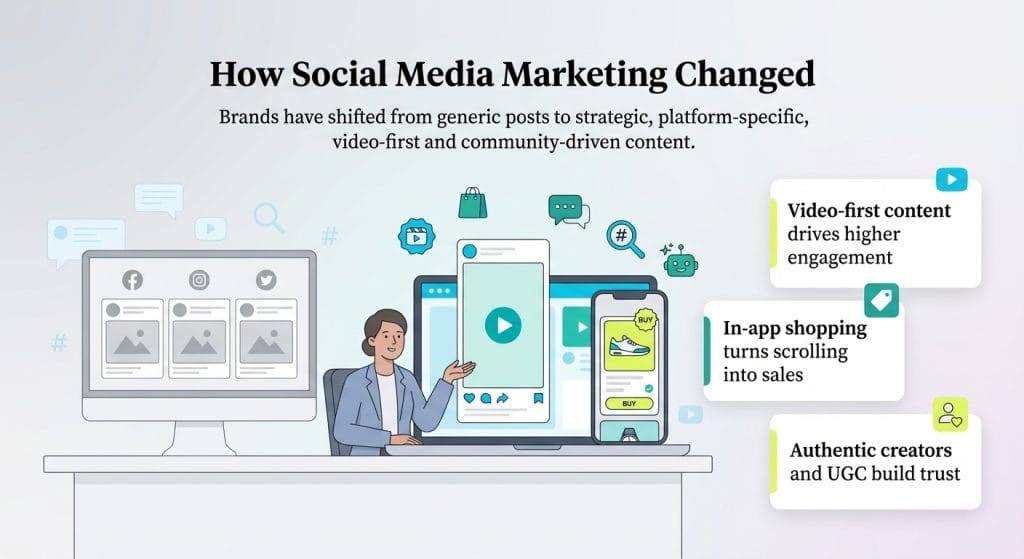
Over time, the social media landscape has become far more competitive as a digital marketing strategy. Platforms are now crowded, and algorithms prioritize engagement over reach. All of this has changed how social media marketing works in practice. What used to be a numbers game now requires more intention, from who you’re trying to reach to how your content shows up on each platform.
Here’s a look at 10 social media marketing trends shaping 2026 that brands should have on their radar.
Today’s social media users like video content — and they like it short and sweet. According to Wyzowl’s 2025 State of Video Marketing report, 89 percent of businesses use video as a marketing tool, and 85 percent of consumers say watching a video has convinced them to buy a product or service. When they’re trying to learn about a product, 63 percent say they prefer watching a short video.
“Short-form video content dominates, with platforms like TikTok and Instagram Reels leading the charge,” said Jason Mudd, CEO of Axia Public Relations.
According to the Interactive Advertising Bureau, digital video ad spending was projected to reach $72 billion in 2025, reflecting continued growth in video-first formats (including social video), even as advertisers tightened budgets. In other words, it’s not enough to simply post video content. What matters is what you share, how long it runs and where it lives.
For example, Facebook Live Q&As are well-suited for product demonstrations, TikTok’s short clips can help you connect with a younger audience, and a YouTube channel is a strong way to engage and educate your audience.
Social commerce is no longer a side feature — it’s becoming a core sales channel. Most major platforms now support in-app purchases, allowing businesses to sell products directly through Facebook, Instagram, X (formerly Twitter), TikTok and Pinterest without sending users elsewhere.
According to eMarketer, U.S. social commerce sales are expected to surpass $100 billion in 2026, with growth continuing even as year-over-year gains begin to moderate. When shopping is built directly into the feed, social selling shortens the path from discovery to purchase while users are already in buying mode.
Influencer marketing has shifted from a nice-to-have awareness play to a real purchase driver, especially for younger consumers. According to IZEA’s 2025 Trust in Influencer Marketing report, 79 percent of consumers say they’ve purchased a product after seeing it used by an influencer, a clear sign that creator content plays a direct role in what people end up buying.
As a result, brands are focusing less on follower size and more on the creators who resonate with specific audiences. Here’s why:
Brands are following the results. Aspire projects the influencer marketing industry will reach $47.8 billion by 2027, with 71 percent of marketers planning to increase their influencer budgets.
Most social feeds are packed with ads, and users have gotten very good at scrolling past anything that feels like a hard sell. When a post looks overly produced or overly promotional, people usually scroll right past it.
User-generated content (UGC) doesn’t read the same way. It shows real customers using a product in their day-to-day lives, which makes it feel more like a recommendation than an ad.
Gabriel Tay, director of customer solutions at Emplifi, says UGC can also drive measurable results. “According to Emplifi’s research, UGC helped drive 63 percent year-over-year revenue growth, underscoring just how compelling authentic content from real customers can be,” Tay explained. “For small businesses, this is especially beneficial, as UGC costs nothing to produce but can drive measurable outcomes across social platforms.”
For many brands, the next step is using that content more widely. Customer videos, photos and reviews can be reused across social feeds, ads, product pages and even email marketing campaigns. Encouraging customers to share how they use your product, whether through a hashtag, a giveaway or a feature on your own channels, helps turn everyday buyers into visible brand advocates.
For years, brands were told to keep their marketing tightly consistent across every channel. A clear voice still matters, but on social media, consistency doesn’t have to mean playing it safe.
More brands are using social media to try ideas that wouldn’t fit into a traditional campaign, whether that’s a looser tone, unexpected visuals or a bit of humor. Posts that break the pattern are often the ones people actually pause on as they scroll.
Social media also makes experimentation less risky. Posts move quickly, and not everything has to land perfectly to be worthwhile. Trying something playful, topical or unconventional can spark engagement, humanize a brand and offer quick feedback on what resonates without committing to a full campaign.
Social media accounts aren’t just for promotions anymore. For many customers, they’re one of the fastest ways to reach a brand when something goes wrong — or when something goes right.
People routinely turn to platforms like Instagram, Facebook and TikTok to ask questions, flag issues and share feedback, often in public. Customer support on X tends to be especially visible and fast-moving, which means brand responses (or the lack of them) can quickly shape public perception.
Handled well, social media support can strengthen customer loyalty and show that your business is paying attention. Quick, thoughtful responses signal accountability, while silence or canned replies can do the opposite. Many businesses now rely on social listening tools and the best CRM software to track messages, comments and brand mentions, making it easier for marketing and support teams to stay aligned and address issues before they escalate.
AI is no longer a novelty in social media marketing. It’s become a practical way for teams to keep up with the pace and volume modern platforms demand. In McKinsey’s 2025 global AI survey, 88 percent of organizations reported using AI in at least one business function, with marketing and sales among the most common areas for generative tools.
For many marketing teams, especially small ones, AI fills a real gap. Instead of replacing creativity, it helps handle the repetitive, time-consuming parts of social media work, such as:
Lee Gentry, founder of Mood Magic, has seen this shift firsthand. “Our customers come to us to augment or replace their traditional photo production pipeline with generative AI to save time and money,” Gentry explained. “Some of our customers report up to 99 percent cost savings and 91 percent time savings. The quality and accuracy of the technology are already at a point where synthetic content is indiscernible from analog.” Gentry noted that results vary by use case and production setup.
For a long time, brands relied on survey data, focus groups or gut instinct to understand how customers felt. Now, much of that feedback is already out in the open, playing out in comments, mentions and replies across social platforms.
Social listening helps marketers pay attention to those conversations in real time. Tools like Sprout Social, Meltwater and Brandwatch make it easier to track brand mentions, keywords and hashtags, giving teams a clearer sense of what’s resonating — and what isn’t.
Used well, social listening isn’t just about damage control. It can surface customer feedback on products, highlight emerging trends and reveal questions people are already asking, often before those insights show up in sales data. It also gives brands a chance to spot brewing issues early and respond thoughtfully, rather than scrambling once a problem has gone public.
For many people, especially younger users, social media has become a starting point for product research, not just a place to scroll. Instead of opening a search engine, they’re searching directly on social platforms to see reviews, comments, demos and real-world opinions.
That shift is already showing up in usage data. For example, according to Statista, 41 percent of respondents say they’ve used TikTok as a search engine. And the We Are Social Digital 2026 Global Overview Report found that 43.7 percent of consumers turn to social platforms when researching brands online.
As social feeds double as search results, discoverability matters more than ever. Tay stressed that brands need to think beyond simply posting for engagement alone. “To win on social media marketing [in the future], businesses need to ensure their content is both discoverable and searchable on social platforms,” he advised. “Creating educational and informative content that directly addresses consumer queries will be a crucial strategy.”
Social media marketing isn’t unregulated anymore, and most brands know it. Disclosure requirements, data use and transparency expectations are now part of doing business on social platforms, not edge cases.
In the U.S., the Federal Trade Commission has updated its Endorsement Guides, raising the bar for how influencers and brand partners disclose paid relationships. If you work with creators, that responsibility doesn’t stop with them. Brands are expected to ensure disclosures are clear, consistent and easy for users to understand.
Regulators, including the FTC, are also taking a closer look at how consumer data is collected and used for targeted advertising, so it’s smart to stay conservative with data practices and be clear with customers about what you collect and why. As those rules evolve, the safest approach for marketers is straightforward: lead with transparency, be conservative with data use and don’t rely on tactics that only work in gray areas.
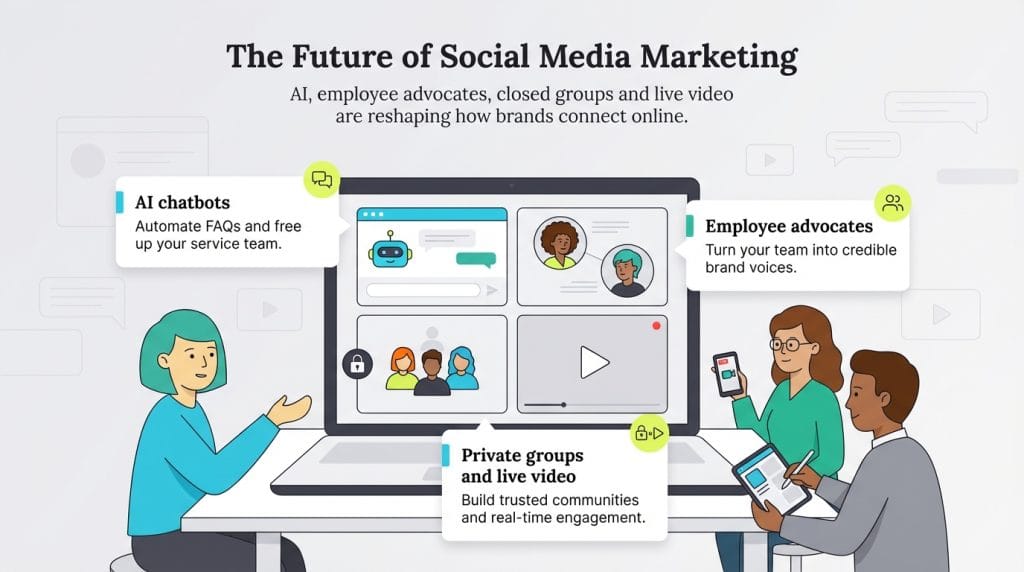
Nothing about social media is guaranteed, and the technology behind it keeps moving fast. Still, the way platforms and audiences are evolving gives us a pretty clear sense of where social media marketing is headed. These are a few trends worth watching.
As social media has become a go-to customer service channel, more brands are using AI chatbots on their social profiles to answer common questions and route more complex issues to live support teams.
Advances in natural language processing have pushed chatbots well beyond simple scripted responses. Today’s AI-powered assistants can handle more natural back-and-forth conversations, offer tailored product suggestions and resolve routine issues without a human stepping in. For many businesses, this reduces the volume of incoming calls and emails while still meeting customers where they already are.
Not every brand has the budget — or the appetite — for influencer marketing. Instead, many are leaning on something simpler: their own employees.
When employees share their employer’s content or talk about the work they do on social media, it often carries more weight than a paid post. These are real people, using their own voices, with firsthand experience of the product or service. That credibility is hard to fake and increasingly hard to buy.
But employee advocacy only works when it’s genuine. Audiences will quickly spot forced enthusiasm or copy-and-paste captions, especially when it all sounds the same. Employee engagement and a strong company culture matter here, as team members are much more likely to participate when they actually like where they work and feel comfortable speaking in their own words.
As organic reach continues to shrink on public feeds, more brands are experimenting with smaller, private communities where they have more control over who sees — and responds to — their content.
Invitation-only groups on platforms like Facebook, LinkedIn and Instagram can function less like traditional social channels and more like member spaces. When done well, these groups give brands a direct line to their most engaged customers and create room for more honest feedback, discussion and testing than a public post ever could.
Some businesses are also moving these conversations off major platforms entirely, using private community tools like Circle to host branded spaces with messaging, live events and member-only content. The goal isn’t to replace social media, but to create a place where engagement isn’t dictated by an algorithm.
Evergreen video still does a lot of heavy lifting for brands, but live video offers something pre-recorded content can’t: immediacy. When audiences know something is happening in real time, it feels more human and less polished, which is often the point.
Today, live video is less about chasing massive view counts and more about creating moments of access. Brands are using live formats for product walk-throughs, Q&A sessions, launches and behind-the-scenes looks that invite participation rather than passive viewing. When done well, these events help build trust and spark more meaningful engagement than a standard post.
Live events can run across multiple platforms, including Facebook, YouTube, LinkedIn, Instagram, TikTok and Twitch, but relying too heavily on a single channel carries risk. Platform rules, algorithms and features change frequently, so it’s smart to spread live content across more than one destination or repurpose it after the event ends.
Jennifer Dublino contributed to this article. Source interviews were conducted by a previous version of this article.