You must plan carefully when calculating how much office space you need. Too much — or too little — space can strain your business budget and disrupt daily operations. The wrong-sized workspace can create friction instead of flow, affecting workplace collaboration, communication and productivity. Below, we break down practical guidelines and formulas to help you estimate your square footage needs so your office supports both your team and your long-term growth.
Estimating the amount of space you’ll need
If you’re starting a business or planning to lease or buy office space, you’re likely thinking about how much space you’ll need. While there’s no one-size-fits-all answer, some general guidelines can help you plan for an efficient office workflow:
- Plan for circulation and flow: Work areas should have enough open space for people to move comfortably and access their workstations. Rooms should also provide adequate ceiling height, floor space and clearance to support employee health, safety and overall comfort.
- Allot enough working space per employee: On average, offices often plan for approximately 150 to 175 square feet per employee, though needs vary widely by industry and layout. Providing enough space helps create a comfortable environment and makes it easier to keep a clean and organized office.
How to determine how much office space you need
Follow these four steps to assess your office space needs.
1. Assess your current employee situation.
Odest T. Riley, broker and partner at SoCal Premier Property Management, emphasized the importance of tailoring office space to employees’ roles and work habits. “There is no reason to have an individual desk assigned to every member of a sales team if a large portion of their time is spent in the streets drumming up business,” Riley explained. However, large teams that collaborate closely still require adequate space.
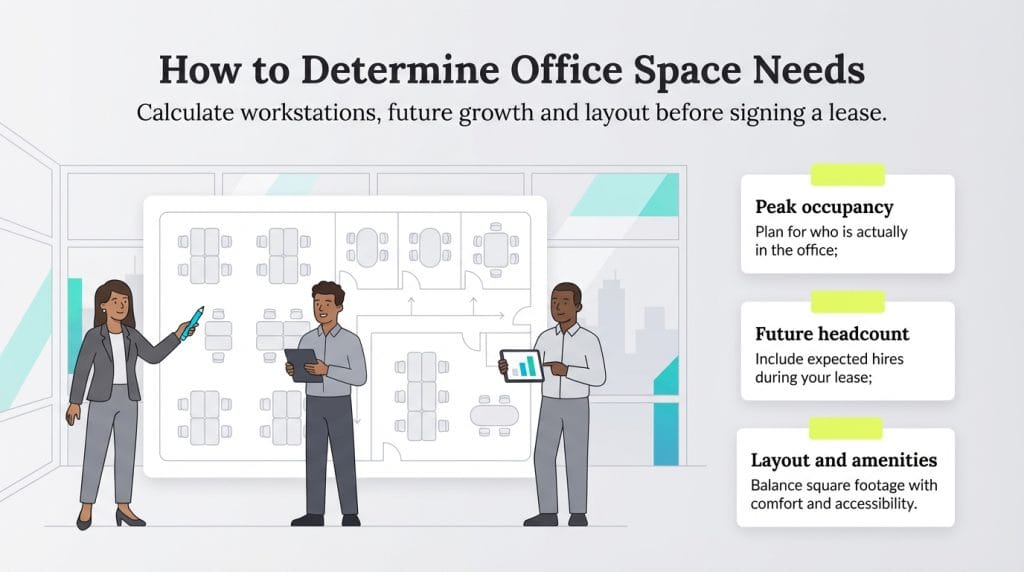
When scouting locations, determine your “peak occupancy” rather than just total headcount. Ask the following questions:
- How many employees do you currently have?
- How many will work in the office as full-time or part-time employees?
- If you have a remote work plan, how many employees will work remotely full-time?
- How many employees will have a hybrid schedule, and on which days will they overlap?
Your answers will help you determine how many workstations you’ll need, whether they should be dedicated and whether shared desks make sense for employees who aren’t in the office every day.
Riley also advised businesses to plan for flexibility, such as designing office layouts that can adapt as team size, schedules or workspace needs evolve over time.
Factor
business accommodations for employees with disabilities into your space calculations. For example, you'll need adequate clearance for wheelchairs or service animals.
2. Look at your growth plans.
Once you understand your current needs, consider how your business may grow over the next few years.
Estimate your goals for profitable growth and determine how many new hires you’ll need to reach them. Can your current office space accommodate your projected headcount? If not, you may need to plan for a move when your lease ends or explore whether your existing location has room to expand.
Consider the following questions:
- Do I expect to add new staff during the current lease term?
- Over what period will I add staff?
- What kind of staff will I add (executive, administrative or sales)?
Understanding your anticipated growth plans can help you scale more smoothly and conduct the hiring process without costly interruptions caused by cramped workspaces or premature relocations.
3. Determine an ideal layout for your office space.
Office spaces generally range from about 120 to 350 square feet per employee, depending on layout and industry. During early planning, assume you’ll need roughly 250 square feet per person as a starting point. This estimate includes individual desk space as well as shared areas like kitchens, lobbies and meeting rooms. You can refine this number as you narrow your options and begin mapping out your space.
Consider the following common layouts:
- Open office floor plan: If you prefer an open office design, you’ll likely fall toward the lower end of the square footage range. Open office floor plans minimize private offices and group desks or workstations together, which is common in call centers and sales environments.
- Traditional office layout: Traditional hard-wall or private office designs sit at the higher end of the range. For example, law firms often include mostly private offices, larger conference rooms and support spaces like libraries, kitchens and file rooms.
You’ll need to decide which layout best fits your operations: open space, private offices or a hybrid approach. Many modern workplaces now use flexible layouts that combine shared collaboration areas with smaller private focus rooms. Once you’ve chosen a layout, you can estimate total space needs more accurately before signing a lease.
4. Factor in other variables.
Many factors come into play when evaluating office space needs. For example, some interior areas may be unusable, or a building may offer amenities that offset a smaller footprint. Additionally, individual businesses and specific industries will have unique concerns and preferences.
Here are some other variables to consider:
- Is the office a space employees will enjoy coming to?
- Is there natural lighting? (This is important, as lighting affects productivity and mood.)
- Can the space accommodate ergonomic workstations and comfortable furniture?
- Is there adequate ventilation?
- Is the location near transportation options and areas where employees live?
- Can you create an office environment that is accessible to employees, customers and vendors who use mobility aids such as wheelchairs, walkers and canes?
After narrowing down your building and office choices, consulting a space planner or interior architect can help you design a layout that fits your operational needs.
Locating your office near convenient transportation hubs or areas where employees live may help reduce
workplace absenteeism and tardiness.
Example of office space calculation
Let’s say you currently employ 10 people and estimate needing approximately 2,500 square feet of office space, based on a planning guideline of about 250 square feet per person, including shared areas. However, you expect to add two new employees each year and want to sign a three-year lease. Do you need to secure an additional 1,500 square feet today to accommodate your projected growth?
Not necessarily. For a more accurate estimate, consider the type of employees you’ll add. For example:
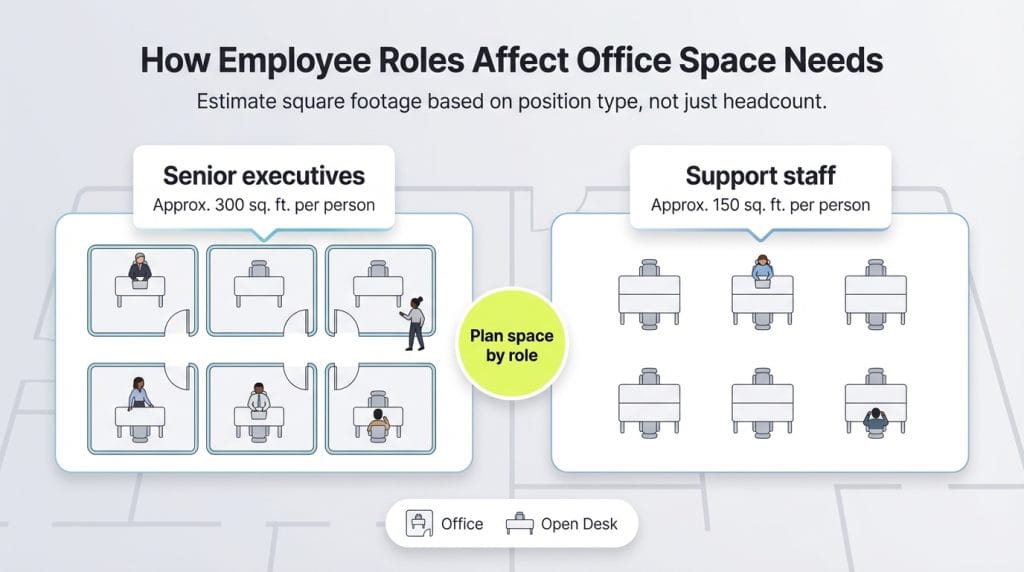
- Senior executives: If you plan to bring on six senior executives who need private offices, you may need to plan for closer to 1,800 additional square feet (300 square feet x 6 executives = 1,800 square feet), depending on how much dedicated office space and shared meeting areas you include.
- Support staff: If you plan to hire six clerical support staff members working in a “bullpen” or open space, you may need only about 900 additional square feet (150 square feet x 6 employees = 900 square feet).
Pros and cons of getting office space in the era of remote work
Today, many employees split their time between home and the office. According to the Pew Research Center, about 75 percent of workers whose jobs can be done remotely now work offsite at least some of the time, reshaping how businesses think about office space and long-term leases.
Additional workplace research highlights shifting expectations around flexibility and productivity:
- Research from the National Bureau of Economic Research suggests remote workers save about 72 minutes per day on average because they don’t commute and spend roughly 40 percent of that extra time on primary job duties. This shift has influenced how many companies rethink office schedules.
- Managers’ perceptions are shifting, too. According to Owl Labs’ 2025 State of Hybrid Work report, 69 percent of managers say hybrid or remote work improves productivity, highlighting why flexible work models remain part of long-term planning.
- Stanford research suggests many employees view working from home several days per week as roughly equivalent to an 8 percent pay increase, underscoring how strongly workers value flexibility.
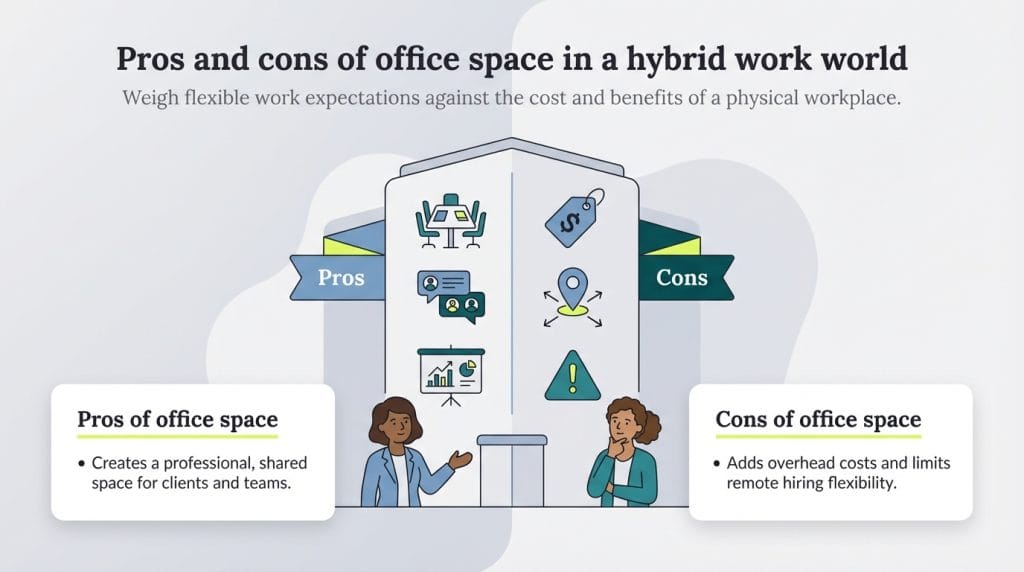
Given these shifting expectations, does it still make sense to secure office space? Here are some advantages and disadvantages of maintaining a physical workplace.
Pros of getting office space
- Office spaces can look more professional: A physical office location can signal stability to potential customers and partners. For some industries — such as legal or financial services — clients may feel more comfortable meeting in a dedicated workspace rather than a home office or virtual setting.
- An office space gives customers a place to meet: When working with clients face to face, having a dedicated meeting area can help you present products, discuss services and create a more structured customer experience.
- You can hold company functions in an office space: Businesses involved in manufacturing, assembly, storage or shipping often need a physical location for day-to-day operations. Offices can also provide space for team meetings, training sessions and collaborative work.
- Office spaces can support a cohesive company culture: Working together in a shared environment can help employees build relationships, stay aligned on goals and build a strong company culture. In-person interaction may also make it easier to reinforce company values and encourage workplace teamwork.
Cons of getting office space
- Some employees prefer remote or hybrid work: Many talented professionals now expect at least some flexibility in where they work. When companies require full-time office attendance, it can be a deal-breaker for them.
- Office space can be expensive: The national average listing rate for office space reached $32.86 per square foot as of December 2025. For a 2,500-square-foot office, that could translate to roughly $82,000 in annual base rent, before utilities and other operating costs. Reducing this overhead cost may free up the budget for expenses like marketing, payroll or inventory.
- Offices can limit your hiring pool: When you require employees to work onsite, you often narrow your employee recruitment efforts to local candidates. Companies that hire remote or hybrid workers often have more flexibility to choose from a wider geographic area without relocation costs.
- Office spaces introduce additional physical risks: When you have a physical workplace, you must consider everyday safety issues, from workplace accidents and slip hazards to ergonomic strain. Long hours at a desk can contribute to eye fatigue or back discomfort, which is why many employers rethink workstation design and scheduling.
Office space still matters in today’s evolving workplace
Estimating your office space needs can be challenging, as many businesses rethink how much space they actually require in the era of remote and hybrid work. However, Pete Evering, business development manager at Utopia Property Management, emphasized that the need for some physical presence isn’t going away.
“While we may need less office space overall, there’s still a need for some onsite work, like meetings, collaborative projects or activities that are harder to do remotely,” Evering explained. “So, it’s likely that companies will still keep a smaller physical office or use flexible workspaces to balance remote and in-person work.”
Whatever your business’s needs, evaluating your space requirements carefully can help you avoid unnecessary costs. Moving offices midlease because you underestimated staffing needs can be far more expensive than planning for growth upfront. On the other hand, paying for unused space can drain resources that might be better invested elsewhere.