Business.com aims to help business owners make informed decisions to support and grow their companies. We research and recommend products and services suitable for various business types, investing thousands of hours each year in this process.
As a business, we need to generate revenue to sustain our content. We have financial relationships with some companies we cover, earning commissions when readers purchase from our partners or share information about their needs. These relationships do not dictate our advice and recommendations. Our editorial team independently evaluates and recommends products and services based on their research and expertise. Learn more about our process and partners here.
Following these tips will help you reduce the potential risks co-employment poses to your business.

Running a small business often means wearing far too many hats. Between payroll taxes, benefits administration and ever-changing HR compliance rules, responsibilities can quickly pull owners away from the work that actually grows the business. To lighten that load, many companies turn to co-employment, outsourcing certain HR functions so they can focus more on strategy and day-to-day operations.
Still, sharing employer responsibilities with another company can give some leaders pause. Questions about control, liability and risk are natural, especially when employees are involved. The good news is that co-employment isn’t inherently riskier than hiring traditional full-time staff. Like any employment arrangement, it works best when you understand the legal framework, set clear expectations and actively manage the relationship.
Co-employment is a working arrangement in which your business shares certain employer responsibilities with another organization, such as a professional employer organization (PEO) or a staffing agency. In these relationships, both parties take on specific legal and administrative duties related to employees.
How that responsibility is divided depends on the type of co-employer you work with and the services you’re using. Different co-employment models are governed by different rules, so the structure — and the level of risk involved — can vary. Choosing the right partner ultimately comes down to what support you need and how much control you want to retain.
Staffing agencies remain an option for businesses that need flexibility in their workforce. Companies often rely on these co-employment partners to bring on temporary or contract talent for seasonal demand, short-term projects or employee leaves of absence.
According to the American Staffing Association, U.S. staffing companies hire roughly 12 to 13 million temporary and contract workers in a typical year. Temporary employees work across nearly every industry, though the distribution has shifted somewhat in recent years. The largest share of staffing placements is in industrial roles (36 percent), followed by office-clerical and administrative positions (24 percent) and professional and managerial roles (21 percent). Engineering, IT and scientific roles account for about 11 percent, while healthcare makes up roughly 8 percent of staffing employment.
Small and midsize businesses without an internal HR department can benefit significantly from entering a co-employment relationship with a PEO. According to the National Association of Professional Employer Organizations, there are more than 500 PEOs operating in the United States, supporting approximately 4.5 million worksite employees and generating $414 billion in gross revenues. NAPEO data also shows that about 14 percent of employers with 20 to 499 employees now partner with a PEO.
By working with a PEO, businesses can outsource a wide range of HR responsibilities, including:
Mark Berry, a senior human resource specialist with Insperity, emphasized the distinction between what a PEO does — and does not — provide.
“When you enter a co-employment relationship with a PEO, the PEO becomes the professional employer of your workforce by providing HR services and employee benefits,” Berry explained. “It does not, however, supply the staff. The operating employer maintains control over business decisions, including day-to-day management, hiring and termination.”
Berry also noted that PEO arrangements vary, and the level of outsourcing depends on the specific services outlined in your agreement.
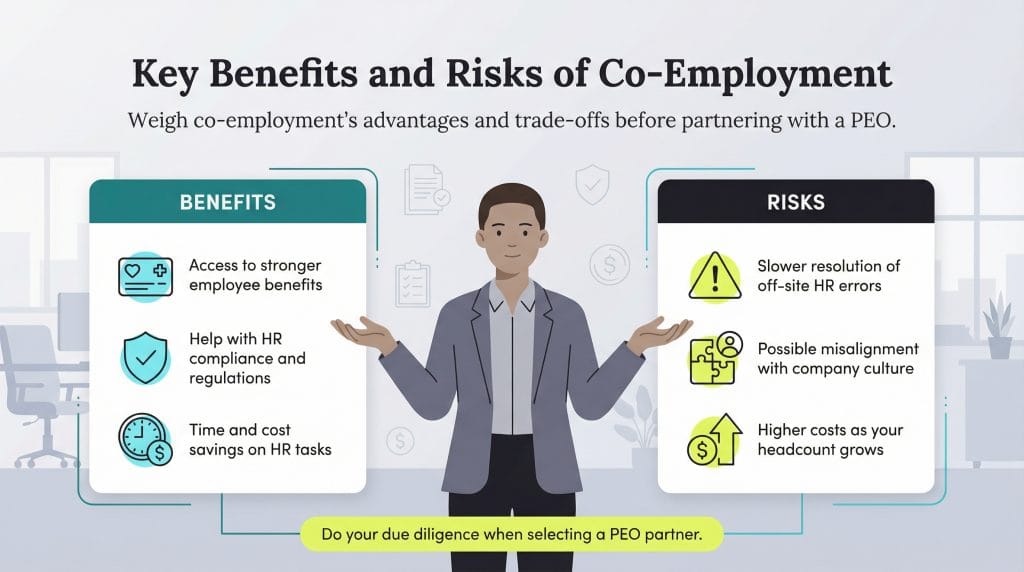
Successful business owners weigh every partnership carefully, and co-employment is no exception. While the model can offer meaningful operational advantages, it also comes with limitations that require careful consideration. Understanding both sides is key to deciding whether co-employment supports your growth strategy.
Here’s a look at the pros and cons of co-employment.
The benefits of co-employment vary based on the type of partner you choose and the services included in your agreement. Still, many businesses experience the following advantages.
Access to enterprise-class benefits
Co-employers can offer access to competitive employee benefits at more affordable rates. This allows smaller businesses, which may not otherwise be able to offer robust benefits, to compete with larger employers when attracting and retaining talent.
“PEOs can be well-positioned to negotiate favorable insurance rates and benefits,” noted Glynn Frechette, head of Paychex PEO. “This can help small businesses save on costs and compete more effectively for great talent.”
Assistance with HR compliance
Navigating labor laws remains a top challenge for business owners, particularly as remote work plans expand and state regulations change regularly. PEOs can help companies stay current with compliance requirements and reduce the likelihood of costly errors. According to NAPEO, businesses that use a PEO are 50 percent less likely to go out of business than those that do not, in part due to stronger regulatory support.
“A co-employment relationship helps mitigate risks and responsibilities associated with having employees, such as correctly reporting, collecting and depositing taxes, I-9 requirements, EEO reporting and claim resolution and management of certain employee-related claims,” Berry explained. “There are myriad other benefits that fall under reduced risk, such as informing employers of regulatory changes, providing guidance on keeping employees safe and helping employers communicate clearly with employees.”
HR support and expertise
Along with compliance assistance, co-employers can help businesses with general HR support and expertise. They can cover administrative tasks such as recruitment, job descriptions, employee handbooks, payroll and performance management. This delegation reduces administrative error rates and ensures processes are handled by certified professionals.
“Instead of spending time handling administrative tasks, business owners can focus on more strategic business functions that offer greater potential rates of return,” said Frechette.
Time and cost savings
The administrative burden on small businesses is measurable, and outsourcing HR functions can help reduce it. According to NAPEO research, the return on investment from using a PEO averages about 27 percent per year, reflecting savings from streamlined HR processes, reduced compliance risk and lower benefit and administrative costs. For many businesses, a co-employer can be an effective way to control expenses while operating more efficiently.
“PEOs can help organizations save time and money through recruiting support, performance management support and strategic HR planning, which helps map out the growth of an organization,” said Berry.
Like any business arrangement, co-employment comes with potential risks, particularly when outsourcing HR responsibilities. Frechette advises employers to weigh the following considerations carefully before entering a PEO relationship:
In addition to these practical concerns, Berry pointed out that many perceived risks stem from misunderstandings about how PEO relationships work. PEOs do not take control of your business or replace internal leadership or HR decision-making. When chosen carefully, a PEO should support operations without disrupting workplace culture.
“As with any other third-party service, it is worthwhile for employers to do their due diligence when selecting a PEO to ensure that they have a full understanding of the depth of services offered by the PEO and their reputation and level of responsiveness,” Berry advised. “PEOs often offer current client testimonials to employers that are looking to utilize their services.”
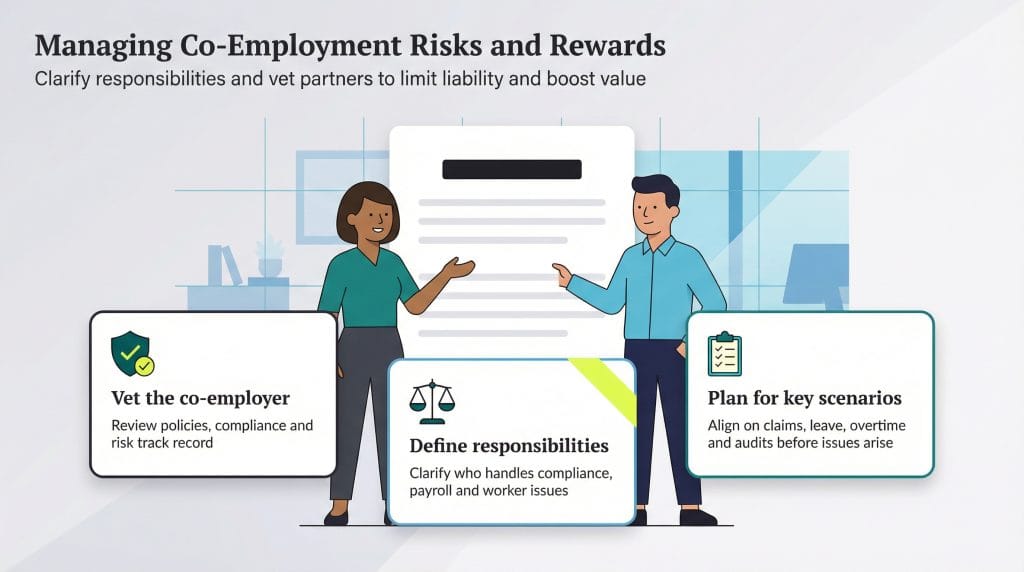
Managing co-employment risk starts with being proactive. The right preparation helps limit liability, avoid surprises and get the most value from the relationship. Keep the following considerations in mind when evaluating a potential co-employer.
Spend time discussing policies, procedures and service expectations before entering a co-employment arrangement. Make sure you understand how responsibilities are handled and confirm that processes align with local, state and federal employment laws. Pay particular attention to the following:
Additionally, review the provider’s screening and testing processes, and don’t hesitate to ask detailed questions to confirm the co-employer understands your workforce needs and business goals.
A successful co-employment relationship depends on clearly understanding what each party is and isn’t responsible for. Business owners should make sure their co-employer has a plan for handling common employment scenarios, while also going into the conversation with a clear understanding of their own legal obligations.
Here are several areas worth discussing upfront:
Ultimately, the division of responsibilities between a business owner and a co-employer depends on the specific relationship and the terms of the service agreement.
Employee benefits are a critical part of any co-employment arrangement, so it’s important to understand exactly what your co-employer offers. Here are a few points to consider:
A clear contract sets expectations and helps both parties understand where responsibilities begin and end. Pay close attention to the following:
There’s always some risk involved when hiring employees. However, taking the time to structure a co-employment agreement carefully can help reduce those risks while giving your business the support it needs to manage people effectively.
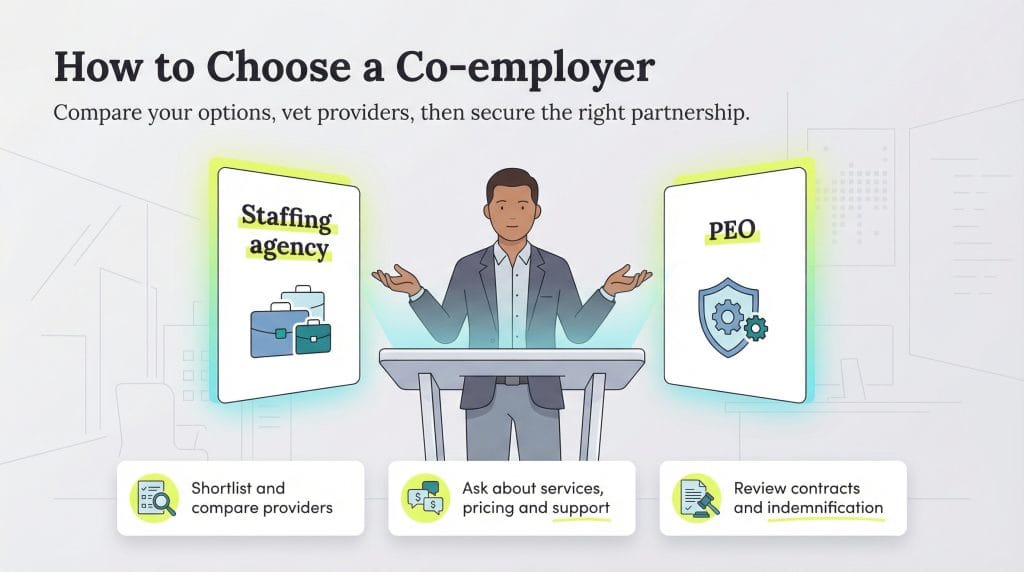
If you’ve decided that a co-employment relationship makes sense for your business, these steps can help you narrow your options and choose the right partner.
Choosing a co-employer isn’t a decision to rush. While there are always risks associated with hiring employees, co-employment adds another layer: the relationship itself. Taking the time to evaluate providers carefully can help ensure the partnership supports your business rather than complicates it.
Skye Schooley contributed to this article.