If you’re in the early stages of starting a business, you’ll need to price your services and products. When dealing with offerings like software or online content, you may also have to select a pricing model to offer customers. Two popular pricing models include licenses and subscriptions.
Subscription services are now common across many industries, especially in software and digital services. According to Zuora’s 2025 Subscription Economy Index, subscription-based companies reported 16.5 percent revenue growth from 2023 to 2024, compared with 8.5 percent growth among S&P 500 companies over the same period.
That momentum doesn’t make subscriptions the right choice for every business. Licenses and subscriptions each come with real advantages and trade-offs. Licensing can support higher upfront pricing, while subscriptions often appeal to customers looking for flexibility and lower initial costs. In the sections below, we break down how each model works, where each one shines, and how to choose the right pricing strategy for your business.
How do you choose the best pricing model for your business?
No matter your business stage, choosing the right pricing model is critical to a successful business growth plan that helps acquire new customers and increase sales. The right pricing model can keep customers loyal and enable your business to grow at a sustainable pace.
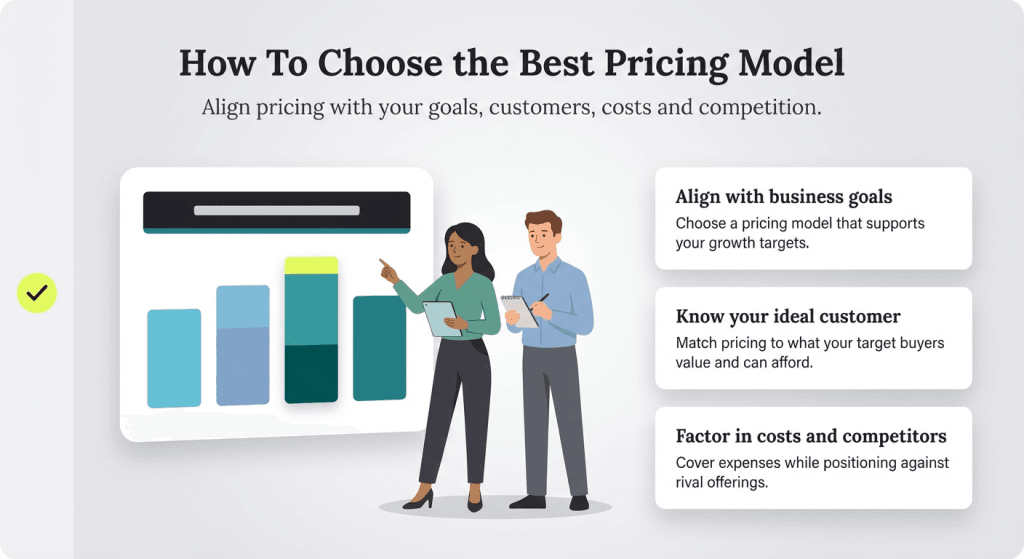
The following guidelines can help you determine the best pricing model for your business:
- Define your business’s goals: Every business decision you make should start with your company’s goals. Once you’ve set your business goals, find ways to align them with your pricing strategy.
- Know your ideal customer: Consider your target audience and how much they can spend. Are you marketing a high-value service for which customers will pay a premium? This will affect the pricing strategy you choose.
- Conduct a competitor analysis: You must also take your market position into account. Conduct a competitive marketing analysis to determine the prices others in your space charge. A competitor analysis will also help you determine your unique selling proposition (USP) and how to set your company apart.
- Understand your costs: You must understand your fixed and variable expenses. If you price your products or services too low, that will affect your business’s profitability.
To better gauge what customers are willing to pay, build
customer personas that include demographics and the purchase factors that prompt them to buy.
What is the licensing model?
A licensing model is an agreement between a software publisher and its customers that defines how the customer can use a product, including usage rights, limitations and support terms. One common type of licensing model is the perpetual license, where customers pay a one-time, upfront fee to purchase ongoing access to a specific version of the software.
However, the business may also charge an optional annual maintenance or support fee — often around 15 to 25 percent of the original license cost — to cover software updates, security patches and technical support. Customers who opt not to pay the annual fee can continue to use the product as licensed, but they typically won’t receive bug fixes, feature updates or customer support.
For years, most software was sold through perpetual licenses. That began to change as cloud computing made ongoing updates, remote access and centralized management easier to deliver. Many software companies gradually shifted to subscription pricing as a result. Adobe’s transition to Creative Cloud in 2013 is one of the more visible examples, but it was part of a broader industry move rather than a sudden turning point.
What are the pros and cons of licensing?
Licensing brings specific benefits and drawbacks for an organization.
Pros
These are the potential benefits of a licensing model:
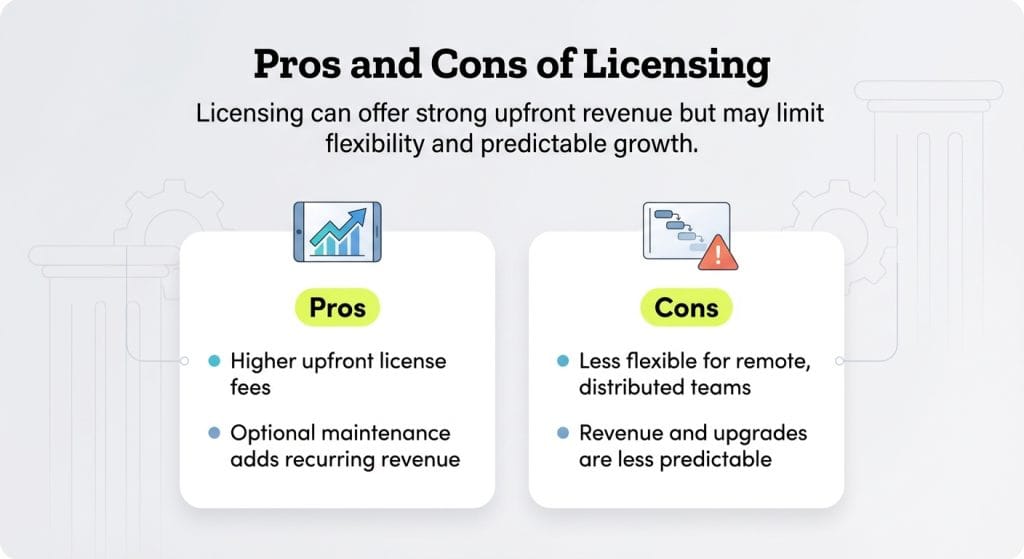
- Businesses may be able to charge higher upfront fees: Licensing can support higher one-time pricing, particularly for larger or enterprise deployments. In these cases, upfront costs may reach five figures or more, depending on the product and the scope of the implementation.
- Annual maintenance fees can create recurring revenue: Many licensed products are sold with an optional maintenance or support agreement. This typically covers updates, security patches and technical support. Customers don’t have to renew maintenance to keep using the software, but they usually lose access to updates and support when they opt out.
- Licensing may appeal to certain B2B customers: Some sectors — including healthcare, government and financial services — may prefer perpetual licenses due to compliance requirements, data-control concerns or long-term budget predictability.
Cons
Downsides to the licensing model may include the following:
- Revenue can decline when customers skip maintenance fees: If customers choose not to renew annual maintenance or support agreements, they may pay less over time, reducing predictable recurring revenue for the business.
- Vendors must continually justify upgrades: Businesses may need to invest heavily in new features and improvements to encourage customers to upgrade or renew maintenance plans. Those development costs can strain budgets and resources, especially if recurring fees don’t fully offset them.
- Licensing models are often less flexible for remote teams: Although cloud-based perpetual licenses exist, many licensing arrangements are still tied to specific machines or on-premise environments, which can be challenging and complicated for teams that work across locations or rely on multiple devices. This matters because remote work plans remain commonplace; about one in five U.S. adults works from home at least part of the time, according to Statista.
- Licensing models tend to be less agile: Product updates and new feature releases often follow longer, more structured development cycles, which can slow innovation compared to subscription-based models.
- Market preferences may limit adoption: Licensing-only options may not appeal to buyers who like and are familiar with subscription setups, especially when it comes to software. The licensing model can feel like a huge commitment, which is a perception that can hurt business in competitive markets.
- Revenue may be less predictable: Licensing models often produce lump-sum payments rather than steady recurring income, making cash-flow forecasting and long-term financial planning more challenging.
What is the subscription model?
A subscription model is a pricing structure in which customers pay a recurring fee to access software, services or content. While a licensing model is traditionally associated with software, a subscription model is widely used for services and exclusive content. Streaming entertainment services like Netflix, with over 300 million paid subscribers globally, and Spotify, with 713 million monthly active users globally as of 2025, are great examples of companies that use the subscription business model.
Many companies offer tiered subscription pricing, with fees typically charged monthly or annually and varying based on features, usage limits and the number of users. Subscription pricing can range from low-cost individual plans to higher-priced business and enterprise offerings, depending on how the product is structured. Customers can typically cancel subscriptions at any time, but they lose access to the software or service if they do.
A subscription model differs from a licensing model because customers pay for continued access rather than purchasing permanent usage rights. Additionally, subscription offerings are commonly cloud-based, allowing customers to access them from multiple devices — a key benefit of cloud computing.
A
subscription website — which requires visitors to pay a recurring membership fee — can be a good way to increase your business's profits if your content is highly valuable to a limited audience.
What are the pros and cons of the subscription model?
Licensing was once the default pricing model for software companies. However, subscription pricing has become increasingly popular because it offers clear benefits for both the businesses selling subscriptions and their B2B and B2C customers.
Pros
Benefits of a subscription model include the following:
- Subscriptions help control costs: When software or services are priced as a subscription, costs are easier to plan around. Businesses and individuals know what they’ll pay each month or year, which takes some of the guesswork out of budgeting. On the other side, predictable billing makes it easier for companies selling subscriptions to forecast revenue and plan ahead.
- Subscriptions support stronger security: Security is a moving target as cyberattack threats continue to evolve, and most businesses don’t want to manage it alone. With subscription software, security updates and patches are rolled out continuously instead of waiting for the next major release. That matters as cyber threats keep rising. Global cybercrime costs are projected to reach $15.63 trillion by 2029, and staying current is often the easiest way to reduce cyber risks.
- Subscriptions reduce hosting and maintenance burdens: Subscription software takes much of the infrastructure work off everyone’s plate. Vendors don’t have to support a long list of on-premise installations, and customers aren’t relying on aging systems that are harder to maintain and secure from data breaches. For many businesses, that trade-off alone is reason enough to move away from traditional licensing.
- Subscriptions simplify software management: With a subscription model, updates, upgrades and support are usually part of the service instead of separate line items. This makes day-to-day management easier for vendors and helps customers avoid surprise costs tied to add-ons or maintenance agreements.
- Subscriptions enable flexible and remote work: Pew Research Center reports that 75 percent of adults in jobs that can be done from home work remotely at least some of the time. Subscription-based tools are typically cloud-based, allowing users to work across devices — a major advantage for mobile, hybrid and remote teams.
- Subscriptions increase accessibility: Paying a monthly fee can feel much less risky and daunting than committing to a large upfront license, especially when teams are still figuring out what they need. This flexibility makes it easier to try new tools and switch providers if a product doesn’t turn out to be the right fit.
- Subscriptions encourage ongoing innovation: Because revenue depends on retention, subscription businesses are incentivized to continuously improve existing features and release new ones, delivering ongoing value to customers.
Cons
Downsides of a subscription model include the following:
- Subscriptions can increase churn risk: In practice, subscription churn usually stays within a fairly narrow range. Many businesses see annual churn between 1 and 5 percent, with monthly churn around 4 percent often used as a rough benchmark. B2B companies generally experience lower churn than B2C businesses, but subscription sellers must consistently invest in customer experience and retention strategies to build customer loyalty.
- Subscriptions require constant value delivery: Customers expect frequent updates, improvements and reliable performance. Subscription businesses must continually evolve their offerings to stay competitive and justify ongoing payments.
- Subscriptions may generate less upfront revenue: Perpetual licenses often produce significant cash flow at the point of sale. In contrast, subscription models spread revenue over time, which can create cash flow challenges, especially when scaling your business.
Boost customer retention by creating a seamless onboarding experience for your subscription service. Research shows that effective onboarding can improve retention rates by up to 50 percent during early usage periods.
Consider your business needs when choosing a pricing model
Software and service companies are increasingly leaning toward subscription models. In fact, the Software as a Service (SaaS) market is projected to reach $842.7 billion by 2030, up from an estimated $370.4 billion in 2025. Subscription pricing models allow businesses to offer reliable services at an affordable monthly price, which is likely one reason why big-name companies like Microsoft, Dell and Adobe have transitioned to subscription-based models.
Most enterprises now operate the majority of their workloads in cloud and SaaS environments, according to Flexera’s State of the Cloud Report, signaling a long-term shift away from traditional on-premise licensing in favor of cloud-based solutions where customers require more flexibility and scalability. Carefully consider your goals, your ideal customer, and what your competitors are offering to help determine the best pricing model for your business.
Mark Fairlie contributed to this article.