Business.com aims to help business owners make informed decisions to support and grow their companies. We research and recommend products and services suitable for various business types, investing thousands of hours each year in this process.
As a business, we need to generate revenue to sustain our content. We have financial relationships with some companies we cover, earning commissions when readers purchase from our partners or share information about their needs. These relationships do not dictate our advice and recommendations. Our editorial team independently evaluates and recommends products and services based on their research and expertise. Learn more about our process and partners here.
Learn why power abuse happens in the workplace, how it affects employees and what organizations can do to prevent it.


More than two-thirds of employees who don’t feel protected from workplace harassment cite fear of retaliation as the reason, according to Traliant’s 2026 State of Workplace Harassment Report. That statistic highlights one of the most troubling realities of workplace power abuse: Employees often know something is wrong but don’t feel safe speaking up.
Power abuse occurs when people use their authority to intimidate, control or silence others. It can come from managers, executives or anyone with influence over another person’s job, opportunities or reputation. Left unchecked, it can damage trust, hurt morale and create a culture where employees are reluctant to raise concerns. We spoke with workplace psychologists and human resources experts about why power abuse happens, the psychology behind it and what organizations can do to stop it.
Power abuse is the misuse of authority to control, intimidate or harm others in the workplace. It occurs when someone with formal power, such as a manager, C-suite executive or supervisor, uses that position to manipulate employees, undermine their autonomy or create a climate of fear.
“Power abuse in the workplace refers to the exploitation of authority or positional power to exert undue influence, control or manipulation over others, often at the expense of psychological safety and trust,” explained Dr. Kennette Thigpen Harris, a renowned corporate well-being consultant and speaker.
From a legal and HR perspective, abuse of power is the improper use of a position of influence or authority against another person. It can affect employment decisions such as work assignments, performance evaluations, promotions or contract renewals. In some cases, it can also contribute to a hostile work environment through intimidation, threats, coercion or other forms of misconduct.
Power abuse isn’t always obvious. It can involve public humiliation, excessive micromanagement, retaliation against employees who speak up or using authority to pressure workers into accepting unreasonable demands. Because the people involved often control key aspects of an employee’s job, these behaviors can be difficult to challenge without support from leadership, HR or colleagues.
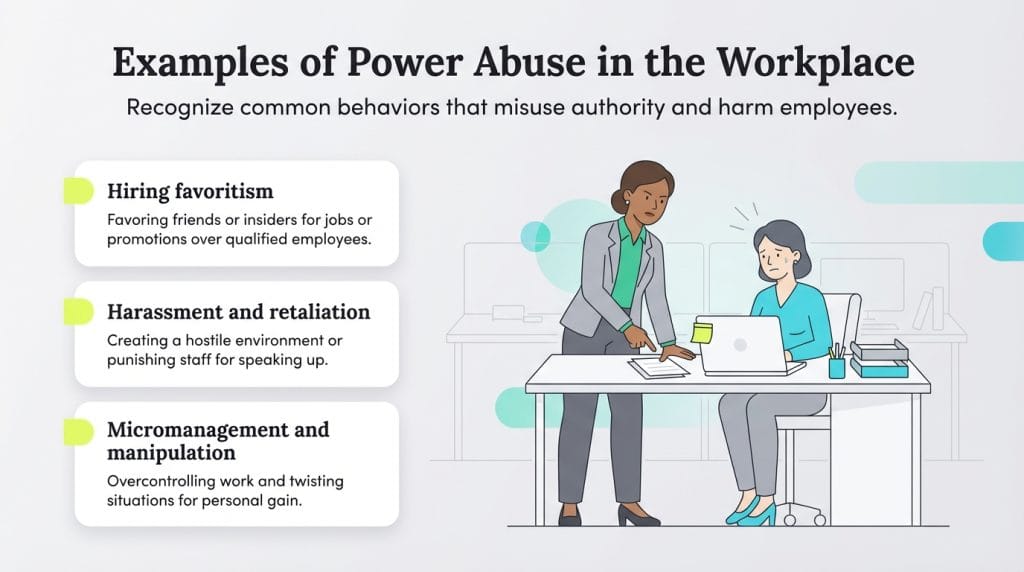
Power abuse can show up in many forms, from subtle manipulation to overt aggression.
“Power abuse happens when leaders exploit their authority to demean, control or marginalize employees,” said Tamanna Ramesh, founder of Spark Careers. “I’ve seen it manifest as micromanagement, favoritism or withholding critical resources, often leaving employees feeling powerless and undervalued.”
Below are some common examples of power abuse in the workplace.
Understanding the psychology behind an abuser’s actions can help explain — though never excuse — why power abuse occurs. Even in professional settings, abuse is often shaped by a mix of personal traits, past experiences and organizational dynamics. Here’s an overview of some reasons abuse of power occurs.
Harris explained that power abuse can persist because of poor organizational culture, rigid hierarchies and societal norms. “Traditional power structures often prioritize authority and results over collaboration and employee well-being, which can normalize or overlook abusive behavior,” Harris explained.
When human resources teams or managers lack the training, tools or authority to intervene, toxic behavior can take root. Without clear people management standards, harmful actions may go unchecked until they cause real damage.
Harris stressed that inclusive policies are needed. “The absence of inclusive policies — such as equitable performance reviews or transparent promotion processes — can unintentionally reinforce power imbalances,” she said. “Organizations that invest in inclusive leadership development create a culture where power abuse is less likely to take hold.”
Many employees don’t immediately recognize power abuse; they may rationalize it as just a demanding leadership style or the typical pressures of the industry. They may assume their experiences are normal or not worth reporting, or they may not know where to turn for help. Depending on who the perpetrator is, employees may feel unsure about reporting the problem or doubt their ability to prove it.
Witnesses can be hesitant, too. Even when something feels off, they may second-guess what they’re seeing or assume it’s not their place to step in, allowing the behavior to continue.
Even when employees recognize power abuse, many hesitate to come forward due to fear of retaliation, job loss or being blamed for the situation. They may also be concerned about the following:
Harris explained that power abuse often has deep psychological roots. “Leaders who lack emotional intelligence or self-awareness may misuse power to compensate for perceived vulnerabilities or to maintain control,” she said. Consider the following:
Although these drivers can seem personal, the consequences often extend beyond the individual. “Unchecked individual power can impede or damage organizational culture by eroding empathy,” Harris cautioned.
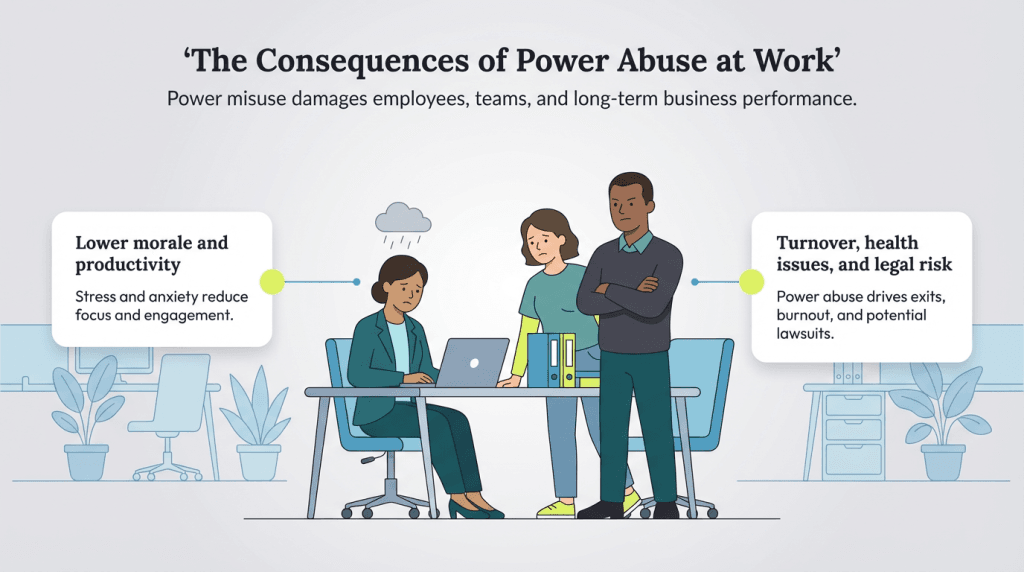
Harris cautioned that in a work environment, power abuse can take a serious toll on both employees and organizations. “For employees at every level, power abuse leads to stress, anxiety and reduced self-worth, often resulting in disengagement and turnover,” she said. “At the team level, power abuse fosters distrust, stifles innovation and weakens collaboration.”
Consider some of the potential consequences of power abuse:
Employees who experience power abuse are less likely to feel engaged or productive when they’re constantly worried about how they’ll be treated. That stress can drain mental energy and motivation, making it harder to focus on work or perform at their best. Over time, it can also lead to more workplace absenteeism and a growing sense of isolation or lack of support. And low engagement can be costly for employers. Gallup’s 2026 State of the Global Workplace report found that only 20 percent of employees worldwide report being engaged at work, a figure that translates to roughly $10 trillion in lost productivity globally each year.
The impact rarely stops with one person. Teams and departments can feel the ripple effects if mistreatment changes group dynamics, disrupts projects or forces colleagues to pick up extra work when someone’s performance suffers.
“For organizations, power abuse impedes workplace excellence and disrupts business functions, from lower levels of productivity to challenges with retention,” Harris said. “An abusive teammate, manager or executive can do outsized harm to a team or organization.”
Power abuse can create a hostile work environment where employees feel uncomfortable speaking up or sharing concerns. Over time, that silence can fuel productivity-killing stress and take a toll on both mental and physical health.
Chronic stress from a toxic workplace is a serious health risk. Team members may experience anxiety, employee burnout, sleep problems or other health issues, which can also increase healthcare costs for employers.
“I’ve coached countless professionals who faced anxiety, burnout and even career derailment due to toxic leadership,” Ramesh said. “From an organizational perspective, these behaviors drive attrition and harm productivity, costing billions in lost talent and morale annually.”
Toxic culture is a major driver of the “revolving door” in many organizations. Low morale and poor well-being tied to power abuse can push employees to start looking elsewhere. When the abuser stays in power and nothing changes, some people decide it’s better to leave than stay in a situation that feels unsafe or unsupported.
Employee turnover also gets expensive fast. According to the Work Institute’s 2025 Retention Report, replacing an employee costs about 33 percent of their salary. Beyond losing institutional knowledge and high performers, companies take on the costs of constant offboarding and onboarding. When a toxic environment creates a steady cycle of exits and new hires, it can slow growth and eat into profitability.
In some cases, an employee who experiences power abuse may decide to take legal action. Whether a claim succeeds depends on the facts and how the employer handled the situation. Companies can face a business lawsuit if they knew or should have known about the abuse and failed to address it, especially when the behavior involves harassment or discrimination tied to a protected characteristic, such as race, disability, sex or sexual orientation.
Legal disputes are only part of the risk. Allegations of power abuse can damage your brand reputation, affecting new employee recruitment and eroding trust with customers, investors and employees.
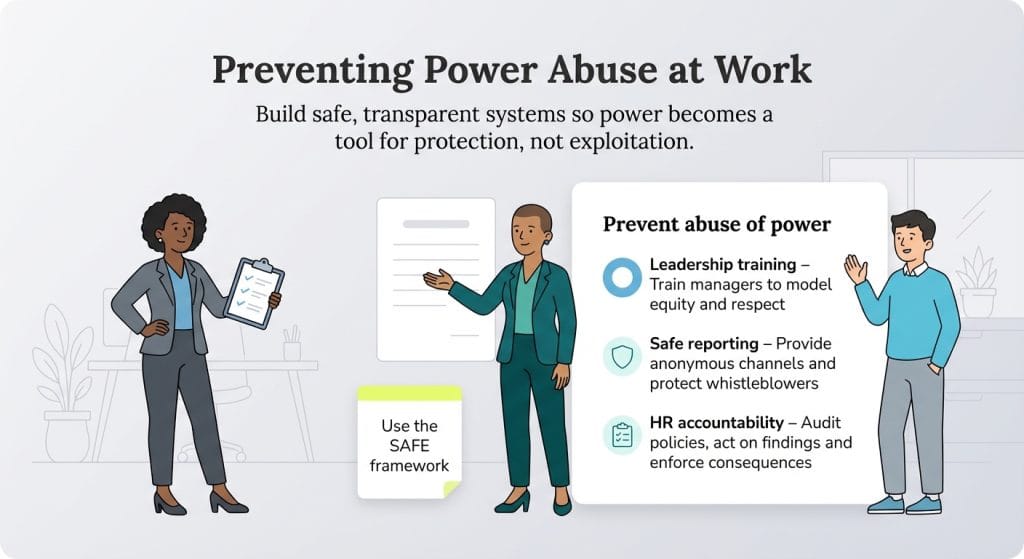
Stopping power abuse requires education and real support systems at the organizational level. Simply having an antibullying policy or a code of ethics or conduct isn’t enough. In many companies, those policies exist on paper but aren’t enforced or taken seriously.
Here are a few ways to prevent abuse of power in your business.
Harris recommends teaching leaders and managers how to foster equity and business transparency, with a focus on soft skills like active listening, empathy and cultural competence. “Inclusive leaders are better equipped to recognize and address power dynamics that may harm others,” Harris explained.
Leaders should set the tone by modeling accountability and respect, but they shouldn’t be the only ones trained. Organizations also need to encourage employees at every level to recognize harmful behaviors and feel safe speaking up. Investing in employee training can help team members call out bad behavior, refuse to participate in it and clearly describe what’s happening.
Establish clear reporting systems so employees can raise concerns about workplace conflicts or abuse with human resources or senior leadership. Multiple channels — including anonymous employee feedback options — can make it easier for employees to speak up without fear.
“A company can thwart power abuse by implementing mechanisms for anonymous feedback and ensure timely responses to reports of abuse,” Harris said.
The response should match the severity of the situation. Some issues may require mediation or coaching, while others call for formal investigations and disciplinary action.
It’s also worth noting that federal protections for whistleblowers vary by industry and the type of misconduct being reported. The Occupational Safety and Health Administration oversees more than 20 whistleblower protection statutes covering employees who report violations related to workplace safety, securities fraud, environmental hazards and more. Familiarizing yourself with the protections that apply to your industry can help you build a reporting framework that employees will actually trust and use.
When early interventions fail to stop the behavior, organizations should escalate consequences in line with their disciplinary action policy and applicable employment and anti-discrimination laws, up to and including employee termination.
HR teams should regularly review whether their harassment and conduct policies actually work in practice. That can include checking how well employees understand the policies, how easy it is to report concerns and whether investigations are handled consistently and fairly. Routine surveys and feedback tools can also help HR spot “hot spots” of dissatisfaction before they turn into larger issues or legal claims.
When Ramesh’s clients ask how to handle power abuse, she recommends what she calls the SAFE framework:
The framework can apply to both employees and organizations. For individuals, it means recognizing abusive behavior, documenting incidents, reporting concerns and, if nothing changes, choosing to leave an unsafe environment. For employers, it means identifying misconduct, documenting what’s happening, supporting affected employees and taking action — up to and including discipline or termination — if the behavior doesn’t stop.
This dual approach gives both employees and HR teams a clear, structured path forward — rather than leaving anyone to navigate misconduct on their own without guidance.
Here’s a quick way to spot the difference between healthy leadership and abuse of power. While every organization looks different, these behaviors can help you recognize when leadership practices cross the line into harmful territory.
Aspect | Healthy leadership | Abuse of power |
|---|---|---|
Delegation and trust | Delegates, trusts team | Micromanages, controls |
Feedback style | Gives constructive feedback | Criticizes, humiliates |
Accountability | Accountable | Blames others |
Decision-making | Transparent, collaborative | Arbitrary, biased |
Communication | Welcomes feedback | Punishes dissent |
Resource allocation | Distributes resources equitably | Shows favoritism, withholds resources |
Work-life balance | Respects boundaries | Ignores boundaries, overworks staff |
Conflict resolution | Fair conflict resolution | Retaliates against complainants |
Impact | Positive culture, stronger retention | Low morale, high turnover, legal risk |
Skye Schooley and Petrina Coventry contributed to this article. Source interviews were conducted for a previous version of this article.