Business.com aims to help business owners make informed decisions to support and grow their companies. We research and recommend products and services suitable for various business types, investing thousands of hours each year in this process.
As a business, we need to generate revenue to sustain our content. We have financial relationships with some companies we cover, earning commissions when readers purchase from our partners or share information about their needs. These relationships do not dictate our advice and recommendations. Our editorial team independently evaluates and recommends products and services based on their research and expertise. Learn more about our process and partners here.
VoIP vs. Landlines
VoIP and landlines are options for your business phone system. Learn the pros and cons of each and how to choose the right communication solution for your growing business.
Business.com earns commissions from some listed providers. Editorial Guidelines.
Table of Contents
When you first selected your company’s business phone system, you were likely offered one of two choices: a business VoIP system or a traditional landline-based system, also known as a plain old telephone service (POTS). If you went with the landline option, it may be time to upgrade to a more modern VoIP solution.
Here’s an overview of business VoIP vs. traditional phone systems for business, including the pros and cons of each to help you determine which type of business phone system is best for your organization now that your business is more established.
Searching for a business phone system and not sure where to start? Tell us a little more about your business and get customized quotes from qualified providers.
VoIP vs. traditional phone systems for business
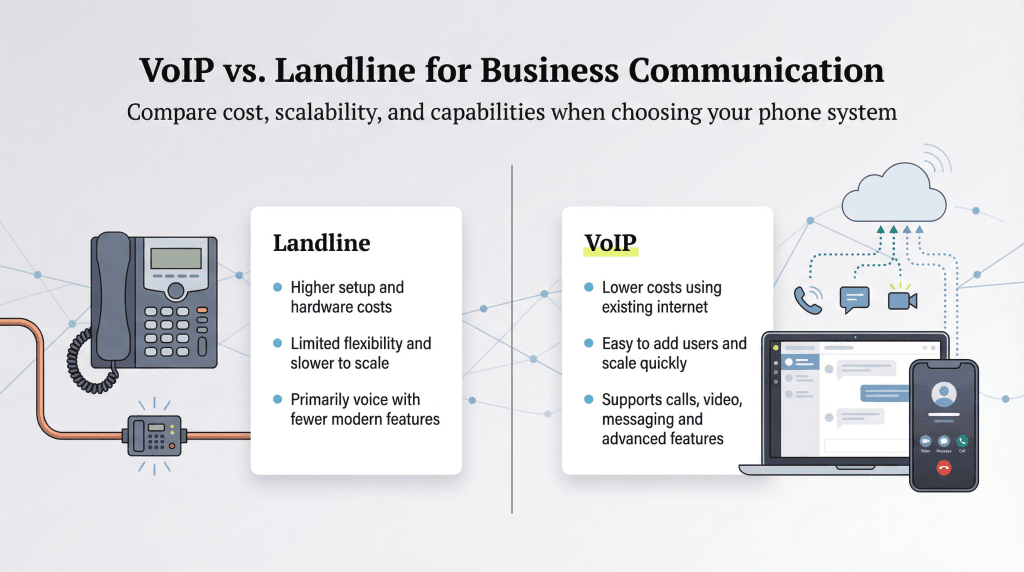
VoIP refers to a cloud-based phone system for small businesses that uses a broadband internet connection to make calls. By contrast, traditional phone systems require a physical connection to a telephone network, which needs switches to transmit analog audio to other phones worldwide.
When comparing VoIP vs. traditional phone systems, consider cost, scalability, reliability and capabilities:
Cost: Because VoIP relies on your existing internet connection, you don’t need to buy additional hardware, like handsets or a private branch exchange (PBX) system.
Scalability: With VoIP, you can add a new number to your corporate plan in just a few clicks. It’s much more complicated with landlines. A technician must physically attach a new connection to the network, which can be costly. Physical lines also need regular maintenance to ensure nothing is eroding and everything is running exactly as it should.
Reliability: VoIP is only as reliable as your internet connection, so it is subject to lag, distortion and downtime. Traditional phone systems are more resilient, making them a good choice for redundancy in systems where communications uptime is vital. For businesses that have generally reliable internet connection, though, VoIP systems will probably do just fine.
Capabilities: A VoIP phone line is much better equipped to handle different forms of communication, like text messages and video conferencing. It also offers access to features such as call recording and archiving. However, if there’s ever a power or internet outage, you’ll lose your ability to communicate with the outside world.
VoIP providers to consider
Most modern businesses choose VoIP providers over landlines. Here are some examples of providers we reviewed when selecting our picks for best business phone systems.
Vendor
Starting Price
Key VoIP Features
Ooma Office
$19.95/user/mo
Unlimited calling, virtual receptionist, ring groups, call park, mobile/desktop apps, video conferencing, voicemail transcription
Unlimited auto attendants, ring groups, call queues, visual dial plan editor, paging, video meetings (up to 250)
Vonage
$19.99/line/mo
Unlimited domestic calling, SMS/MMS, virtual receptionist, desktop/mobile apps, video conferencing (up to 200)
Zoom Phone
$10/user/mo
Metered or unlimited calling, voicemail prioritization, IVR, call recording, AI call summaries, team chat, video meetings
Nextiva
$15/user/mo
Unlimited calling, auto attendant, voicemail transcription, smart call routing, team messaging, video meetings
Dialpad
$23/user/mo
Unlimited calling, AI voice transcription, visual voicemail, ring groups, call recording, SMS/MMS, team messaging
Quo
$15/user/mo
Shared phone numbers and inboxes, AI call summaries and transcripts, auto-replies, voicemail transcription, phone menus (IVR), call recording, CRM integrations and API access.
Verizon Business
Custom pricing
Unlimited SMS/MMS, auto attendants, visual voicemail, video meetings (up to 3,000), international calling, mobile app
RingEX
$30/user/mo
Unlimited calling, multilevel auto attendant, call recording, AI meeting summaries, team messaging, video (up to 200), 500+ integrations
What are the pros and cons of VoIP?
VoIP-powered cloud-based phone systems for small businesses became the go-to choice for a reason, but that doesn’t mean it’s suitable for every organization. Here are its pros and cons.
Pros
Cons
Lower cost
Dependence on a broadband connection
Comprehensive features
Limited emergency services
Portability and scalability
Audio and latency issues
VoIP pros
Lower cost: Because they’re compatible with multiple devices, VoIP phone lines tend to have a lower total cost of ownership than landlines do. An employee is usually assigned a corporate computer so they can easily access a dedicated VoIP phone line without needing extra hardware. VoIP phone lines start at just $10 per user per month, making it easy to add lines as your business expands and your workforce grows.
Rich functionality: VoIP lines can send text messages, images, videos and faxes. They often also provide access to professional business phone system features such as caller ID, conference calling and video conferencing. A VoIP number can easily forward calls to remote teams or employees working from home so you can provide constant support for your customers.
Portability: VoIP phone lines are completely independent of specific devices or locations. You can tether your VoIP number to a mobile device or laptop to receive calls from clients and colleagues wherever you go.
Scalability: Cloud-based VoIP platforms are easily scalable for teams and growing businesses. In fact, they are designed to be multiline phone systems, so it’s easy for users to add or delete new lines within seconds without contacting a service provider. Once a new VoIP line is created, a new team member can make and receive calls on PCs and cellphones, so you don’t have to purchase extra equipment. [Learn more about cloud PBX and other cloud-based phone systems]
Ideal solution for global teams: Thanks to its flexibility and scalability, VoIP is an ideal solution for remote teams. You can create VoIP phone lines for specific regions or countries to provide local support without long-distance charges. Additionally, your business can leverage advanced features like automatic call distribution and intelligent routing to ensure customers reach the right department regardless of time zones.
Did You Know?
Many VoIP systems integrate with apps such as Slack to enhance workplace communication with in-office and remote staff. Before switching to a VoIP solution, make sure the system integrates with the software your business already uses.
VoIP cons
Dependence on broadband connection: VoIP’s biggest drawback is its reliance on a stable broadband internet connection. A VoIP phone line transmits data packets through a broadband connection to another line. Without a consistent connection, you could lose audio quality or drop a call entirely. In an internet or power service outage, a VoIP line won’t work.
Limited emergency services: When someone places a 911 call, emergency service providers track the phone number to find a home address or GPS location so they can send help. This is a problem with VoIP numbers. Because a VoIP phone line appears as an IP address, it’s challenging for emergency services to pinpoint someone’s physical location. A delay can be catastrophic in a situation where every second counts.
Audio and latency issues: If there’s a bandwidth or latency issue, like an unstable connection or multiple simultaneous users on a single network, problems could ensue. Without the proper connection, the call quality on a VoIP line could suffer, resulting in stuttering audio or lags in teleconferences.
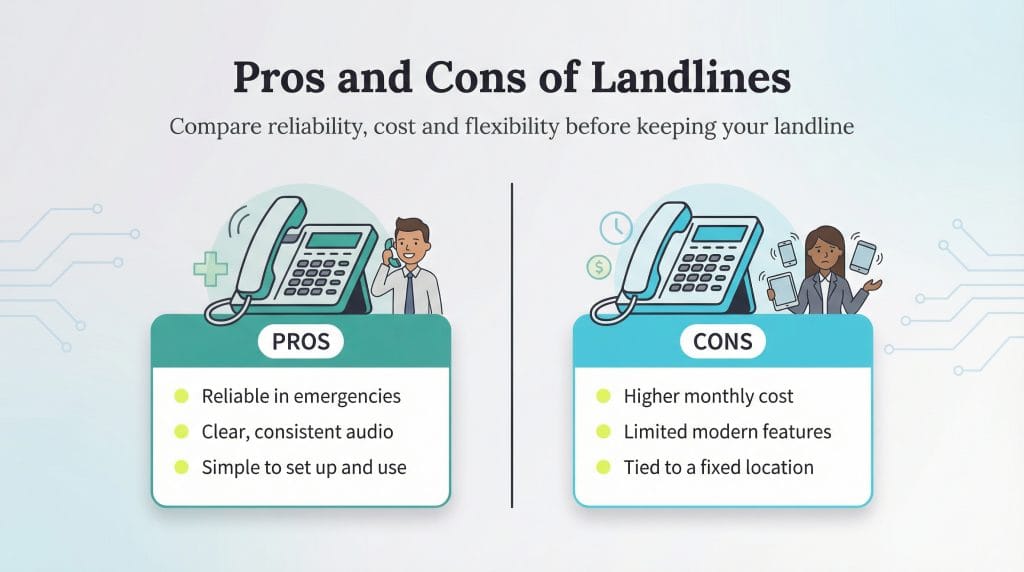
What are the pros and cons of landlines?
As a traditional landline user, you’re probably familiar with these pros and cons.
Pros
Cons
Reliability in emergencies
Higher cost
Good audio quality
Limited functionality
Ease of use
Stationary devices
Landline pros
Reliability in emergencies: Traditional landlines run on their own source of power, independent of the power that connects to a home or an office. If the electricity goes out in your neighborhood, you can still dial 911 and connect to an operator. Because a landline is tied to a physical location and device, emergency services can quickly and easily locate an address and send help.
Good audio quality: A land-based phone line uses a tried-and-tested network of physical copper lines that deliver consistent voice quality. With a landline’s dedicated connection, you’ll experience fewer dropped calls, and every call you make will deliver clean, clear audio.
Ease of use: Traditional phone line hardware is easy to learn and use. These devices usually have a handset or a receiver and a keypad. All you have to do is enter the correct number and your call will go through. Landlines are usually stationary within a business or home (unless you have a wireless receiver), so they’re easy to access when someone calls.
Landline cons
Higher cost: As you’ve likely experienced, traditional landlines cost more, and the more numbers you add, the more that cost increases. For example, if you have a business with 100 people and pay $25 per month for each number, you’re looking at $2,500 per month.
Limited functionality: A landline is best for audio calls. Because they were created before text messaging, video conferencing or image sharing, traditional phone lines cannot perform many of the tasks that VoIP can. Your growing business may now be at a point where it needs those features.
Stationary devices: When someone calls your landline number, they’re not calling you; they’re calling your desk or whatever surface your phone is mounted on. If you’re away from your desk, you miss the call if you don’t have voicemail. You could miss a sale or an important call.
Did You Know?
Many VoIP vendors make the best business phone systems for restaurants. Auto-attendants can direct incoming calls, and eateries can integrate their VoIP system with POS software to target the right customers for promotions by email and text messaging, all from one screen.
How to choose between a VoIP service and a landline
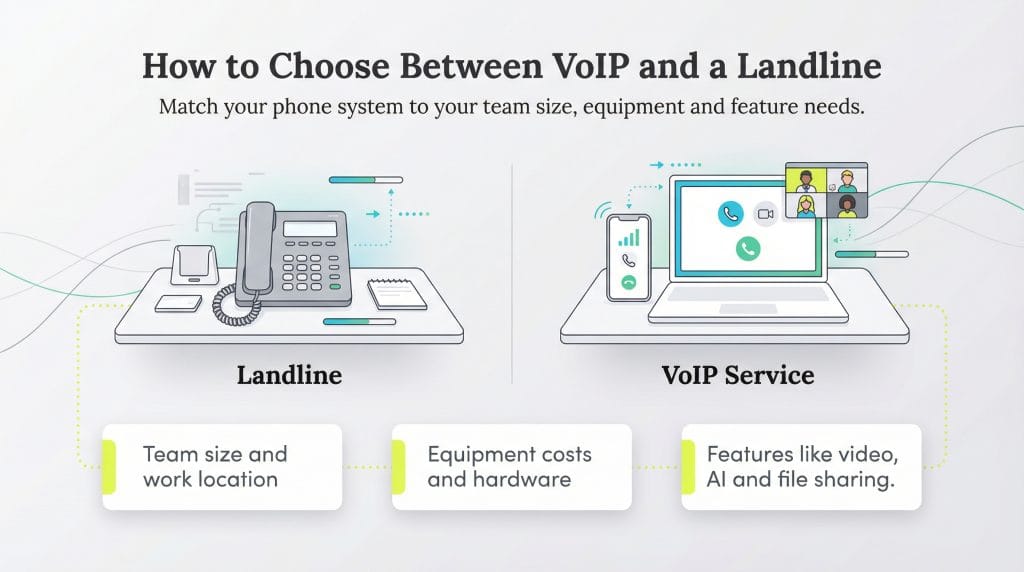
There are a few important questions you should ask when you’re deciding whether to switch from a landline phone system to a VoIP service.
How big is your team? VoIP may be the right choice if you now have a large team that works remotely or employees who are scattered across different regions. Because of VoIP’s inherent scaling and portability, it’s an ideal, reasonably priced option for teams that don’t work in the same location. On the other hand, if you still have a small, local team that needs just a few no-frills phone lines, a landline phone service may still be the best route.
What are your equipment concerns? Consider VoIP if you want to avoid the extra costs of buying a new phone for each new employee you hire. However, if you account for the cost of hardware you already have or will need, a landline option may still be within your budget.
Which features do you need? A landline is still a good option if you only need to make short local calls. However, VoIP is far more suitable if you want to transfer files from the field, send videos to employees or colleagues, hold video conferences with an entire workforce or leverage AI-powered features like call transcription and sentiment analysis.
Tip
One great way for companies with outbound telemarketing teams to squeeze more value out of their phone system, whether VoIP or a landline, is to add an auto-dialer. An auto-dialer predicts when a call is about to end and starts dialing the next number, thereby reducing downtime and increasing productivity.
Mark Fairlie brings decades of expertise in telecommunications and telemarketing to the forefront as the former business owner of a direct marketing company. Also well-versed in a variety of other B2B topics, such as taxation, investments and cybersecurity, he now advises fellow entrepreneurs on the best business practices.
At business.com, Fairlie covers a range of technology solutions, including CRM software, email and text message marketing services, fleet management services, call center software and more.
With a background in advertising and sales, Fairlie made his mark as the former co-owner of Meridian Delta, which saw a successful transition of ownership in 2015. Through this journey, Fairlie gained invaluable hands-on experience in everything from founding a business to expanding and selling it. Since then, Fairlie has embarked on new ventures, launching a second marketing company and establishing a thriving sole proprietorship.