Business.com aims to help business owners make informed decisions to support and grow their companies. We research and recommend products and services suitable for various business types, investing thousands of hours each year in this process.
As a business, we need to generate revenue to sustain our content. We have financial relationships with some companies we cover, earning commissions when readers purchase from our partners or share information about their needs. These relationships do not dictate our advice and recommendations. Our editorial team independently evaluates and recommends products and services based on their research and expertise. Learn more about our process and partners here.
E-commerce is now a core part of how many businesses sell, making it essential to have a digital marketing strategy that supports online growth.


To attract new customers and increase revenue, you need an e-commerce marketing strategy that’s intentional and well-targeted. When your marketing aligns with how and where you sell online, it’s easier to reach the right audience and turn interest into sales.
With so many marketing tactics to choose from, figuring out where to start can feel overwhelming. Below, we’ll break down how to build an effective digital marketing strategy and share practical ideas you can put to work right away.
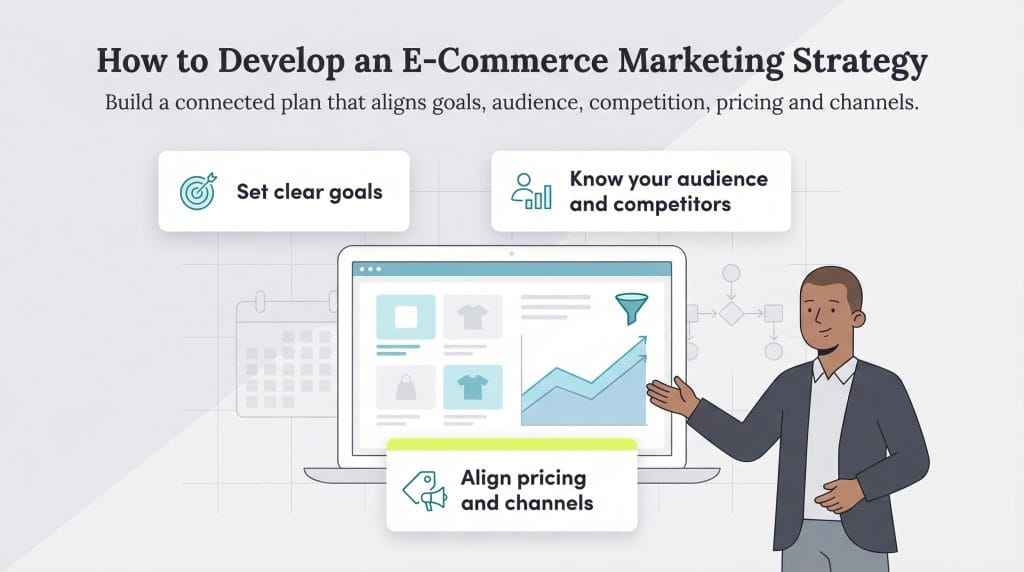
It’s easy to focus on individual marketing tactics without stepping back to build an overall plan. That’s a common misstep. A clear strategy helps your tactics work together so they deliver results over time instead of in isolated bursts.
Follow these five steps to develop an effective e-commerce marketing strategy.
Before you shape your marketing strategy, take time to define what you want to achieve over the next year. Clear goals give your strategy direction and make it easier to measure success.
Common e-commerce marketing goals include:
Once you’ve identified a broad annual goal, get more specific. For example, if your objective is to attract new customers, you might set a target of converting 100 new customers per month. Breaking larger goals into measurable milestones makes them easier to track and easier to adjust if needed.
Once you’ve outlined your goals, the next step is to define your target market. Knowing who your ideal customer is helps you decide where to focus your marketing efforts and how to reach people who are most likely to buy. Without this clarity, it’s easy to waste time and budget on channels or messages that don’t resonate.
If you already have an audience, customer survey data can offer valuable insight into what they want, need and struggle with. If you’re still building an audience, start by creating a clear picture of your ideal customer, often referred to as a customer persona.
In your market research plan, consider factors such as:
Understanding these details makes it easier to tailor your messaging, choose the right platforms and create marketing campaigns that feel relevant instead of generic.
Next, identify your main rivals and take note of their strengths and weaknesses. Understanding what they do well and where they fall short can help you spot opportunities to stand out from the competition.
Start by reviewing your competitors’ websites and product offerings. Look at how detailed their product descriptions are and how they position their brand. Do they publish blog content to attract customers, and if so, how often? If you use an SEO tool such as Ahrefs, you can also analyze where your competitors’ traffic comes from and which channels drive the most visibility.
Keep in mind that competitor research isn’t a one-time task. Regularly monitoring what other brands are doing helps you stay ahead of shifting industry trends and customer expectations. Consider subscribing to competitors’ email newsletters, following them on social media, and even purchasing their products to experience the buying process firsthand.
Because it’s easy for consumers to compare prices, pricing deserves careful consideration. Now that you understand your ideal customers, you should have a clearer sense of what they value and what they’re willing to pay, whether you’re pricing products, services or a mix of both.
Pricing your services or products too high can push potential customers away, while pricing too low may undermine your positioning or margins. The goal is to set pricing that aligns with customer expectations, reflects your value and differentiates your brand in a crowded market.
With your strategy defined, it’s time to put it into action. The details of your plan will depend on your business goals, but most e-commerce brands benefit from a multichannel approach that reaches customers in more than one place.
Your plan might include tactics such as:
Once your strategy is live, tracking performance is just as important as execution. Use the data available through your ad platforms, email marketing tools and analytics software to monitor key metrics, evaluate what’s working and adjust your approach over time.
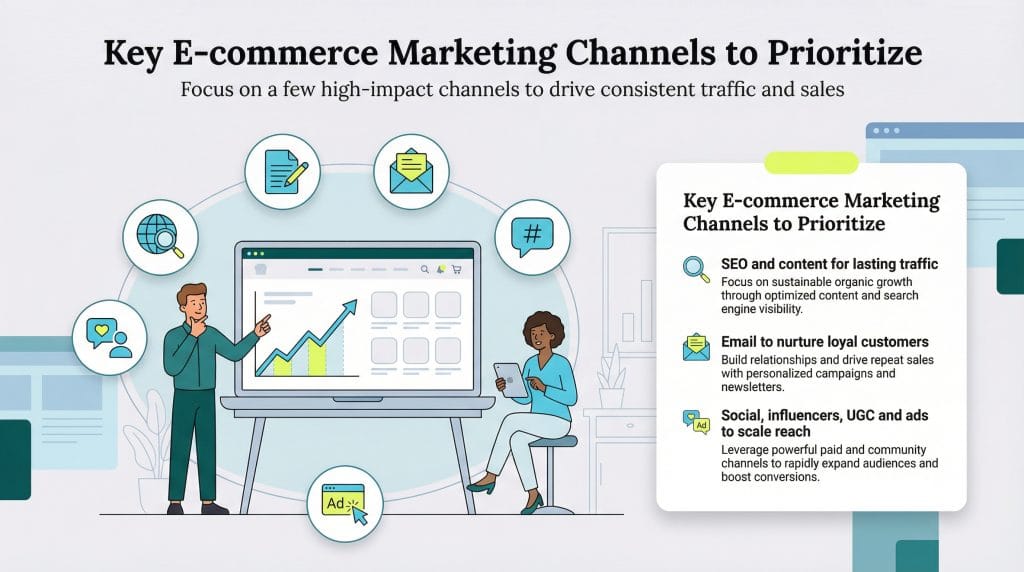
With the groundwork in place, you can start narrowing in on the specific marketing channels that will do the heavy lifting for your e-commerce business. The sections below highlight seven areas worth prioritizing.
Search engine optimization focuses on improving your website so it appears more prominently in search results. Done well, SEO helps your business attract customers who are actively searching for the products you sell, making it one of the most effective ways to drive organic traffic.
SEO does require upfront effort, which is why some business owners put it off. However, once your site begins ranking for relevant, high-intent keywords, it can generate consistent traffic over time without ongoing ad spend.
A good place to start is keyword research. Look for search terms that strike the right balance between demand and competition — keywords people are actively searching for, but that aren’t already dominated by larger or more established brands. Choosing keywords with very low search volume won’t move the needle, while overly competitive terms can be difficult to rank for.
After you know which keywords you’re targeting, the next step is making sure they show up in the right places on your site. Focus on pages that play the biggest role in search visibility, such as:
For best results, incorporate keywords into page titles, URLs, image alt text, body copy and meta descriptions, always prioritizing clarity and readability over keyword stuffing.
Content marketing is about sharing useful, relevant content that helps customers learn about your brand and make informed buying decisions. When it’s done well, content marketing builds trust, keeps your audience engaged and supports long-term growth.
Before you dive in, decide what types of content make the most sense for your business and your audience. A strong content strategy usually includes a mix of formats, such as:
Email remains one of the most effective ways to stay connected with your audience. Automated email sequences help you nurture relationships over time, keep your brand top of mind and encourage repeat purchases without requiring constant manual effort.
Instead of sending emails sporadically, it helps to settle into a regular cadence. Many businesses start with a weekly or biweekly newsletter because it’s manageable and easy to maintain. Over time, that consistency makes it easier to share useful content, promote new products or offers and stay connected with subscribers who’ve already raised their hand.
Social media has become an increasingly important sales channel for e-commerce brands. It’s no longer just a place to post updates; many platforms now let businesses showcase products and turn followers into customers via social selling tools without leaving the app.
Here are some of the top social media platforms to consider for e-commerce marketing:
As consumers have grown more resistant to traditional ads, many brands have shifted toward influencer marketing to reach new audiences in a more natural way. That shift is reflected in the market’s growth: Aspire’s 2025 State of Influencer Marketing Report projects the industry will reach $47.8 billion by 2027.
Influencer marketing involves partnering with creators who have built a loyal following within a specific niche and can introduce your products in a way that feels more natural than a standard ad. For e-commerce businesses, these partnerships often play out on social media, where influencers can showcase products through posts, videos or stories.
Because influencers have already earned their audience’s trust, their recommendations tend to carry more weight, which can make influencer marketing especially effective when it’s done thoughtfully.
User-generated content puts real customers front and center, showing how people actually use your products. That kind of real-world context can be especially helpful for shoppers who are still weighing their options.
User-generated content can take many forms, from product reviews to photos and videos shared on social media. Many e-commerce brands actively encourage this kind of content through branded hashtags or campaigns. For example, Starbucks regularly invites customers to share photos of its seasonal cups, while GoPro features customer-submitted videos that show its products in real-world use. Fashion retailers like ASOS also highlight customer photos to show how products look on real people.
For smaller businesses, the takeaway is simple: Encourage customers to share their experiences and make it easy to spotlight that content on your website, email campaigns or social channels.
Paid advertising often gets dismissed as expensive or ineffective, but when it’s used strategically, it can be one of the fastest ways to drive targeted traffic and sales. Most e-commerce paid advertising falls under pay-per-click (PPC) models, meaning you only pay when someone actually clicks on your ad.
Two of the most common PPC channels for e-commerce are Google Ads and Facebook Ads, which also place ads on Instagram.
In practice, paid ads tend to work best alongside your organic efforts. They can help you get in front of the right audience quickly, while strategies like SEO, content and email continue to build over time.
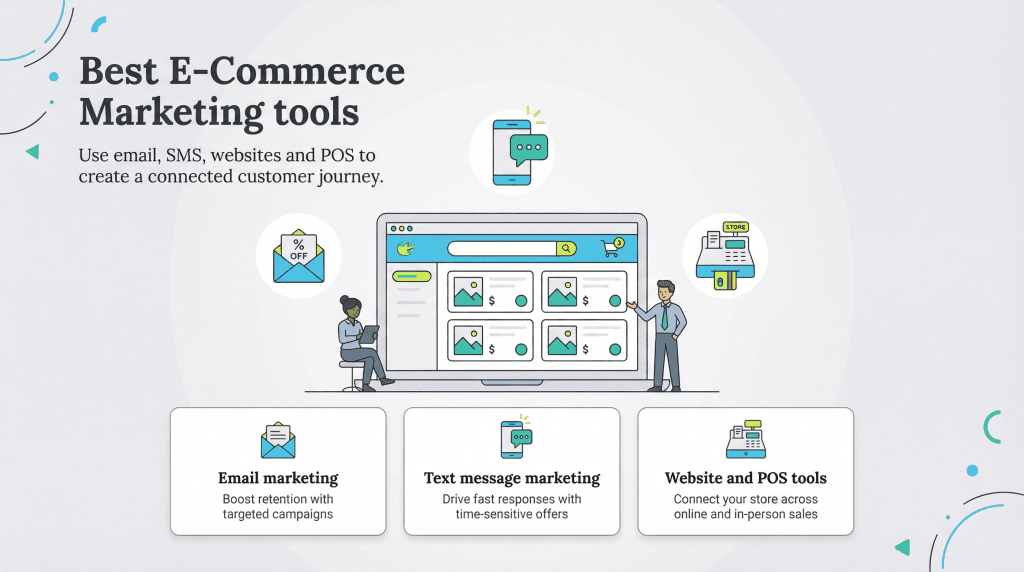
The right tools make it easier to put your e-commerce marketing strategy into action and manage campaigns without adding unnecessary complexity. Below are some of the most useful tools for supporting common e-commerce marketing efforts.
The best email marketing software solutions help businesses stay in touch with customers in a more personalized way. These platforms let you send targeted promotions, recommend products based on past purchases and automate follow-ups, such as reminders when shoppers leave items in their carts. Re-engagement email strategies can also help bring back customers who haven’t purchased from your business in a while, supporting retention as well as sales.
Text message marketing gives businesses a more direct way to reach customers, especially when timing matters. While social posts and emails can be easy to miss, text messages tend to get seen quickly, which is why many businesses use SMS messaging for reminders, alerts and limited-time offers.
The best text message marketing services typically let you segment your audience, automate messages and send targeted promotions based on customer behavior. Text messages also tend to be seen more quickly than email. According to EZ Texting’s 2025 Consumer Texting Report, marketing texts have an average open rate of 98 percent, which makes SMS especially useful for short, time-sensitive messages rather than long-form communication.
The best website builders and design services make it easier to launch an e-commerce store without needing coding or design experience. Many platforms offer customizable product pages, built-in shopping carts and checkout tools, along with SEO-friendly features that help your site get found in search results.
E-commerce POS systems help businesses manage online and in-store sales from a single platform. By connecting your digital storefront with physical locations, these systems make it easier to track inventory in real time and keep stock levels accurate across channels.
Many of the best POS systems also include built-in loyalty programs, customer relationship management (CRM) tools and mobile functionality, which can help businesses recognize repeat customers, personalize promotions and process sales from anywhere.
Building an effective e-commerce marketing strategy takes time, and it’s rare to get everything right on the first pass. What matters most is getting started, testing what works and learning from the results.
Rather than trying to do everything at once, focus on one or two strategies and see how they perform. If something isn’t delivering results, adjust your process or try out another channel. Over time, this trial-and-error process helps you refine your strategy and build a marketing plan that fits your business, your audience and your goals.