Business.com aims to help business owners make informed decisions to support and grow their companies. We research and recommend products and services suitable for various business types, investing thousands of hours each year in this process.
As a business, we need to generate revenue to sustain our content. We have financial relationships with some companies we cover, earning commissions when readers purchase from our partners or share information about their needs. These relationships do not dictate our advice and recommendations. Our editorial team independently evaluates and recommends products and services based on their research and expertise. Learn more about our process and partners here.
Making simple operational changes can significantly improve your business's environmental impact.


Computing plays a larger role in your company’s environmental footprint than many business owners realize. From energy-hungry data centers to always-on devices, everyday technology choices add up. As sustainability becomes a higher priority for customers, employees and regulators alike, more businesses are looking for practical ways to reduce their carbon footprint without disrupting operations.
Green computing focuses on using technology more efficiently and responsibly, often in ways that also lower costs and improve performance. In this guide, we’ll explain what green computing looks like in practice and outline specific, eco-friendly strategies your business can implement today.
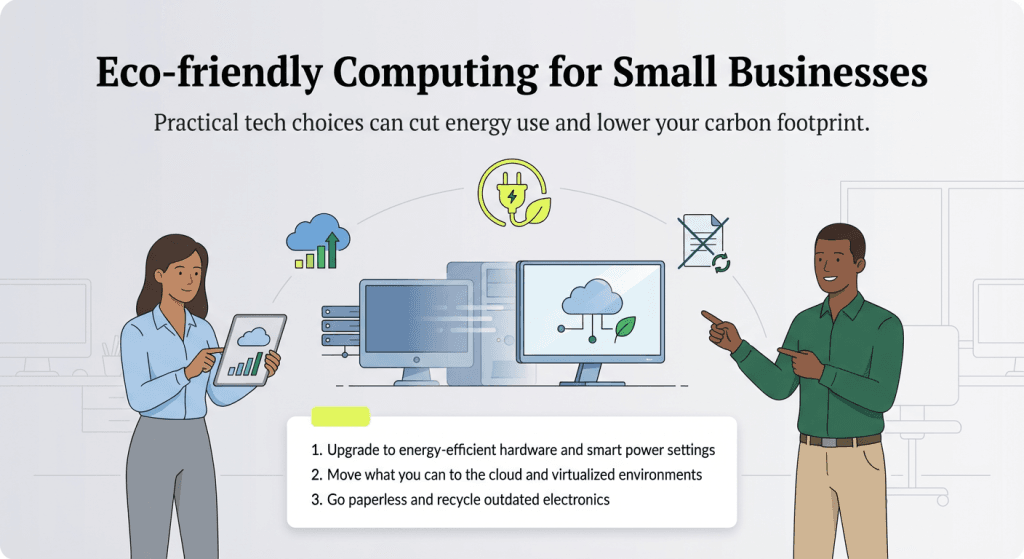
Green computing, also called sustainable computing, is the energy-efficient and environmentally responsible design, use and disposal of computers and related technology. In practice, it focuses on reducing energy consumption, minimizing electronic waste and using hardware and software more efficiently across a business’s operations.
For many companies, green computing shows up as part of broader environmental, social and governance (ESG) efforts. In practice, that often means finding ways to run technology more efficiently, such as using less energy, extending the life of equipment and cutting back on unnecessary waste. Done thoughtfully, these changes can support sustainability goals without adding friction to day-to-day operations.
Making lasting changes can feel daunting, especially when it comes to technology. Many business leaders assume energy conservation initiatives are complicated, time-consuming or disruptive. In reality, living up to a sustainable business model often starts with practical tech updates you may already be planning.
Keeping your systems current, especially as more work shifts to modern computing and cloud-based tools, can reduce energy use without interfering with daily operations. Here are eight ways to go greener while keeping your business running smoothly.
Investing in energy-efficient equipment is one of the most straightforward ways to reduce your carbon footprint. Older computers, servers and networking equipment tend to consume more power than necessary, which affects both the environment and your operating costs. On-site legacy systems are also often overprovisioned, leaving hardware running and drawing power even when it isn’t being fully used.
“Upgrading modern, power-efficient computers, servers and networking devices can significantly lower a company’s overall energy use,” noted Mark Bradley, senior manager of product management at Flexera. “Tracking hardware energy consumption helps businesses identify optimal times for equipment upgrades, ensuring they significantly reduce energy waste.”
Virtualization lets businesses do more with fewer physical machines. By running multiple virtual machines on a single server, companies can reduce the amount of hardware they need to buy, power and maintain. That consolidation can lower both technology costs and ongoing energy use.
“This strategy not only cuts hardware costs but also drastically lowers energy consumption,” Bradley explained. “Virtualized environments lead to more efficient resource use and reduced heat generation, helping organizations reduce their environmental footprint.”
When you move work to the cloud, you’re usually running less hardware on-site. That means fewer servers to power, cool and maintain in your own space, since much of that load shifts to large, centralized data centers. Over time, that change can add up to lower energy use tied to everyday computing.
Bradley agrees that there can be substantial energy savings by moving IT operations to the cloud. “By analyzing cloud providers’ energy consumption and emissions data, businesses can choose the most sustainable option, ensuring their shift to the cloud aligns with their green goals,” he said.
Cloud computing can also reduce emissions tied to physical hardware. Businesses that replace traditional desktop computers with hosted or virtual desktop clients can lower power use and cut back on the production, packaging and disposal associated with on-site machines. Many major cloud providers, including top cloud storage services, have also committed to carbon-neutral or carbon-negative goals, which can further reduce reliance on costly, energy-intensive on-premise hardware.
Remote work changes some basic assumptions about how work gets done. Fewer commutes, less office space in constant use and more flexibility around where people live can all start to add up. For many businesses, remote or flexible work arrangements also make it easier to hire from a broader talent pool without adding real estate costs.
Research backs up the environmental impact of this shift. A 2023 study by Cornell University and Microsoft found that remote workers can have a 54 percent lower carbon footprint than fully on-site workers.
Reducing paper use is one of the more manageable changes businesses can make to lower their environmental impact. Despite the shift toward digital tools, paper consumption across offices remains high. That’s why many companies are moving toward a paperless office model, especially as the pulp and paper sector was responsible for about 190 million metric tons of carbon dioxide emissions in 2022, according to the International Energy Agency.
The best document management systems make it easier to move away from paper-heavy processes. Scanning and storing files electronically creates searchable, secure libraries while cutting down on ongoing paper use. Transitioning to digital contracts, computerized filing systems and cloud storage also reduces the energy tied to printing, shipping and disposing of paper documents.
Power management tools help reduce energy use without changing how employees work. Built-in software settings can trigger sleep modes, dim displays or schedule automatic shutdowns during nights and weekends, preventing devices from drawing power when they aren’t in use.
“Monitoring device utilization helps businesses identify where power management improvements can be made, reducing energy waste without compromising performance,” explained Bradley.
As more work moves online, businesses rely on technology for nearly every part of their daily operations. Over time, that dependence creates a steady stream of outdated devices — phones, laptops, tablets and monitors that eventually need to be replaced.
Responsible disposal matters, especially as e-waste continues to pile up. According to the 2024 Global E-waste Monitor, a record 62 million metric tons of electronic waste was generated worldwide in 2022, yet only 22.3 percent was formally collected and recycled. Too often, unwanted electronics end up in landfills or are shipped elsewhere for disposal, creating environmental and health risks along the way.
Recycling doesn’t have to be complicated. A quick Google search can help you find a nearby electronics recycling center. In some cases, local nonprofits or charities can also take usable devices and put them back into circulation.
Web hosting relies on always-on infrastructure, with servers running around the clock to keep websites live. That constant demand can add up in terms of energy use, especially at scale.
To reduce that impact, some web hosting providers take steps to operate more sustainably. In practice, web hosts tend to do this in a few common ways:
For businesses, choosing a greener host doesn’t necessarily mean paying more. Many environmentally focused hosting plans are priced similarly to traditional options. Providers such as GreenGeeks, DreamHost, Solve and iPage offer hosting services that emphasize energy efficiency alongside standard performance features.
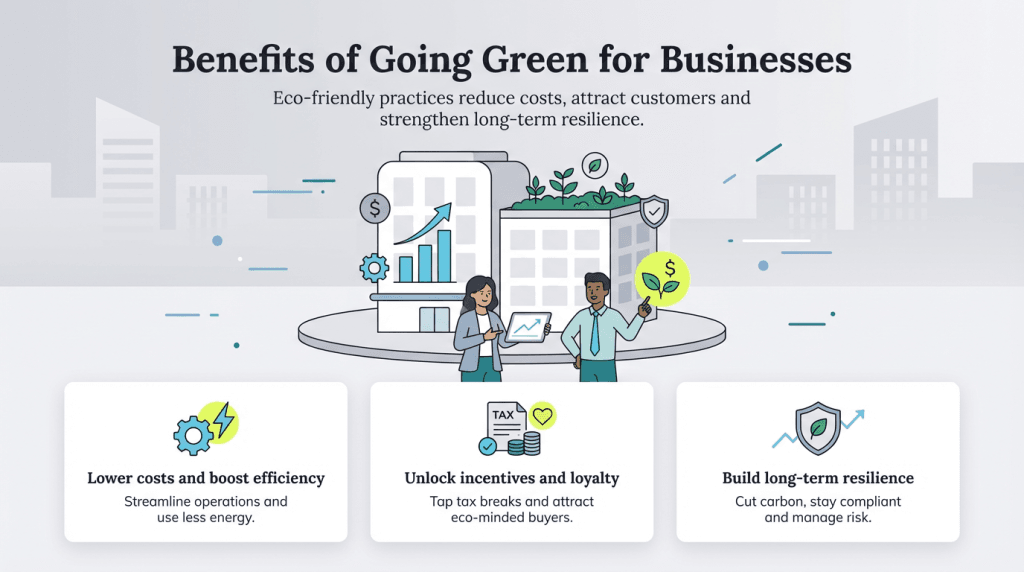
Adopting eco-friendly practices isn’t just about environmental impact. For many businesses, it also supports long-term stability, tighter operations and a strengthened public image. When sustainability efforts are tied to everyday decisions, especially around technology, the benefits tend to be practical and measurable. They include the following:
Streamlining workflows and reducing reliance on paper, hardware and other physical resources can lower operating costs over time. Leaner systems are also easier to adjust, which gives businesses more flexibility as needs change.
Optimizing technology often brings performance gains alongside energy savings. That efficiency can free up time and budget for other priorities. Businesses that focus on green computing frequently find they can do more with fewer resources.
“A key piece of advice is to treat carbon consumption like you would treat dollars,” said Bradley. “Companies that optimize their IT infrastructure not only reduce their carbon footprint but also drive significant cost savings, often reducing energy consumption by as much as 30 percent.”
Federal and state programs can make sustainability upgrades easier on the budget. In some cases, tax incentives help offset the cost of clean energy and efficiency projects, so businesses don’t have to bear the full expense up front.
A key example is the Investment Tax Credit (ITC) — the long-standing tax credit for business clean energy investments — which, for projects beginning construction in 2025 and 2026, is now administered through what the IRS calls the Clean Electricity Investment Credit. That credit can be worth up to 30 percent of eligible project costs when wage and apprenticeship requirements are met.
Taking a more eco-friendly approach can also shape who you work with, from partners and vendors to potential hires and customers. In some industries, sustainability has become part of how companies evaluate each other.
Recent data points in that direction. According to McKinsey and Nielsen, sales of consumer packaged goods with ESG-related claims grew 28 percent over five years, compared with 20 percent growth for similar products without those claims.
Rather than being a branding exercise, sustainability efforts can influence long-term relationships. For many businesses, eco-friendly practices are increasingly tied to customer loyalty, especially as expectations continue to shift.
Having a sustainability strategy in place can also make it easier to respond to evolving federal and state environmental regulations. Tracking energy use and documenting changes over time helps businesses understand where they stand and what may need attention as reporting requirements expand.
Business transparency plays a role here as well. Sharing clear information internally — and, when appropriate, with customers and stakeholders — creates accountability and reduces surprises. For many companies, focusing on greener practices becomes less about hitting targets and more about building consistent, defensible processes year over year.
Sustainability efforts can also influence how your business is perceived in the market. Companies that take a proactive approach often stand out to customers, partners and potential hires who pay closer attention to how businesses operate, not just what they sell.
Keeping up with green compliance and evolving expectations can also help businesses stand out from the competition. For many companies, sustainability becomes part of how they signal credibility and seriousness, especially as expectations around environmental responsibility continue to shift.
Bradley emphasized the role green computing can play in planning ahead. “Predictive analytics and scenario planning can help companies anticipate energy challenges and regulatory changes, ensuring they are equipped to handle future risks in a rapidly changing environment,” he said.
Focusing on green computing early can make it easier to respond to change later. For many businesses, sustainability investments support more consistent processes around energy use, reporting and infrastructure — areas that tend to matter most when conditions shift.
Robin Hau contributed to this article. Source interviews were conducted for a previous version of this article.