Business.com aims to help business owners make informed decisions to support and grow their companies. We research and recommend products and services suitable for various business types, investing thousands of hours each year in this process.
As a business, we need to generate revenue to sustain our content. We have financial relationships with some companies we cover, earning commissions when readers purchase from our partners or share information about their needs. These relationships do not dictate our advice and recommendations. Our editorial team independently evaluates and recommends products and services based on their research and expertise. Learn more about our process and partners here.
A Guide to Payroll Forms for Employers
Keeping accurate payroll records is critical for managing your finances and meeting your tax obligations.
Business.com earns commissions from some listed providers. Editorial Guidelines.
Table of Contents
While owning a business can be rewarding on many levels, dealing with payroll taxes and their accompanying forms can be complex and challenging. Depending on your business type and number of employees, you may need to work with multiple payroll forms, and the stakes are high if they aren’t handled correctly.
Searching for payroll software or services and not sure where to start? Tell us a little more about your business and get customized quotes from qualified providers.
The IRS penalizes businesses for filing employment taxes incorrectly or missing a payroll tax filing deadline, making payroll accuracy more than just an administrative concern. Fines vary by charge level, with federal offenses typically more expensive than state ones. In fiscal year 2024 alone, the IRS collected $120.2 billion in unpaid assessments on returns filed with additional tax due. We’ll highlight the payroll forms business owners should know about and share tips on using payroll software to streamline the process and reduce compliance risk.
Payroll tax forms are a core part of running a compliant business, but it’s not always obvious which ones apply to you or how often they’re required. While the best online payroll services can automate many of these filings and reduce the risk of errors, employers still need to understand which forms they’re responsible for and when they’re due.
“Payroll forms are how employers communicate with tax agencies like the IRS and state tax agencies,” explained Samantha Reynolds, director of sales operations at Helpside, a PEO and HR outsourcing company. “They are used to show that you have withheld the proper amount of taxes and Social Security/Medicare contributions from your employees’ paychecks.”
Common payroll tax forms and filing timelines
The chart below outlines the most common payroll tax forms and their typical filing timelines.
Important: IRS payroll tax deadlines can shift when they fall on a weekend or federal holiday. Always confirm current-year due dates with the IRS or your payroll provider.
Form name
Due dates
Form 941
Quarterly; due by the end of the month following each quarter
Form 944
Annually; due January 31
Form 940
Annually; due January 31
Form W-2
Annually; due January 31
Form W-3
Annually; due January 31
Form 1095-B
Annually; January 31 to recipients; February 28 (paper); March 31 (electronic)
Form 1094-B
Annually; due February 28 (paper); March 31 (electronic)
Form I-9
Within three business days of an employee’s start date
Form W-9
Before issuing payment to a contractor or vendor
Form 1099-MISC
Annually; January 31 to recipients; February 28 (paper); March 31 (electronic)
Form 1099-NEC
Annually; due January 31
Form W-4
On or before an employee’s start date; updates due by February 15 if claiming exempt status
Form 8027
Annually; February 28 (paper); March 31 (electronic)
Not every employer is required to file every form listed above. Which forms apply to your business depends on factors like employee numbers, worker classifications and how you run payroll.
Below, we break down the most common payroll forms, explain when each one is required and highlight what employers need to know to file them correctly.
1. Form 941
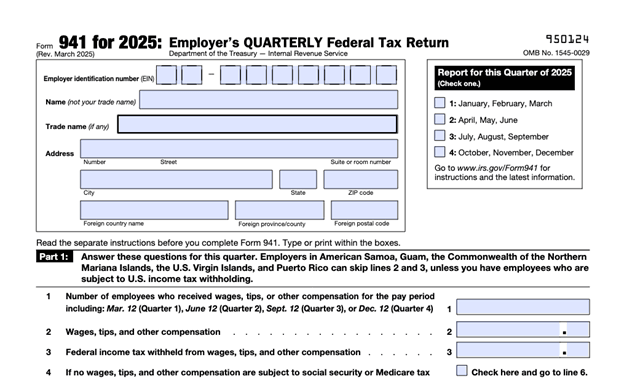
Form 941 reports income taxes, Social Security and Medicare taxes withheld from employee paychecks. Source: IRS
Form 941, the Employer’s Quarterly Federal Tax Return, reports the number of employees you have, their wages and taxable tips, and the federal income taxes you withheld. Social Security and Medicare taxes, sick pay, and any quarterly adjustments are also documented on this form.
Most employers must file Form 941 unless they have already submitted a final return, are a seasonal employer, or only employ farm or household workers.
Form 941 is filed quarterly. For employers filing in 2026, the deadlines are:
April 30, 2026
July 31, 2026
October 31, 2026
February 1, 2027 (January 31 falls on a Sunday)
2. Form 944
Very small businesses sometimes use Form 944, the Employer’s Annual Federal Tax Return, instead of Form 941. This form is designed for employers with $1,000 or less in total annual liability for Social Security, Medicare and federal income taxes.
To file Form 944, you must receive written notification from the IRS authorizing you to use it. Employers can’t choose this form on their own.
Unlike Form 941, which is filed quarterly, Form 944 is filed once per year, which can simplify payroll tax reporting for eligible businesses.
Due date: January 31
3. Form 940
Form 940, the Employer’s Annual Federal Unemployment Tax Return, is used to report federal unemployment taxes under the Federal Unemployment Tax Act (FUTA). These taxes help fund unemployment benefits for workers who have lost their jobs.
Your business generally must pay FUTA taxes if you paid $1,500 or more in wages in any calendar quarter during the current or previous year. While FUTA taxes may be paid quarterly, the tax is reported once per year on Form 940.
Note: Employers in credit reduction jurisdictions may pay higher FUTA tax if their state has outstanding federal unemployment insurance loans. Check the IRS website each year to see whether your state is affected.
Due date: January 31
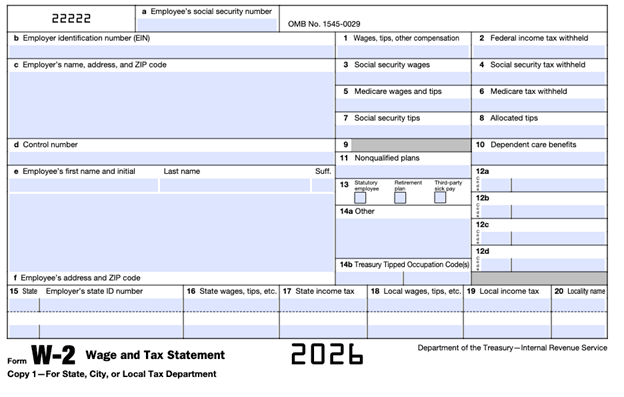
Employers must provide Form W-2 to employees and file it with the Social Security Administration annually. Source: IRS
Form W-2, the Wage and Tax Statement, is one of the most widely used payroll tax forms. Employers must provide a W-2 to each employee at the end of the year. It reports an employee’s annual compensation and federal, state and other payroll tax withholdings.
Employers do not issue W-2s to independent contractors. Instead, contractors receive Form 1099, which is covered below.
“Most of us are familiar with the classic W-2, which is used for every employee in the U.S. The Wage and Tax Statement form shows the employee’s pay and how much was withheld for federal and state taxes and contributions to Social Security, Medicare and FICA,” said Reynolds.
According to the Social Security Administration, the Social Security wage base was $176,100 for the 2025 tax year and increased to $184,500 for 2026.
Important: As of tax year 2024, businesses filing 10 or more information returns in aggregate must file them electronically. This threshold applies across all information return types.
Due date: January 31
5. Form W-3
Form W-3, the Transmittal of Wage and Tax Statements, is a summary form that accompanies your W-2 filings. It consolidates the information from all W-2s you issue. For example, a single W-3 can summarize data from multiple employee W-2 forms.
The W-3 reports total earnings, Social Security and Medicare wages, federal income wages, and the total taxes withheld. Employers do not provide W-3 forms to employees. Instead, the W-3 is submitted to the Social Security Administration along with copies of all W-2s.
Due date: January 31
6. Form 1095-B
Form 1095-B is used by employers or insurers that provide health coverage meeting the Affordable Care Act’s definition of minimum essential coverage. The form reports the type of health insurance provided, whether dependents are covered, and the months of coverage during the prior year.
Employees may use Form 1095-B for their records and to verify that they had qualifying health coverage during the year. If your business has at least 50 full-time employees and is considered an “applicable large employer” under the ACA, you would generally file Form 1095-C instead.
Due date: January 31
7. Form 1094-B
Form 1094-B, the Transmittal of Health Coverage Information Returns, is a summary form that accompanies Form 1095-B. It reports the total number of 1095-B forms you’re submitting and provides the IRS with your business contact information in case questions arise.
Employers do not provide Form 1094-B to employees. Instead, it is submitted to the IRS along with the associated 1095-B forms. Businesses classified as “applicable large employers” under the Affordable Care Act generally file Form 1094-C instead.
Due date: February 28 (paper); March 31 (electronic)
8. Form I-9
Form I-9 is used to verify an employee’s identity and authorization to work in the United States. Employers must include the form as part of the onboarding process for all new hires, including U.S. citizens and noncitizens.
Employees complete their portion of Form I-9 by attesting to their work authorization and presenting acceptable documentation, such as a passport or a combination of identity and work authorization documents. Employers must review the documents to confirm they reasonably appear genuine and relate to the employee. The completed form must be kept on file in case of a government inspection or an audit by Immigration and Customs Enforcement (ICE).
According to U.S. Citizenship and Immigration Services (USCIS), employees must complete Section 1 of Form I-9 no later than their first day of work for pay, and employers must complete Section 2 within three business days of the employee’s start date. For example, if an employee begins work on a Tuesday, Section 2 must be completed by Friday.
Note:USCIS periodically updates Form I-9. Employers should always use the most current edition available (currently the January 20, 2025 version); completing I-9s on expired versions can lead to compliance issues.
Due date: Section 1 by the employee’s first day of work; Section 2 within three business days of the hire date
9. Form W-9
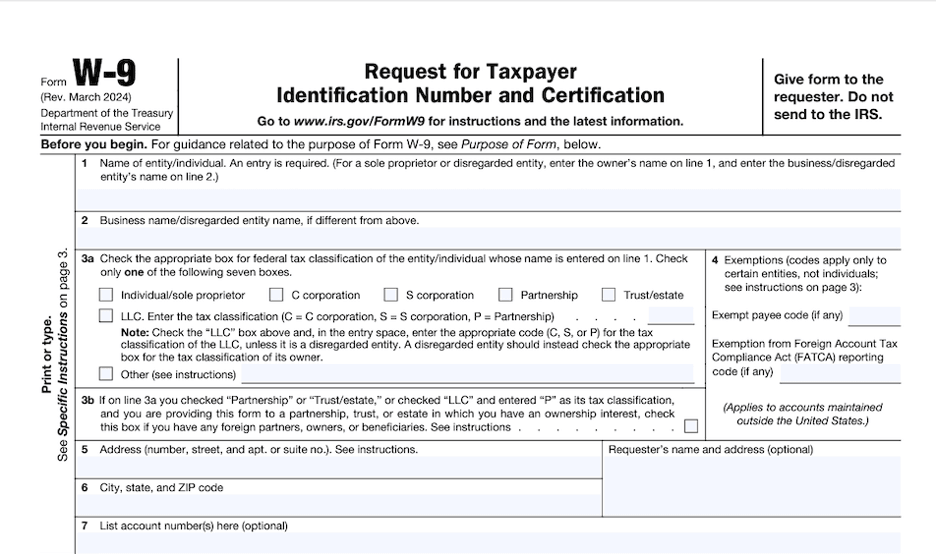
Employers use Form W-9 to request tax numbers from contractors. Source: IRS
Form W-9 is used to collect tax information from independent contractors and other payees. Businesses request this form to obtain the contractor’s legal name, address and taxpayer identification number.
If a business pays an independent contractor $600 or more during a tax year, those payments are generally reported to the IRS on Form 1099-NEC (see below). Form W-9 itself is not filed with the IRS. Instead, it is kept on file by the business for reporting and backup withholding purposes.
Because Form W-9 is not submitted, it does not have a formal filing deadline. However, businesses should request a completed W-9 before issuing payment to a contractor.
Due date: Before payment is made to the contractor
10. Form 1099-MISC
Form 1099-MISC is used to report certain types of miscellaneous income paid to individuals or businesses, such as rent, royalties, prizes and awards, attorney fees, and certain healthcare payments.
Form 1099-MISC is not used to report payments to independent contractors or freelancers. Compensation for nonemployee services is reported separately on Form 1099-NEC.
Due date: January 31 to the recipient; February 28 (paper); March 31 (electronic)
11. Form 1099-NEC
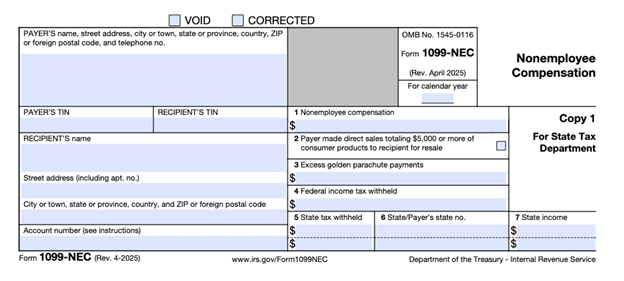
Use Form 1099-NEC to report payments to independent contractors. Source: IRS
Form 1099-NEC is used to report $600 or more paid to a self-employed individual, freelancer or independent contractor for services provided to your business. This includes fees, commissions, prizes and awards, and other compensation for nonemployee services.
Form 1099-NEC was reintroduced for the 2020 tax year to separate nonemployee compensation from Form 1099-MISC.
Due date: January 31
Did You Know?
Form 1099-MISC and Form 1099-NEC are not interchangeable. Nonemployee compensation belongs on Form 1099-NEC, while Form 1099-MISC is used for specific non-service payments.
12. Form W-4
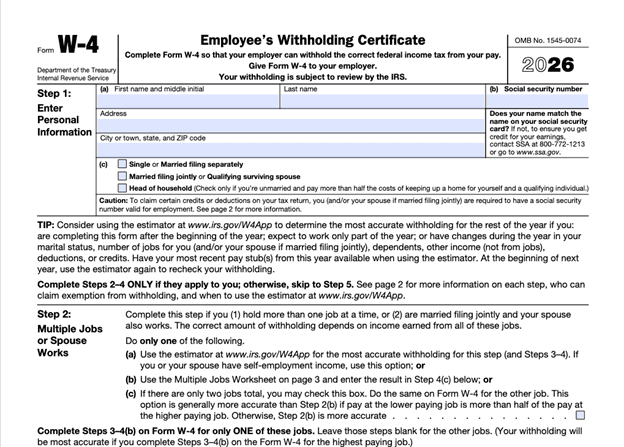
New hires must complete Form W-4 to determine tax withholding. Source: IRS
Form W-4, the Employee’s Withholding Certificate, must be provided to all new hires. Employees should complete the form on or before their first day of work. Form W-4 gives employers the information needed to calculate federal income tax withholding and helps ensure payroll is processed accurately.
Employers keep Form W-4 on file and use it when preparing employees’ W-2 forms. The form is not sent to the IRS.
Due date: On or before an employee’s first day of work; February 15 for employees claiming exempt status
Bottom Line
The IRS does not require existing employees to submit a new Form W-4 each year. However, employees who claim exempt status must submit a new W-4 by February 15 to continue that exemption. Employees can submit a new W-4 at any time if they want to adjust their federal withholding.
13. Form 8027
Form 8027, the Employer’s Annual Information Return of Tip Income and Allocated Tips, applies to certain food and beverage establishments where tipping is customary. It is required for businesses that employ more than 10 employees on a typical business day and operate in industries such as restaurants and bars.
The form reports total tip income received by employees and compares it to gross receipts. If reported tips fall below IRS thresholds for the size and type of business, employers may be required to allocate additional tips to employees. Form 8027 is used to calculate and report those allocated amounts.
Due date: February 28 (paper); March 31 (electronic)
Tips to avoid common payroll mistakes
There’s no shame in asking for help. If you’re unsure how to set up payroll or want to avoid navigating payroll regulations on your own, consider using a payroll service or hiring an accountant. Paying for expert help upfront is often less expensive than fixing filing errors or dealing with penalties later.
Here are some practical ways to reduce common payroll mistakes:
Pay attention to tax payment and filing deadlines. Depending on your business and deposit schedule, payroll taxes may be due monthly, quarterly or annually. Missing a payment or filing deadline can trigger penalties and interest, even if the underlying tax amount is correct.
Calculate overtime accurately. Overtime rules can differ between federal and state jurisdictions. In most cases, the law that provides the greater benefit to the employee applies. Review your state’s wage and hour rules regularly to ensure compliance, especially if you operate in more than one state.
Classify workers correctly. Misclassifying employees as independent contractors, or the reverse, can lead to incorrect tax filings and back taxes.
Formalize your payroll processing schedule. Rushing payroll increases the risk of data entry mistakes. Set aside dedicated time to review hours, wages and deductions before processing payroll and issuing payments. A consistent review process helps prevent underpayments or overpayments and reduces the need for retroactive corrections.
Invest in your payroll process. It can be tempting to cut corners on payroll, especially for newer businesses watching their budgets. However, payroll mistakes can become costly quickly. “Legal and financial consequences to your employees, your business and its reputation as an employer are too dire to take risks by incorrectly filing payroll forms,” Reynolds cautioned.
Tip
Common payroll discrepancies often come down to small oversights, such as adding employees incorrectly, misplacing payroll records or miscalculating paid time off. Catching these early can prevent larger compliance problems later.
Payroll form FAQs
A payroll direct deposit authorization form gives an employer permission to deposit wages directly into an employee's bank account. Employers typically ask for a voided check or official bank documentation so they can verify the employee's routing and account numbers.
Once the employee signs and returns the form, wages can be deposited electronically. Most direct deposits are processed through the Automated Clearing House (ACH) network.
Direct deposit is generally more secure than issuing paper checks and eliminates the need for employees to visit a bank or wait for a check in the mail.
Businesses working on certain federal or federally funded construction projects are often required to submit certified payroll records, typically using Form WH-347.
This certification confirms that workers have been paid in accordance with the prevailing wage requirements of the Davis-Bacon Act. A certified payroll report generally includes each employee's name, job classification, hours worked, wages paid and any fringe benefits provided.
Compliance is critical. Certified payroll reports must follow specific formatting rules and are usually submitted weekly, though exact requirements can vary depending on the contract and state or local agency overseeing the project.
Adding an employee to payroll requires a few administrative steps upfront. Setting up a clear payroll process and understanding your federal and state requirements will make onboarding smoother.
Obtain an employer identification number (EIN). If you don't already have one, apply for an EIN from the IRS by submitting Form SS-4. You may also need state and local tax registration numbers, depending on where you operate.
Collect required employment forms. New hires must complete Form I-9 to verify work eligibility and Form W-4 so you can withhold federal income tax correctly. You may also need state withholding forms and new hire reporting, depending on your state.
Set up pay details. Establish pay periods, determine compensation terms and confirm policies for overtime, holidays and paid leave before issuing the first paycheck.
Enter the employee into your payroll system. Once you've collected the required forms, add the employee to your payroll software or provide the information to your payroll provider. Review their pay rate, tax settings and deposit information carefully before processing payroll. Always deposit and report payroll taxes on time to avoid penalties.
Payroll status change forms and payroll deduction forms serve different purposes, and both are common in employee recordkeeping.
Payroll status change form: When an employee's role or employment status changes, the update should be documented. A status change form records adjustments such as promotions, pay rate changes, reclassification from part-time to full-time employee, department transfers or job title changes. Keeping this documentation in the employee's personnel file creates a clear employment record and helps ensure payroll reflects the correct compensation.
Payroll deduction form: A payroll deduction form authorizes and documents amounts withheld from an employee's wages. Some deductions, such as federal, state and local taxes, are required by law. Others — including 401(k) retirement plan contributions, health insurance premiums or union dues — are voluntary and require employee authorization. Court-ordered wage garnishments, such as child support, must also be processed through payroll. These forms provide the information your payroll system or provider needs to withhold the correct amounts.
Anna Baluch contributed to this article. Source interviews were conducted for a previous version of this article.
Simone Johnson dedicates her time to educating small business owners on the best practices for both daily operations and long-term sustainability. With a longstanding passion for finance, she often guides entrepreneurs on financial matters.
At business.com, Johnson covers finance topics like business loans and grants, cash flow strategies, credit card processing and payroll forms.
Johnson has also profiled entrepreneurs and assisted companies with customer targeting and brand refinement. Recently, she has focused on workforce management, providing advice on helping employees set company-aligned goals, the pros and cons of employee monitoring, and more. Armed with a bachelor's degree in communications and a master's in journalism, Johnson brings a unique blend of expertise and insight to her advisory work.