Business.com aims to help business owners make informed decisions to support and grow their companies. We research and recommend products and services suitable for various business types, investing thousands of hours each year in this process.
As a business, we need to generate revenue to sustain our content. We have financial relationships with some companies we cover, earning commissions when readers purchase from our partners or share information about their needs. These relationships do not dictate our advice and recommendations. Our editorial team independently evaluates and recommends products and services based on their research and expertise. Learn more about our process and partners here.
Not Just a Game: Legal Considerations for Social Media Contests and Sweepstakes
Contests and sweepstakes can boost engagement, generate leads and create buzz for your brand, but doing it right matters.
Business.com earns commissions from some listed providers. Editorial Guidelines.
Table of Contents
People love contests for a simple reason: they’re fun, and there’s a chance to win something valuable. That’s why so many businesses use social media marketing campaigns like contests, sweepstakes and giveaways to attract new audiences and keep existing customers engaged.
But before you launch your next promotion, it’s important to understand the legal rules that come with it. A contest that looks harmless on the surface can create compliance headaches if the official rules, entry requirements or prize disclosures don’t hold up.
We’ll explain the laws surrounding social media contests and sweepstakes and share practical tips for running promotions that generate excitement, leads and positive attention for your brand.
What is a giveaway, sweepstakes or contest?
Before adding giveaways, contests or sweepstakes to your social media marketing plan, it helps to understand how these promotions are classified legally. First, though, it’s important to understand what a lottery is, because lotteries sit at the center of most giveaway laws.
Lotteries: Lotteries are defined by three elements: a prize, consideration (payment or something of value) and chance. A classic example is buying a ticket in hopes of winning millions in a state-run lottery. Because lotteries include all three elements, they’re heavily regulated forms of gambling generally reserved for state governments. That means private businesses can’t run an actual lottery as a social media promotion. If a business promotion includes all three lottery elements, it may start looking a lot more like an illegal lottery. To stay on the right side of the law, businesses usually structure promotions to remove at least one of those elements.
Now, here’s how the most common promotional games differ:
Giveaways: “Giveaway” isn’t usually a separate legal category. It’s a marketing term businesses often use to describe a promotion that’s legally structured as either a sweepstakes (randomly selected winners) or, less commonly, a skill-based contest.
Sweepstakes: Like lotteries, sweepstakes give people the chance to win a prize, and winners are chosen at random. The big difference is that participants must have a free way to enter. That no-purchase option helps separate a legitimate sweepstakes from something that starts looking a lot more like an illegal lottery.
Contests: Unlike sweepstakes ― games of chance ― a contest awards prizes based on skill or merit, such as art contests, cookoffs or trivia contests. Because the element of chance is eliminated, companies can require consideration for entry into a contest (although some state laws prohibit this). However, even though entry requirements are somewhat relaxed when prizes are earned, not awarded, contests must also be administered within the confines of the law.
The key legal distinction is that removing one of the three lottery elements — payment, chance or prize — may help a promotion avoid being classified as an illegal lottery. Businesses must still comply with applicable state laws, platform rules and disclosure requirements.
Social media contests and sweepstakes can create buzz around your brand, support a product launch, generate leads and drive sales. But before you launch one, business owners and marketing teams need to understand the legal rules that come with it.
Every legitimate sweepstakes or contest should include these core legal safeguards:
No purchase necessary: Sweepstakes generally must offer a free way to enter. If participants are required to make a purchase or provide other consideration to enter a game of chance, the promotion may start looking a lot more like an illegal lottery.
Clear eligibility criteria: Spell out exactly who can — and can’t — participate, including age requirements, geographic restrictions and whether employees or family members are excluded.
Defined timelines: Participants should know when entries open, when they close, how winners will be selected and when prizes are expected to go out.
Complete terms disclosure: Every contest or sweepstakes should come with clear official rules, accessible fine print and easy-to-find terms and conditions. That usually means spelling out basics like “no purchase necessary,” who qualifies to enter, when winners will be notified, what the prize actually includes and any restrictions participants should know about.
Mark Voronov, co-founder and CEO of SocialPlug, emphasized just how costly missing details can be.
“The absolute worst thing a company could do is assume there is no need for the fine print,” Voronov cautioned. “You may be shocked at the number of campaigns that are suspended due to not completely laying out and spelling out guidelines for eligibility, along with any prize tax details that might need to be included.”
In some states — including New York — businesses may also need to issue tax documents, such as a Form 1099-MISC, when prize values cross certain reporting thresholds. (More on state-specific obligations below.)
Did You Know?
Social media giveaways are getting more FTC attention, especially when social media influencers or brand partners are involved. If your promotion runs on platforms like Instagram, TikTok or YouTube, sponsorship disclosures should be clear, easy to spot and never buried in hashtags, captions or comment threads.
Alternative methods of entry (AMOE) explained
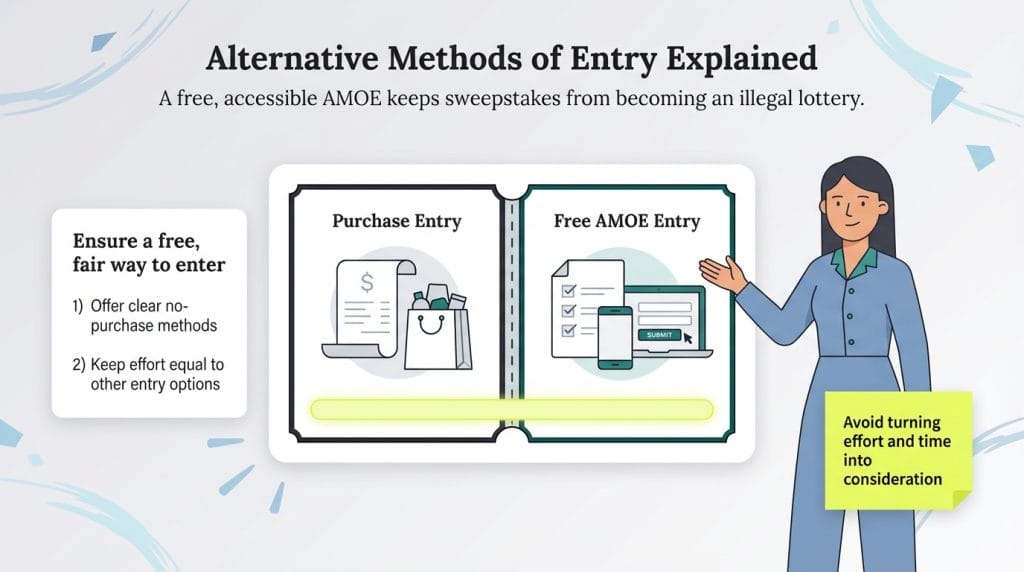
A free alternative method of entry (AMOE) is one of the most common ways businesses structure sweepstakes to avoid accidentally creating an illegal lottery. Many brands want to reward existing customers by offering entries with a purchase. But once money changes hands, the promotion may introduce consideration — one of the three elements regulators look for when determining whether a game crosses into lottery territory.
To help avoid that issue, businesses often offer a free way to enter with no purchase necessary.
An AMOE doesn’t automatically make a promotion compliant, but under many state sweepstakes laws, it can help remove the payment element that separates a legal sweepstakes from an illegal lottery.
Think about a major fast-food chain that hands out game pieces with every purchase. That kind of promotion may involve consideration, since customers are spending money to participate. To avoid crossing the line, many brands also offer a free mail-in or online entry option so people can enter without buying anything.
Common AMOE examples include:
Mail-in entries with handwritten information
Online form submissions without a purchase
Phone-in entries during specified hours
In-store visits to complete entry forms
The AMOE should be reasonably accessible and not significantly more burdensome than the primary entry method. In other words, a free entry option shouldn’t require extra hoops, excessive paperwork or substantially more time than paid participants face. In some cases, time and effort can be treated as a form of consideration, too.
State-specific sweepstakes rules you can’t ignore
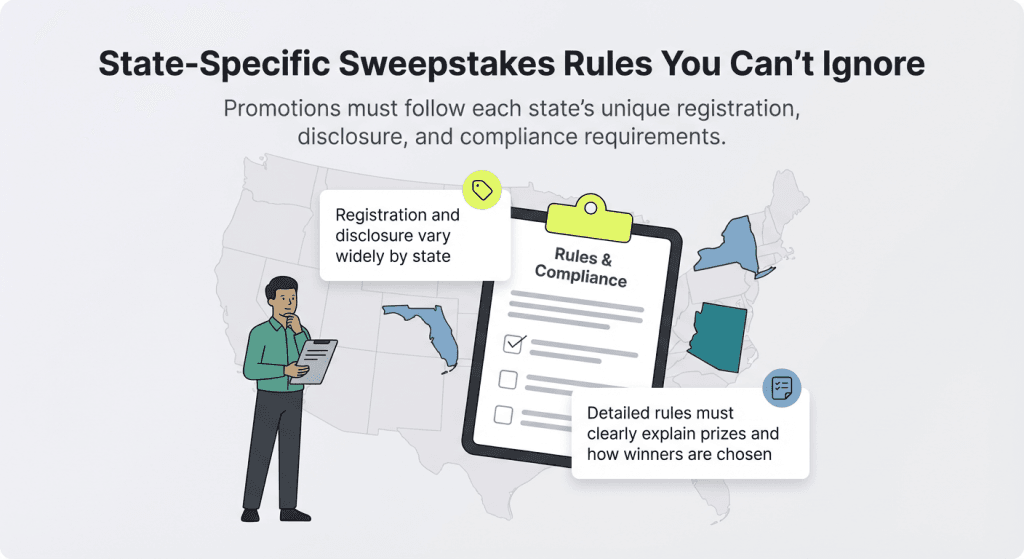
State law is where a lot of businesses get tripped up. You may feel like your contest or sweepstakes checks all the right boxes, only to find that another state has its own filing requirements, disclosure rules or prize restrictions.
For example, Florida, New York and Rhode Island require certain sweepstakes offering prizes above specific thresholds to be registered before launch. And Arizona has its own wrinkle for certain purchase-based skill contests. Businesses may need to register the promotion with the attorney general’s office and submit a sworn statement confirming that no extra fee was added to the product’s established purchase price because of the contest.
Key state requirements may include:
Registration and bonding requirements for high-value prizes
State-specific disclosure language
Filing fees and administrative paperwork
Ongoing compliance, recordkeeping and reporting
Your official rules should also clearly explain prize details, entry methods, eligibility requirements and how winners will be selected. These are only a few examples of what states may require, so always review the laws in every state where your promotion will be available before launch.
Tip
If your promotion includes high-value prizes, paid entries or participants across multiple states, it may be worth having a business lawyer review your official rules before launch.
Creating legally compliant rules for your giveaway
When it comes to contests and sweepstakes, clear rules aren’t optional. Before your promotion goes live, participants should be able to quickly understand a few basics, including:
What’s actually being awarded
When entries open and when they close
How winners will be chosen
When prizes are expected to go out
How winners will be contacted
What the prize-delivery process looks like
Those details should be finalized before launch and stay easy to find for as long as the promotion is running.
And that’s just the starting point. Your official rules should also cover things like:
Liability limitations and indemnification clauses
Tax responsibility disclosures
Whether prize substitutions are allowed
Situations that could lead to disqualification
How participant data will be collected, stored and used
Failing to spell out those details can backfire fast — as one Florida Hooters location learned the hard way. In an effort to boost beer sales, the restaurant ran a contest for its servers and promised the winner a new “Toyota.” On prize day, the employee was blindfolded, escorted to the parking lot and presented with a “toy Yoda” instead.
As you might expect, the employee wasn’t amused. She challenged the promotion, alleging breach of contract and misrepresentation. The dispute eventually ended in a settlement, and Hooters agreed to buy the former employee a new Toyota.
While extreme, it’s a memorable reminder that vague prize language, misleading marketing and incomplete rules can create very real legal exposure.
“Just avoid deception in any form,” Voronov cautioned. “Don’t claim [a] $5,000 gift card as money that will change someone’s life unless that truly is what you are trying to claim.”
Did You Know?
Some of the most popular giveaway items (e.g., branded food, stress balls, lip balm and reusable water bottles) may seem low-risk, but businesses should still disclose product limitations, shipping restrictions or age requirements if prizes can't be delivered to every eligible winner.
Common mistakes to avoid in sweepstakes compliance
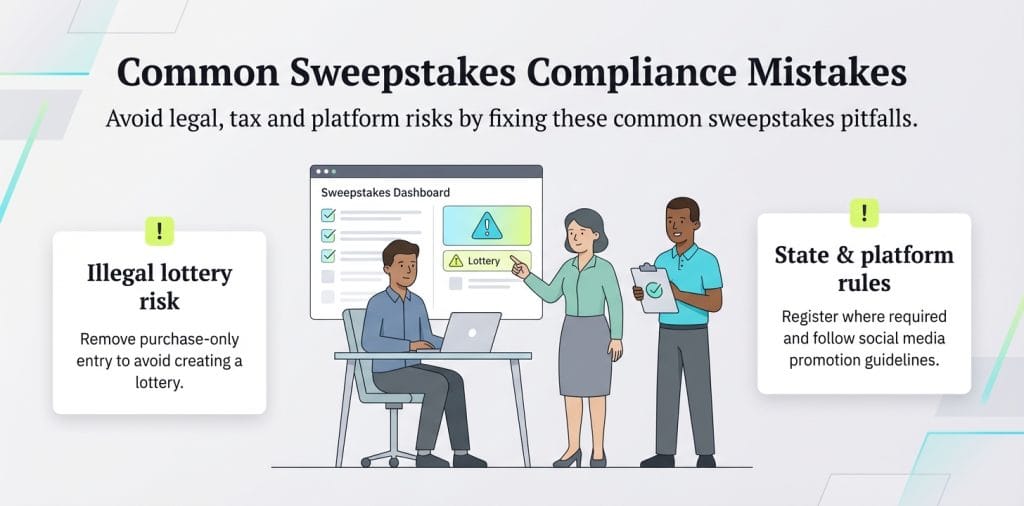
Watch out for these compliance pitfalls — they can trigger legal disputes, fines or even force your promotion to shut down mid-campaign.
Creating illegal lotteries
One of the fastest ways to create compliance problems is accidentally structuring your promotion like an illegal lottery. In the United States, lotteries are heavily regulated forms of gambling generally reserved for state governments, not private businesses.
To stay on the right side of the law, businesses typically need to remove one of the three lottery elements: prize, consideration or chance. A lawful sweepstakes, for example, may offer participants the chance to win a prize, but it generally can’t require a purchase or other consideration to enter.
Omitting AMOE requirements
Many businesses make the mistake of requiring a purchase for every entry method without offering a free alternative way to enter. That can quickly make a sweepstakes look a lot more like an illegal lottery, especially when chance and prizes are already part of the promotion.
Even when an AMOE is technically included, businesses can still run into trouble if the free option is harder to find, takes significantly more effort or creates extra hoops for participants.
To hold up under state sweepstakes laws, the AMOE should be reasonably accessible, clearly disclosed and comparable to the primary entry method.
Ignoring state registration requirements
States like Florida, New York and Rhode Island have registration, bonding and disclosure requirements for certain sweepstakes offering prizes above specific thresholds.
Miss those filing requirements, and a promotion that looked harmless on paper can suddenly create regulatory headaches, financial penalties or unwanted attention from state regulators.
Some businesses assume they only need to follow the rules where their company is based. In reality, they may need to meet the requirements of every state where eligible participants can enter — a detail that gets expensive fast when it’s overlooked.
Platform rule violations
Following federal and state sweepstakes laws is only part of the job. Social media platforms have their own promotion policies, and ignoring them can get an otherwise compliant contest flagged, suspended or removed.
Most major platforms — including Facebook, TikTok and X — require businesses to clearly state that the platform does not sponsor, endorse or administer the promotion.
Specific platforms have their own rules as well. For example:
Facebook requires promotions to run through business Pages, Groups or Events (not personal profiles) and prohibits “share to enter,” mandatory reposts or friend-tagging requirements as a condition of entry.
X requires contests to discourage participants from creating multiple accounts or repeatedly posting duplicate entries.
TikTok requires giveaway videos to clearly disclose prize details, eligibility requirements, entry instructions, winner selection methods and end dates directly within the video, not just in the caption.
A business that ignores those rules — or simply fails to keep up with policy updates — could find its promotion removed or, in some cases, its social media account restricted.
FYI
If you use your Instagram business account to run social media contests, review the platform's promotion guidelines before launch. A giveaway that builds followers and brand awareness still needs clear rules, disclosures and prize details to stay compliant.
Inadequate prize descriptions
Vague prize language can create real legal exposure, as the infamous Hooters “toy Yoda” case made painfully clear.
When promoting a giveaway, businesses should describe prizes as specifically as possible. For physical products, that may include model names, versions, approximate retail values and any meaningful limitations, substitutions or availability restrictions.
If the prize that shows up doesn’t reasonably match what people thought they were entering to win, excitement can fade fast. What started as a fun promotion can suddenly turn into customer complaints, breach-of-contract claims or accusations of deceptive marketing.
Be especially clear about what winners will actually receive, including whether they may be responsible for taxes, shipping costs or other expenses tied to the prize.
Missing tax compliance
Tax compliance is easy to overlook until a winner claims a prize and your business suddenly needs paperwork. The Internal Revenue Service requires businesses to issue tax forms once certain prize-reporting thresholds are met, and some states may apply additional requirements or lower thresholds.
For prizes awarded in 2026 and beyond, the federal reporting threshold increased to $2,000 — up from $600 — with annual inflation adjustments beginning in 2027.
Many companies forget to collect winners’ taxpayer information upfront or fail to document prize distributions properly. That can create headaches for your finance team, trigger penalties from tax authorities or leave winners facing tax surprises they never saw coming.
Establish a clear process for collecting tax documentation, issuing required forms and communicating potential tax obligations before your contest ever goes live.
Reference table: giveaway and sweepstakes legal checklist
Use this checklist to ensure compliance before launching your promotion:
Requirement
Sweepstakes
Contest
Action required
No purchase necessary
Required
May be allowed*
Include AMOE if purchase involved
Official rules
Required
Required
Draft comprehensive terms
Eligibility criteria
Required
Required
Define age, location, employee restrictions
State registration
If prize thresholds are met
If prize thresholds are met
Check FL, NY, RI requirements
Platform compliance
Required
Required
Follow social media platform rules
Winner selection method
Random
Merit-based
Document selection process
Tax documentation
May apply
May apply
Collect tax information, issue 1099-MISC for prizes valued at $2,000+ (2026+) and remind winners that prizes may still be taxable
Liability protection
Recommended
Recommended
Include limitation and indemnification clauses
*Some states prohibit consideration even for skill-based contests
Tips for hosting social media contests and sweepstakes
Social media promotions aren’t just a passing fad; they’ve become a digital marketing trend that continues to evolve as brands look for new ways to connect with customers, generate leads and create buzz online. Consider the following best practices to make your next contest or sweepstakes more successful.
1. Determine the goal of your contest or sweepstakes.
Before launching your promotion, decide which of those outcomes matters most. Once you’re clear on the goal, build the contest around it.
Here are a few examples:
Contests designed to increase sales: If your goal is to increase sales, consider asking current customers to submit videos showing creative ways they use your product. That kind of user-generated content can act as a real-world testimonial and help prospective buyers picture themselves using your product.
Sweepstakes designed to increase brand awareness: If visibility is your priority, consider offering a prize that naturally connects to your brand and your audience’s interests. For example, a luxury travel company might offer a 10-day Mediterranean cruise with excursions included.
Did You Know?
Some businesses use social media contests to run giveaways featuring excess inventory, discontinued products or seasonal merchandise, helping recover costs while getting products into customers' hands.
2. Narrow your target audience.
The best contests don’t try to appeal to everyone. To attract the most relevant entries, start by getting clear on exactly who you want to reach — your target audience. What do your ideal customers have in common? Where do they spend time online? What kinds of offers, visuals or messaging tend to get their attention?
Your existing customer data, website analytics and social media insights can reveal patterns you might otherwise miss, from age and location to buying habits, interests and content preferences.
“Hosting a successful contest starts with understanding your audience,” Voronov said. “Design your campaign with your audience in mind. Use good graphics, clear instructions and time-limited calls to action.”
3. Choose the right social media platform.
Not every platform will make sense for your brand, and that usually becomes obvious once you start looking closely at your audience. The people entering a contest on one app may respond very differently on another, so where you launch can affect not just how many entries you get, but the kind of engagement you see.
For example, if you’re targeting established professionals, connecting through your LinkedIn business profile or Facebook page may make the most sense. If your brand targets Gen Zers or millennials, platforms like Instagram, TikTok or Snapchat may generate stronger visibility and participation.
A bigger audience doesn’t always translate into better results. In many cases, the strongest contest platform is the one your audience already uses naturally — the place where they follow brands, interact with content and don’t think twice about clicking, commenting or signing up.
4. Decide what type of promotional game you want to run.
Do you want to run a sweepstakes or a contest? Your goal will help inform your decision. Here are some characteristics of each to help you determine the best fit for your brand:
Sweepstakes: Sweepstakes tend to be more general. They often attract a wider audience because they’re free to enter and usually require very little effort from participants. Sweepstakes are well-suited for increasing brand awareness, gaining social followers and boosting web traffic.
Contests: Consider a contest if you want to engage people further down in your sales funnel, such as social media followers, prospects and current customers. A contest can help you focus on increasing engagement and sales within those groups.
You should also consider your budget and secondary goals. For example, a photo or video contest showing people using your product can increase sales while creating user-generated content for future marketing campaigns.
5. Choose your prize and game rules.
Clear rules help keep your promotion fair for all entrants while protecting your business from people trying to game the system. Your official rules should spell out how long the contest or sweepstakes will run, when entries open and close, how winners will be selected and when prizes will be awarded.
The prize itself should feel connected to your brand and valuable enough to motivate people to participate. When it comes to sweepstakes, the best prizes tend to spark conversation, generate sharing and keep your promotion visible longer, all of which can help improve your digital marketing return on investment.
6. Actively promote your game.
Even if your contest or sweepstakes lives on social media, don’t rely on one platform to do all the heavy lifting. Promote your campaign through other channels too, including email marketing campaigns, influencer partnerships, in-store signage and your company website.
“After the contest is underway, stay engaged,” Voronov said. “Monitor submissions, answer questions promptly and keep entrants on their toes with updates. Experiment with new formats, review performance metrics and tweak strategies based on what performs best.”
You can also encourage participants to spread the word by offering referral incentives, such as discounts, bonus entries or early access to future promotions. The more people who discover your game, the more opportunities your business has to build awareness, grow your audience and turn that attention into real customer interest.
Tip
To get influencers to market your game or contest, find creators who are already popular in your niche. Build a relationship first, then give them exclusive content, early access or behind-the-scenes material worth sharing.
7. Make the most of your winner announcement.
Announcing your contest or sweepstakes winner shouldn’t feel like a quiet administrative task that happens behind the scenes. Of course, you’ll need to notify the winner directly, but the announcement itself can become one of the most valuable parts of the campaign.
Share the news across your social channels. Feature it on your website. Mention it in your next email campaign. And if the promotion has local appeal or even industry buzz, it may be worth reaching out to local media or putting together a quick press release.
Whenever possible, capture photos or video of the winner receiving — or genuinely enjoying — the prize. That kind of real-world content keeps the excitement going and can extend the promotional life of your campaign long after entries have closed.
8. Analyze game KPIs and feedback.
Once your contest or sweepstakes wraps up, don’t just move on to the next campaign. Take time to look at the numbers and figure out what actually worked.
Did you hit your primary goals? Did website traffic increase? Did you gain qualified followers, generate leads or see a noticeable lift in sales? And just as importantly, did the promotion create benefits you weren’t necessarily planning for, such as stronger user-generated content or higher brand visibility?
Metrics matter, but so does participant feedback. In addition to tracking key performance indicators (KPIs) like website traffic, new followers and revenue, consider gathering feedback with questions like:
Did participants enjoy the experience?
Has their perception of your brand changed?
Did the contest feel fair and easy to enter?
What would make your next promotion even better?
Those answers can reveal patterns that numbers alone won’t show and help you build smarter, stronger promotions next time.
Sammi Caramela and Daliah Saper contributed to this article. Source interviews were conducted for a previous version of this article.
Jennifer Dublino is an experienced entrepreneur and astute marketing strategist. With over three decades of industry experience, she has been a guiding force for many businesses, offering invaluable expertise in market research, strategic planning, budget allocation, lead generation and beyond. Earlier in her career, Dublino established, nurtured and successfully sold her own marketing firm.
At business.com, Dublino covers customer retention and relationships, pricing strategies and business growth.
Dublino, who has a bachelor's degree in business administration and an MBA in marketing and finance, also served as the chief operating officer of the Scent Marketing Institute, showcasing her ability to navigate diverse sectors within the marketing landscape. Over the years, Dublino has amassed a comprehensive understanding of business operations across a wide array of areas, ranging from credit card processing to compensation management. Her insights and expertise have earned her recognition, with her contributions quoted in reputable publications such as Reuters, Adweek, AdAge and others.