Business.com aims to help business owners make informed decisions to support and grow their companies. We research and recommend products and services suitable for various business types, investing thousands of hours each year in this process.
As a business, we need to generate revenue to sustain our content. We have financial relationships with some companies we cover, earning commissions when readers purchase from our partners or share information about their needs. These relationships do not dictate our advice and recommendations. Our editorial team independently evaluates and recommends products and services based on their research and expertise. Learn more about our process and partners here.
Decision support systems may provide businesses with more accurate projections, better inventory management and stronger data analysis.


Steve Jobs trusted his instincts above almost everything else, and those instincts often paid off.
Intuition still matters in business. But for many entrepreneurs, relying on instinct alone feels riskier as data complexity grows and information plays a larger role in everyday decision-making. To reduce that uncertainty, leaders increasingly use decision support systems to test scenarios, analyze data and validate ideas before moving forward. Below, we explain how decision support software works and how it can help businesses operate more effectively.
A decision support system (DSS) is a computer-based system that collects, organizes and analyzes business information, similar to business intelligence tools. Leaders use these systems to manage operations, plan strategy and evaluate potential outcomes.
A DSS typically pulls information like sales figures, revenue forecasts and inventory levels into a centralized platform, often using relational databases. The information can come from multiple sources, including operational systems, cloud-based applications, IoT sensors, business models, documents and employee insights.
“They take the guesswork out of decision-making by turning raw data into actionable insights,” said Arias WebsterBerry, CEO of WebsterBerry Marketing. “They streamline workflows, improve accuracy and allow businesses to anticipate market shifts or customer behaviors with predictive modeling. For us, DSS has been a cornerstone in optimizing marketing campaigns and maximizing ROI.”
Decision support systems are used in many industries, including credit approval, medical diagnosis, business management and project bid evaluation in fields like engineering, agriculture and transportation. Because these systems rely heavily on analytics, strong data management and governance are critical. Poor-quality information can lead to flawed decisions, making data integrity especially important — the classic “garbage in, garbage out” principle.
Brittany Hart, founder and CEO of Communiscape, said DSS tools help businesses cut through large volumes of data and focus on the insights that matter most.
“Decision support systems are designed to help businesses make informed decisions by taking large amounts of data and analyzing trends to provide insights and make recommendations to bring the highest-value decisions to the forefront,” Hart explained.
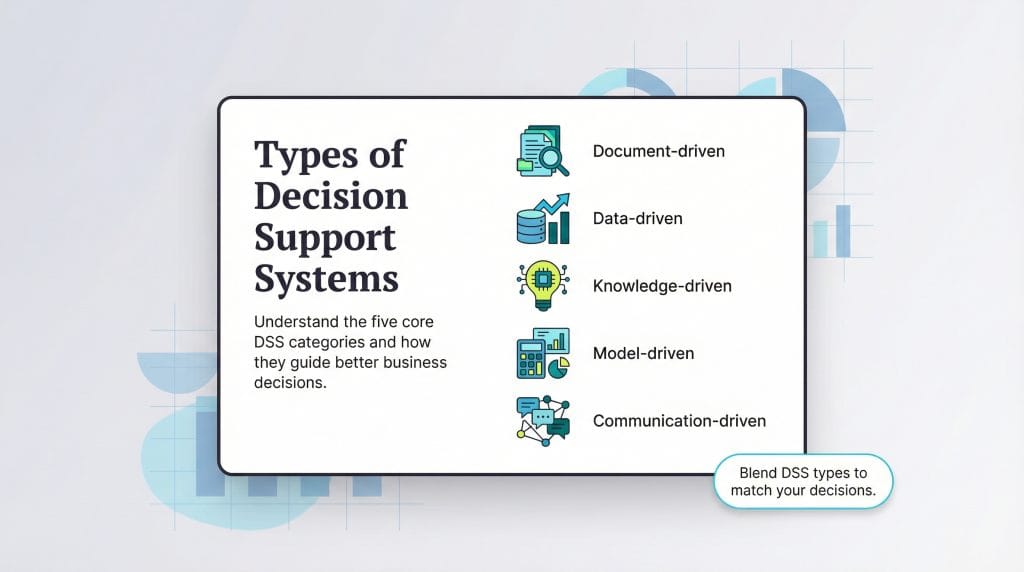
While there is a DSS application for nearly every decision-making process, most tools fall into one of five categories. Here is a breakdown of the main types and how businesses use each one.
Document-driven DSSs help users search internal and external information sources, such as company files, knowledge bases and online sources, using keywords or natural language queries. Modern systems increasingly use natural language processing (NLP) to interpret context, allowing users to ask questions in plain language instead of writing complex queries or code.
These tools analyze both structured and unstructured content, including reports, profiles, ratings, financial records and spreadsheets.
Data-driven DSSs analyze large datasets, including big data sources, to support business decisions through dashboards, reports and predictive models. They break down business questions into measurable metrics so leaders can evaluate options based on evidence instead of assumptions.
Common uses for data-driven DSSs include:
For example, a business owner evaluating a major equipment purchase could use a data-driven DSS to review revenue trends, equipment utilization rates and operational efficiency metrics. Dashboards can visualize this information and help determine whether the expected return on investment justifies the capital expense.
In practice, these systems can also highlight operational problems that are easy to miss in traditional reporting. Hardik Chawla, product manager at Uber, explained that data-driven DSS tools “excel at uncovering subtle correlations that traditional analysis might miss, such as links between supplier delivery times and production bottlenecks.” He added that combining real-time monitoring with deeper statistical analysis can improve both daily decisions and long-term process improvements.
Over time, bringing together information from finance, marketing and procurement can help businesses identify patterns across departments, including how pricing changes influence demand or how supply chain delays affect revenue.
Knowledge-driven DSSs function more like digital advisors for managers. Instead of simply presenting charts or reports, they suggest actions based on predefined rules, past outcomes and expert input. For example, banks use knowledge-driven DSS tools to automate business loan approvals, while IT teams use them to recommend troubleshooting steps.
By combining AI tools with human expertise, these systems help businesses understand how different factors influence one another and identify possible next steps.
Hart also noted that knowledge-driven systems are often used for personalization, drawing on past behavior and preferences to shape interactions. That kind of context can help businesses deliver a great customer experience, particularly in financial services, where decisions often depend heavily on client profiles and risk factors.
Model-driven DSSs help users evaluate options and understand the likely outcomes of a decision. They rely on mathematical, financial and simulation models to compare scenarios and support planning.
Model-driven DSS tools usually rely on smaller, structured datasets and are designed around targeted questions. For simpler situations, one model may be enough to support decision-making.
When combined with historical data and real-time inputs, model-driven DSSs can run “what-if” scenarios, such as testing the impact of supply chain disruptions or pricing changes, so organizations can plan ahead instead of reacting after problems arise.
Communication-driven DSSs help teams collaborate and make decisions together, especially when people are spread across locations or departments. They focus on sharing information quickly and keeping everyone aligned during the decision-making process.
Platforms that combine messaging, file sharing and live data dashboards are increasingly considered communication-driven DSSs. They allow teams to discuss options, review information in real time and make decisions without relying entirely on in-person meetings or long email threads. Internal communication apps are also a major part of this category because they give distributed teams a central place to share updates, gather feedback and discuss decisions as they happen.
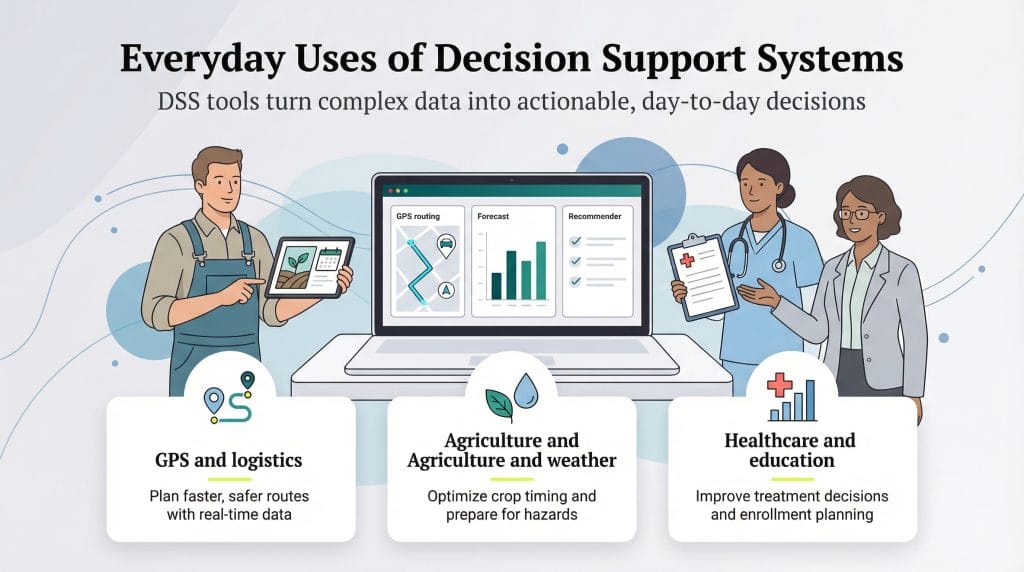
Managers use DSS tools for everything from daily operations to long-term strategic planning, and most organizations tailor them to specific business needs or workflows. Inventory planning, sales forecasting and industry-specific analysis remain among the most common applications. Below is a closer look at how businesses put these tools to work.
We use decision support systems every day, often without realizing it. Search engines, navigation apps and analytics platforms all rely on complex data models to help people make faster, better-informed choices.
Google Search is a familiar example. It analyzes massive amounts of information to surface relevant results, including images, videos, documents and web pages, so users can quickly find what they need.
GPS navigation tools are another common DSS. Many of the best GPS fleet management services, including those used in logistics and field service, analyze traffic patterns and routing data to help drivers find faster, more efficient routes and avoid congestion. (Our Verizon Connect Fleet Management review covers one example.)
DSS tools are also used across many industries, including:
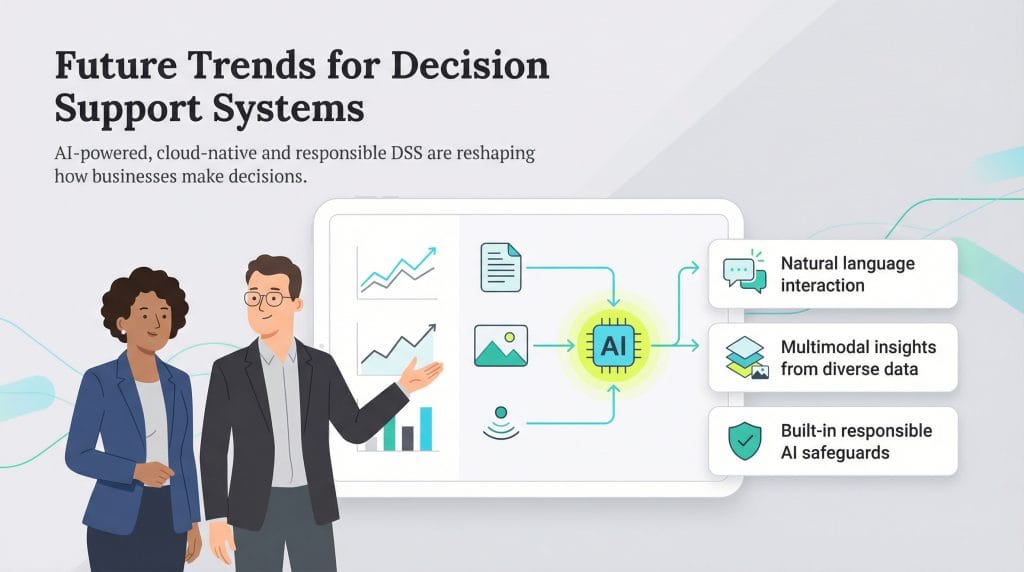
Decision support systems are evolving quickly, largely driven by advances in artificial intelligence, cloud computing and easier-to-use analytics tools. Here are a few trends shaping where DSS technology is headed.
Many newer decision support systems use AI to automate analysis and generate recommendations behind the scenes. Hart noted that some platforms include built-in models, so businesses can start using them without having to design complex systems on their own.
According to McKinsey & Company, generative AI technologies could automate tasks that currently account for 60 to 70 percent of employees’ time, potentially accelerating how quickly organizations can analyze data and make decisions.
As businesses rely on more cloud-based software, DSS platforms are increasingly designed to connect directly with other systems, such as CRMs, ERP software and analytics platforms. WebsterBerry noted that integrations and clear data visualization will become even more important as DSS tools grow more common.
“Making data actionable and easy to understand is the key to proliferation,” he said. “Cloud-based platforms that offer native integrations to DSS systems will own tomorrow.”
Chawla highlighted several emerging capabilities, including large language model (LLM) interfaces that let users interact with systems in plain language, as well as multimodal analytics that combine text, images and sensor data.
He also pointed to responsible AI frameworks built into decision models to improve transparency and governance. “We’re seeing systems that can now understand operational context, process multiple data types and provide natural language interfaces to complex analytics,” Chawla said.
Choosing a decision support system starts with understanding which business decisions you want to improve. WebsterBerry recommends defining your goals early, training employees on the system and selecting a platform that can scale as your business grows. “A well-integrated DSS isn’t just a tool — it’s more like a second set of eyes in strategic decision-making,” WebsterBerry explained.
When evaluating options, consider how well the system connects with your existing tools, such as your CRM or ERP software. You’ll also want to compare customization options, workflow automation features and overall ease of use. Good integrations can reduce manual data entry and help keep information consistent across systems.
Before implementing a DSS, map out your key decision workflows so you know exactly where the tool will deliver the most value. Identifying recurring decisions — such as pricing adjustments, inventory planning or sales forecasting — helps you prioritize the right features and avoid overbuilding a system that goes underused.
Shayna Waltower contributed to this article. Source interviews were conducted for a previous version of this article.