Business.com aims to help business owners make informed decisions to support and grow their companies. We research and recommend products and services suitable for various business types, investing thousands of hours each year in this process.
As a business, we need to generate revenue to sustain our content. We have financial relationships with some companies we cover, earning commissions when readers purchase from our partners or share information about their needs. These relationships do not dictate our advice and recommendations. Our editorial team independently evaluates and recommends products and services based on their research and expertise. Learn more about our process and partners here.
The rapid growth of food trucks is reshaping the food service industry, and technology is playing a crucial role in their success.


The food truck industry continues to grow, with the global food truck market reaching $6.4 billion in 2025 and projected to grow to $11.9 billion by 2034, according to Global Market Insights. As competition increases and customer expectations evolve, gaining an edge is more important than ever — and one of the best ways to stand out is through technology.
From mobile payment systems and digital menus to GPS-based marketing tools and food-safety software, today’s food truck operators have access to technology that can help them work smarter, serve customers faster and run more efficiently. We’ll explain which tools are worth considering and how the right tech can help your business grow.
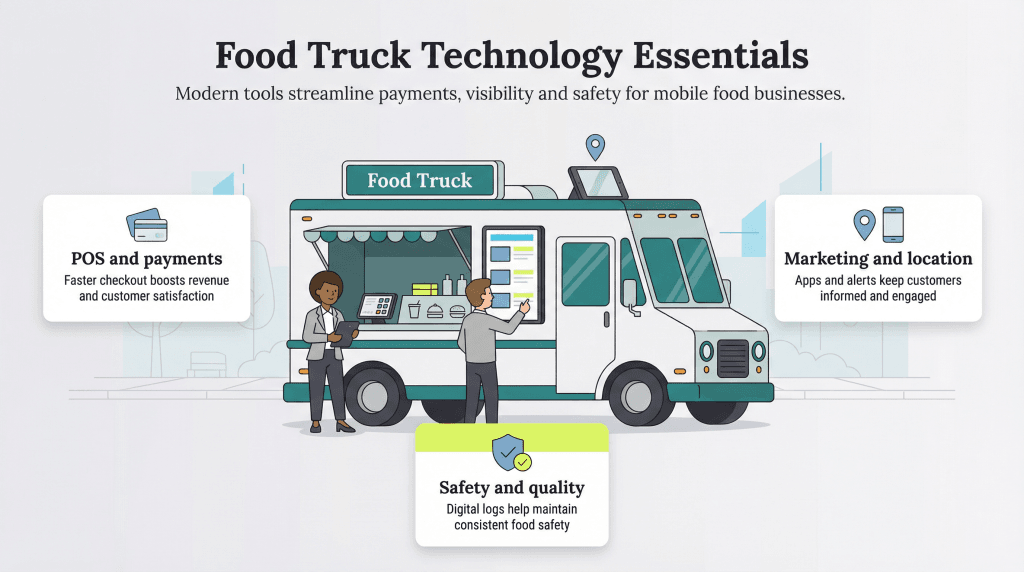
The right technology can help food truck owners move lines faster, avoid service slowdowns and keep things running smoothly when business suddenly picks up.
When you’re working in a tight space and serving a line of hungry customers, the last thing you need is bulky hardware or a register that slows you down. Modern point-of-sale (POS) systems are built for speed, mobility and flexibility, and many of today’s best POS systems are designed with restaurants, food trucks and other mobile businesses in mind.
“[POS systems] streamline and quicken the payment process, improving both the customer’s experience and the worker’s efficiency so they can move on to other customers or other tasks,” said Bryan Quoc Le, food scientist, food industry consultant and author of 150 Food Science Questions Answered. “This may improve profitability by attracting customers due to ease of process and/or shorter wait times.”
Most food truck-friendly POS platforms require minimal hardware and setup, making it easier to get up and running quickly. Many of the best restaurant POS systems can also be adapted for food truck use or offer mobile-friendly versions. Below are just a few of the options available.
TouchBistro
TouchBistro is a great fit for food trucks that need a lightweight setup without sacrificing restaurant-grade features. The platform runs on iPads over a local network, and it can continue processing orders even when your internet connection gets spotty — a big plus for festivals, street fairs and other mobile events. Its customer-facing display can also showcase menu items and photos while guests wait to order. Pricing starts at $69, with additional customization options available as your business grows. Learn more about this iPad-based POS system in our review of TouchBistro.
Lightspeed
Lightspeed works well for food trucks that want to manage sales, inventory and customer engagement from one platform. The system lets you tie menu items to ingredient tracking, so you can monitor usage as orders come in and spot low-stock items before they become a problem. Lightspeed works with its own hardware or can integrate with equipment you may already have, which can help keep startup costs in check. It also includes built-in marketing tools, allowing customers to join your email list when they choose a digital receipt — an easy way to promote specials, events or location updates. Pricing starts at $69 per month. Learn more in our review of Lightspeed.
Square
Square consistently ranks among the best credit card processors for restaurants, and it’s easy to see why food trucks and other mobile businesses gravitate toward it. With low upfront costs, flexible hardware and an easy setup process, Square makes it simple to start taking payments almost anywhere. “Square is simple, affordable and … popular among small businesses,” Le said. In fact, according to the Food Truck Profit survey cited above, Square is the most-used POS platform among food trucks.
The card reader and Square app work with iPhones, iPads and most major Android devices, and the software is easy to customize for taxes, discounts and menu changes on the fly. Square’s hardware is designed with mobility in mind, with reader options that connect through USB-C, Lightning and other common ports, depending on your setup.
Your first magstripe reader is free, and additional readers cost $10 each. Square’s basic POS software is also free, with no monthly subscription required. Instead, Square charges 2.6 percent plus 15 cents for in-person card payments. As your business grows, Square also offers hardware bundles, payroll tools, e-commerce features and marketing add-ons. Learn more in our review of Square.
Toast
Toast is a restaurant-focused POS system with flexible hardware, built-in payment processing and a wide range of add-ons that can grow with your business. Its Starter Kit starts at $0 per month and includes a cloud-based POS system, hardware with no upfront costs and support for one or two terminals — a great fit for food trucks and other mobile operators that want to keep startup costs in check.
“We use Toast, as it provides all of the tech assistance needed to facilitate the ordering process,” said Kathy Voss, a food, beverage and hospitality industry veteran with more than 20 years of experience. “Toast also offers direct marketing to our customers through email.”
Toast also offers digital ordering tools, menu management features and marketing add-ons that can help food trucks stay nimble as they grow. Learn more in our review of Toast.
Food truck customers often discover their next meal online long before they spot your truck on the street. Listing your business on major food truck apps and directories can help customers find you in real time while also opening the door to catering gigs, festivals and private events. Here are a couple of examples:
Roaming Hunger
Roaming Hunger helps food truck owners do more than share their location. The platform lets customers track your truck through its website and mobile tools while also connecting your business with companies, schools, event planners and individuals looking to book food trucks for catering.
With a network of more than 20,000 food truck partners, Roaming Hunger can help operators land everything from corporate lunches and university events to private parties, street fairs and large-scale productions. The platform also lets you showcase your menu, availability and service areas, and signing up is free.
TruckSpotting
TruckSpotting helps your customers find you long before they wander past your truck. The platform uses GPS-based tracking to show diners your location in real time through its website and mobile apps, making it easier for loyal customers and hungry first-timers to track you down.
Customers can search by city or truck name, view your menu and schedule on your truck profile, and save favorite trucks for future visits. Food truck owners can also create a profile for free, giving you another way to stay visible between lunch rushes, festivals and weekend events while supporting your broader local marketing strategy.
Great food may get customers talking, but consistent marketing is what keeps them coming back. If customers can’t easily find your menu, track your location or hear about your next stop, building a loyal following gets much harder. That’s why many food truck owners invest in websites, email marketing, text campaigns and mobile apps that keep their brand front and center. Here are some tech examples to check out:
Appy Pie
Appy Pie makes it possible to build a custom mobile app without writing code, giving food truck owners another way to stay connected with regulars between stops. You can create an app where customers can track your location, browse your menu, place orders, join loyalty programs and access special offers, all from one place.
Appy Pie supports Android and iOS app development; its paid plans start at $16 per app, per month when billed annually, with higher-tier plans offering additional features and platform support.
Textmagic
Textmagic makes it easy for food truck owners to reach customers the moment plans change. Whether you’re announcing a last-minute location change, a sold-out special or a limited-time promotion, the platform lets you send text message marketing and email marketing campaigns from one dashboard while keeping two-way customer conversations organized in a shared inbox.
Textmagic works from your computer or mobile device, supports automation workflows and helps you stay on top of carrier messaging rules as your customer list grows. Pricing is usage-based: 1,000 U.S. text messages cost $49, and the first 10,000 emails are included at no extra charge.
Mailchimp
Mailchimp is one of the most recognizable names in email marketing, and it’s easy to see why. Food truck owners can use the platform to send location updates, limited-time offers, surveys and loyalty campaigns through email and SMS from one dashboard.
Mailchimp also offers workflow automation tools, audience segmentation, AI-powered content features and 300-plus integrations, making it easier to keep regular customers engaged while attracting new ones. The platform has a free plan for smaller contact lists, along with a 14-day trial of its Standard plan for businesses that want to test more advanced features. SMS marketing is available as an add-on to paid plans.
Customers need to know where to find your truck. If you’re managing multiple vehicles, you need that same visibility behind the scenes. GPS fleet-management tools can show you where drivers are in real time, flag maintenance issues early and help you keep an eye on vehicle health before a truck is sidelined during a busy shift. Many businesses rely on the best GPS fleet-management software, including the following:
Samsara
Samsara gives food truck operators a live view of where drivers and vehicles are, which becomes especially useful when multiple trucks are heading to different stops, events or catering jobs. The platform also supports electronic logging devices, preventive maintenance alerts and over-the-air diagnostics, so small vehicle issues are less likely to turn into bigger problems down the road. Pricing depends on fleet size and the tools you want to use, so you’ll need to request a custom quote through Samsara’s website. Product demos are available. Learn more in our review of Samsara.
GPS Trackit
GPS Trackit helps food truck operators keep tabs on vehicles in real time with interactive maps, geofencing and cloud-based fleet monitoring tools. The platform also includes dashcams, analytics and theft-protection alerts that can notify you if a vehicle or piece of equipment moves unexpectedly — even after hours.
For operators managing multiple trucks, trailers or other mobile assets, that extra visibility can support a stronger fleet management strategy while helping reduce downtime and theft-related losses. Pricing is quote-based, so you’ll need to contact GPS Trackit for a custom estimate.
Azuga
Azuga works well for food truck operators who want better visibility into their fleet without a steep learning curve. Its plug-and-play hardware pairs with a centralized dashboard, giving you a clear view of your vehicles, driver activity and overall fleet operations in one place.
Azuga also offers a mobile app for both managers and drivers, along with AI-powered dashcams that can send automatic safety alerts when risky driving behavior is detected. Pricing and contract terms are quote-based, so you’ll need to contact Azuga for a custom estimate. Learn more in our review of Azuga.
Improve your truck’s presentation by using digital display screens for menus that can be mounted to the side of your truck. Here are some examples:
Sharp
Sharp offers digital menu boards designed for demanding food-service environments. The company says its displays can show menu items, promotions and point-of-sale messaging, with content updated throughout the day based on specials, inventory or seasonal offerings. Sharp also notes its professional-grade displays are built to handle challenging environments with grease, dust and temperature swings, making it a practical fit for busy food truck operations.
ScreenCloud
ScreenCloud helps food truck operators turn almost any screen into a digital menu board with plug-and-play hardware support for Amazon, Android and Chrome devices. Its cloud-based platform includes a dedicated Digital Menu Board app, customizable templates, smart scheduling and 80-plus apps and integrations for adding social feeds, videos and other dynamic content. ScreenCloud’s Core plan starts at $20 per screen per month when billed annually.
ElectroMenu
ElectroMenu builds self-contained digital menu boards for restaurants, concessions and food trucks. Its all-in-one system includes built-in authoring tools, optional internet connectivity and POS integration, so you can make menu changes without keeping a separate computer connected. ElectroMenu also offers custom templates and cloud-based management for operators with multiple screens or locations. Pricing varies based on your setup, so you’ll need to request a custom quote.
A great meal brings customers in, but food safety is what keeps them coming back. In a food truck, where refrigeration, prep space and holding equipment all operate in tight quarters, staying on top of food storage and temperature is part of the job every day.
FreshCheq is one example of a food-safety platform designed to help operators digitally log and monitor food and equipment temperatures, making it easier to spot issues before they become bigger problems. The platform also generates digital logs and compliance reports that can be shared during health inspections. Pricing starts at $60 per month or $629 annually.
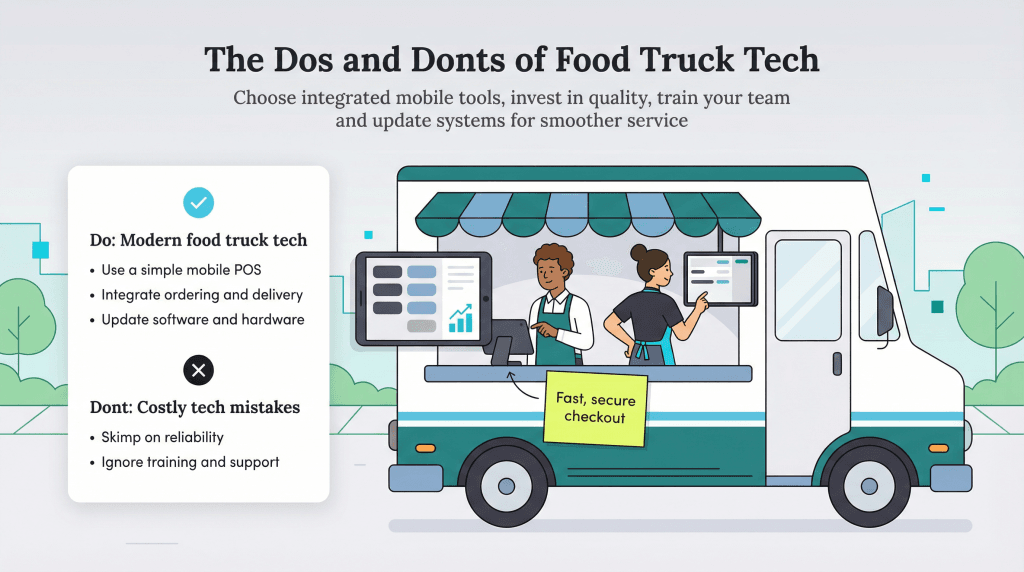
As you invest in new technology for your food truck, it pays to be strategic. The right tools can speed up service, support your staff and help your business grow. The wrong ones can drain your budget and create unnecessary headaches. Keep these best practices in mind before you buy.
Miranda Fraraccio and Andreas Rivera contributed to this article. Source interviews were conducted for a previous version of this article.