Your free business.com+ membership unlocks exclusive tech deals and advisor support
Join Free
BDC Hamburger Icon

Menu

Close
BDC Logo with Name
Search Icon
Search Icon
Advertise with us
Advertising Disclosure
Close
Advertising Disclosure

Business.com aims to help business owners make informed decisions to support and grow their companies. We research and recommend products and services suitable for various business types, investing thousands of hours each year in this process.

As a business, we need to generate revenue to sustain our content. We have financial relationships with some companies we cover, earning commissions when readers purchase from our partners or share information about their needs. These relationships do not dictate our advice and recommendations. Our editorial team independently evaluates and recommends products and services based on their research and expertise. Learn more about our process and partners here.

Outgrowing Your Office Space? Should You Lease or Buy?

Deciding whether to lease or buy office space starts with a close look at your finances, growth plans and the current commercial real estate market.

author image
Written by: Karina Fabian, Staff WriterUpdated Feb 24, 2026
Gretchen Grunburg,Senior Editor
Business.com earns commissions from some listed providers. Editorial Guidelines.
Table Of Contents Icon

Table of Contents

Open row

If you’ve noticed your office getting a bit more crowded, it’s probably time to look for a new space. And while square footage and amenities matter, the bigger decision — leasing or buying — can shape how your business allocates resources and plans for profitable growth. For companies with strong cash reserves, purchasing property may offer long-term stability. However, tying up capital in commercial real estate doesn’t always deliver the same return as reinvesting in your operations. 

Before you take this big step, it’s important to weigh the benefits and drawbacks of buying versus leasing. Here’s a look at what to consider as you compare both options. 
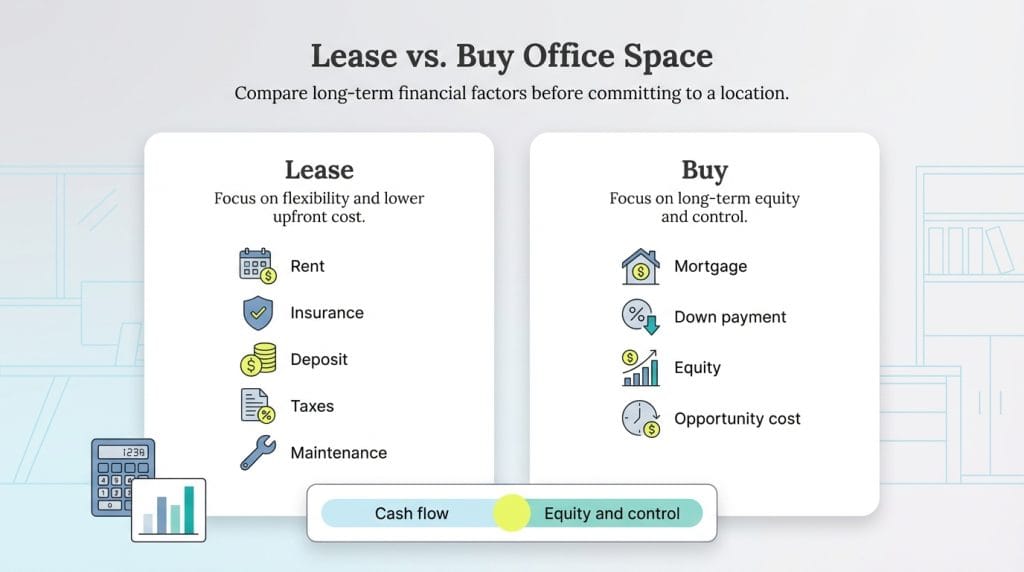
Should you lease or buy office space?

lease vs. buying office space

Before deciding whether to lease or buy, it helps to step back and ask a few practical questions about your business’s goals, finances, long-term plans and office space needs. Consider the following:

How long can you commit to a location or building?

You may hear commercial real estate professionals talk about a “seven-year rule” as a rough guideline when deciding whether it makes sense to buy: If you don’t plan to stay in one location for at least seven years, the upfront costs of buying may ultimately outweigh the benefits. This is why leasing is often the more practical choice for shorter timelines. But if you expect to establish a long-term headquarters — think a decade or more — ownership may become the more financially attractive option over time. 

How fast is your business growing?

If your business is growing quickly and you anticipate opening a new location or otherwise expanding in the next few years, leasing can offer greater flexibility. That same flexibility can help if your team shrinks or more employees work offsite, since you’re not locked into a long-term ownership commitment. 

Buying may reduce that flexibility, since you could end up locked into a layout that no longer fits your team or paying for square footage you don’t fully use, especially if more employees shift to remote work plans or hybrid arrangements.

FYIDid you know
You're not alone in rethinking office space. Pew Research Center data shows about 75 percent of workers with remote-capable jobs now spend at least some time working offsite — one reason many businesses are reassessing how much space they need.

How’s your local economy?

Local office markets can look wildly different, even when national headlines sound the same. Before you commit to a long lease or a purchase, look at what’s happening in your specific submarket: 

  • Vacancy and availability
  • Rent trends
  • Concessions (like free rent and tenant improvement allowances)
  • New construction and building conversions
  • Whether employers are actually adding jobs locally

If there’s strong demand for buildings in desirable locations in your area, buying may start to make more sense, especially if you expect to stay put for the long haul. But if vacancy is elevated and building owners are competing hard to fill space, you may find leasing offers more flexibility and access to concessions without taking on long-term value risk.

CBRE Research expects commercial real estate leasing activity to continue recovering through 2026, with investment activity projected to increase as larger occupiers return to the market — trends that may influence how aggressively landlords negotiate depending on local demand.

Did You Know?Did you know
Nationally, office vacancy has been hovering around the low-20-percent range, depending on how a report defines "vacancy." For example, Cushman & Wakefield put the U.S. office vacancy rate at 20.5 percent at the end of 2025.

What’s the rental market like in your area?

Beyond overall market conditions, take a close look at local rent levels and how quickly they’re changing. If your business is located in a large urban area like New York City, where rents are high, it may make more sense to buy, since your mortgage payments may be equivalent — or even lower than — what you would pay to lease comparable space.

Madison Sutton, a commercial and residential real estate expert, pointed out that instead of paying $10,000 or more each month for rent, business owners could be building equity while protecting themselves from future market disruptions and rent hikes. 

Sutton also has seen a trend of business owners investing in mixed-use properties. “Buyers are taking a hybrid approach — operating their businesses in the retail space while utilizing residential units for either personal use or rental income to offset costs,” she explained.
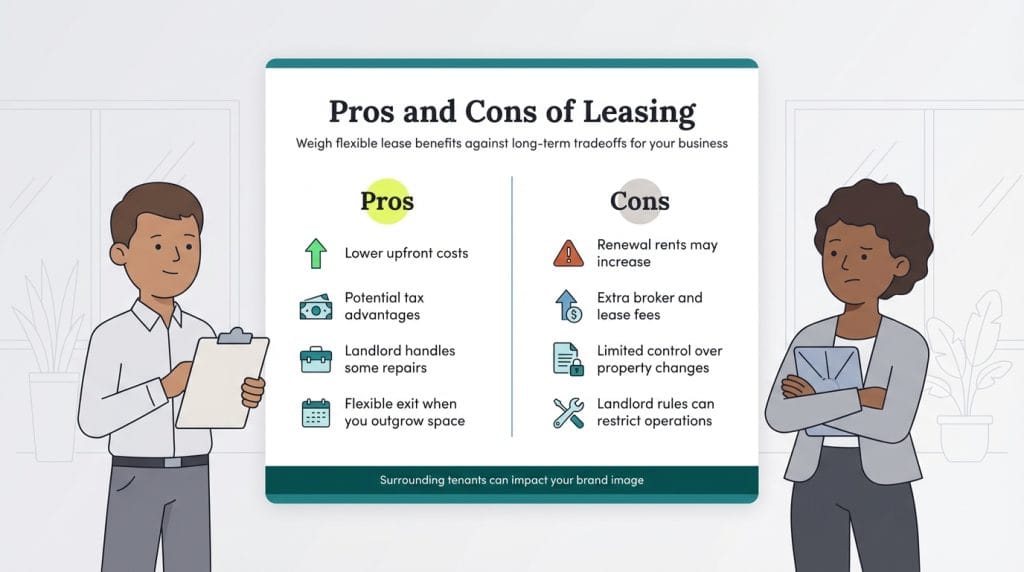
Pros and cons of leasing

pros and cons of leasing

Leasing comes with a mix of tradeoffs. Here’s a closer look at where it tends to work well and where it may fall short.

Pros

  • You have a low initial financial commitment with no down payment, just a deposit.
  • Lease payments are often tax-deductible.
  • The property owner or manager may handle repairs and maintenance.
  • In higher-vacancy markets, building owners may offer concessions such as free rent periods or tenant improvement allowances.
  • Generally, you can lease in a nicer area than if you buy.
  • The higher cash flow may help your credit rating.
  • The property owner or manager may pay for a particular utility, such as waste management or water, or for housekeeping.
  • It’s easier to leave if you outgrow the space or need a different office workflow.

“Leases allow flexibility for more types of businesses, and some companies can benefit from the prior occupants’ build-out and furnishings,” explained Kristina Chervenka, co-founder and chief operating officer of Five Buffalo Capital.

TipBottom line
Whether you rent or buy, consider the surrounding tenants. The businesses around you can shape your brand reputation — for better or worse.

Cons

  • If you use a broker, you may pay an annual broker fee or see brokerage costs reflected in lease pricing, depending on the deal structure.
  • Rent usually increases when you renew a lease.
  • You’re at the mercy of the property owner or manager for the timeliness and quality of repairs, which could be frustrating for companies like construction businesses.
  • The property owner or manager may have rules concerning the use and state of outside areas that may impact your ability to store vehicles and materials. Be sure to discuss these beforehand.
  • Even if you have a good arrangement with the property owner or manager now, that could change in the future.
Did You Know?Did you know
Tenant improvement allowances — funds a building owner may offer to help customize a space — are often negotiable, especially in tenant-friendly markets where building owners are competing to fill vacancies.

Pros and cons of buying

Owning your office space can change how your business manages growth, cash flow and day-to-day operations. Like any major investment, it comes with advantages and potential risks to weigh carefully.

Pros

  • You build equity, which you may be able to use as collateral for future financing.
  • If you have extra space, you can rent it out to generate additional revenue.
  • With a fixed-rate commercial mortgage, your principal and interest payments can remain more predictable over time, unlike rent, which may increase.
  • Interest payments are often tax-deductible.
  • You may be able to claim building depreciation.
  • You can make changes to the building (within local ordinances).
  • You control what happens on your property.
  • Because you own the property, you may eventually sell it and use the proceeds toward retirement or other business goals.

Cons

  • Commercial borrowing costs have been more volatile in recent years, which can increase the long-term cost of financing depending on when you buy and how your business loan is structured.
  • There are large initial expenditures, such as the down payment, closing fees and real estate agent fees.
  • There’s a higher opportunity cost. In other words, the money you invest in the property could be used to grow your business in other ways. You need to determine if that’s an issue.
  • You must pay for remodeling, repairs and maintenance.
  • If you outgrow the space, you may need to sell or lease out the property.

Chervenka noted that there may be additional risks. “Property tax and interest rate increases can negatively impact the company’s cash flow, and property values may lower when it is time to move the company [or sell],” she said.

FYIDid you know
Commercial buildings are often categorized as Class A, B or C. Generally, Class A refers to newer construction with modern features, Class B properties are typically older and may need updates, and Class C buildings are usually older properties that may require more significant renovations.

Financial considerations when deciding whether to lease or buy

As noted above, the longer your commitment is to a location, the more cost-effective it may be to purchase rather than lease your office space. However, before you commit, run some numbers or hire an accountant to analyze the costs over time. Here are some financial factors to compare side by side.

  • Mortgage versus rent
  • Business insurance
  • Down payment (10 to 25 percent) versus security deposit
  • Taxes (consider tax advantages with leasing as well as buying)
  • Regular maintenance (budget roughly $2 to $3 per square foot annually for basic repairs as a general planning estimate, plus reserves for major capital expenses like HVAC or roof replacement)
  • Equity (keep resale value in perspective)
  • Opportunity cost, i.e., how much that money could earn if invested back into your company. (When buying, use the down payment to calculate this cost. If there’s a difference between the monthly mortgage and the lease, compare that gap against whichever option costs more.)
  • Broker fees (annually, if leasing) versus real estate agent fee (one-time fee, if buying)
  • Lawyer fees for lease negotiations (real estate commissions typically cover this when you buy)
  • Closing costs, if buying
  • Remodeling expenses
  • Utilities (if your lease currently covers them, factor those costs in when evaluating a purchase)

There’s no single answer to whether you should purchase or lease your next property. It depends on how your business is performing, whether preserving cash flow matters more than building equity right now, and how much control you want over your space versus the convenience of someone else managing it. Taking the time to run the numbers now can help you avoid surprises later.

Jennifer Dublino contributed to this article. Source interviews were conducted for a previous version of this article. 

Did you find this content helpful?
Verified CheckThank you for your feedback!
author image
Written by: Karina Fabian, Staff Writer
Karina Fabian is a full-time writer and mother of four. By day, she writes reviews of business products and services for Top Ten Reviews and articles for Business.com, Business News Daily and Tom’s IT Pro. As a freelancer, she writes for Catholic educational sites and teaches writing skills. She has 17 published novels of science fiction and fantasy. Learn more at http://fabianspace.com.