Big business loves enterprise resource planning (ERP) solutions that help management gather data across complex and, sometimes, multinational structures. ERP software offers a single platform for managing multiple business elements, helping businesses drive quality and efficiency in client, employer, supplier and regulator interactions.
In the next decade, small and medium businesses will increasingly adopt ERP technology as costs decrease and cloud-based solutions become more accessible. We’ll explore ERP market predictions for change and growth, and explain how modern ERP solutions are evolving to meet business needs.
What is ERP software?
ERP software records and stores real-time business performance data across departments within a company. You can generate reports from that data to analyze how well departments and individuals are doing. These insights can help businesses streamline processes and help team members operate more efficiently, increase productivity, preserve quality and achieve profitable growth.
An ERP system can take the following forms:
- A collection of software as a service (SaaS) packages that communicate with one another (usually via API or custom integration)
- A bespoke ERP system built around a business’s specific needs
ERPs share a common database, operate in real time and, depending on permission levels, provide a standard user interface. Thus, you won’t have to maintain separate databases or periodically merge databases to generate reports.
ERPs constantly collect and compare departmental metrics. Based on the metrics they select, users can create accurate reports on business performance, such as how productively a team uses company resources.
Companies may use ERP reports to do any of the following:
- Set budgets and targets across the business
- Manage projects more effectively
- Measure business performance as a whole and on a granular level
What are the ERP industry trends to watch?
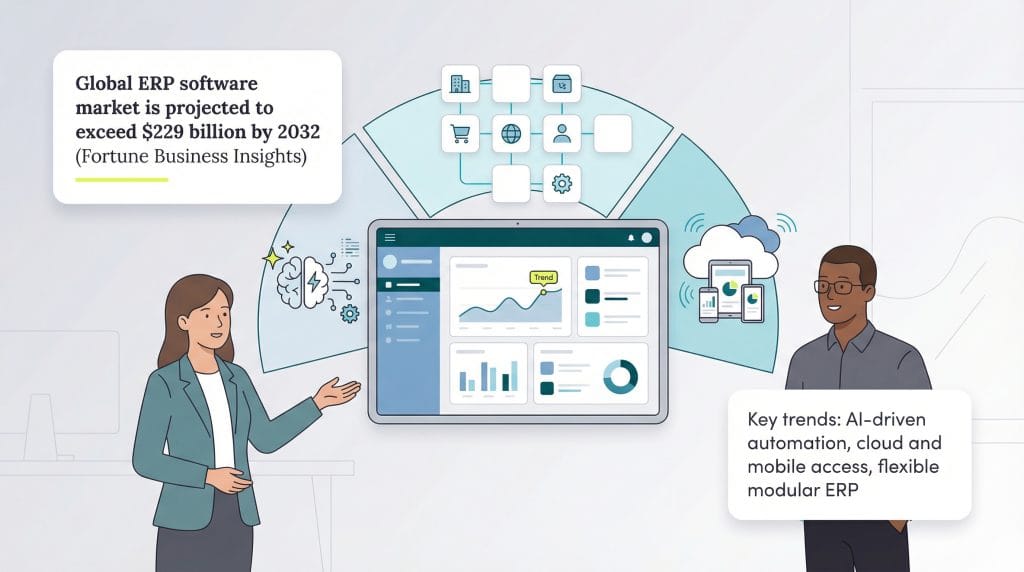
According to Fortune Business Insights, the global ERP software market size was valued at $81.15 billion in 2024 and is expected to grow to more than 229 billion by 2032, at a compound annual growth rate of 13.8 percent. As more businesses rely on ERP solutions, the sector continues to evolve with new capabilities and technologies.
Industry analysts expect to see the following six significant changes shaping the ERP landscape:
1. AI and machine learning are transforming ERP systems.
ERP vendors are rapidly integrating artificial intelligence and machine learning into their platforms. Recent developments include Microsoft’s integration of Copilot AI across its Dynamics 365 suite and Oracle’s embedding of generative AI capabilities throughout its Fusion Cloud ERP platform. These tools enable natural language queries, automated report generation and predictive analytics.
Here are three areas where AI is helping transform ERP systems:
- Real-time data processing: IoT devices can transmit real-time operational data directly to AI-powered ERP systems for instant analysis. For example, IoT devices can transmit data on uptime, performance and output quality from factory floor equipment to ERP systems to help manufacturers schedule production, set accurate staffing levels and more. [Read related article: 5 Ways Machine Learning Is Leading to Smarter Manufacturing]
- Inventory and supply chain management: AI integration into ERP is also affecting inventory and supply chain management. Thanks to the data analytics these tools provide, businesses will be much better able to reduce excess inventory and improve order turnaround times.
- Intelligent automation: Modern ERP platforms leverage AI to automate routine tasks like invoice processing, expense categorization and financial reconciliation. Natural language processing allows employees to interact with ERP systems through conversational interfaces, making complex queries as easy as asking a question in plain English.
2. Industry-specific ERPs are helping businesses customize solutions.
Industry-specific ERP systems include standard ERP features like inventory management and finance and accounting tools. However, they also incorporate specialized tools to help businesses in particular sectors.
Businesses can customize standard ERPs with third-party plug-ins to add more functionality. However, this approach requires a significant investment of time and money. In contrast, industry-specific ERPs can bring them much closer to an ideal solution. They also provide specialized plug-in stores with apps that address specific sector challenges. For example, a manufacturer-specific ERP might include apps and customizable automated workflows for shop floor scheduling, product engineering and material requirements planning (MRP).
Implementation time for industry-specific ERPs is often much quicker and less expensive than generic ERPs. Sectors with industry-specific ERPs include apparel and textiles, chemical engineering, food and beverage, mining and quarrying, professional services, and semiconductors.
Companies that invest in ERP software experience enhanced inventory control, streamlined compliance and superior supplier interactions, which help them create
great customer experiences.
3. More ERP solutions are moving to the cloud.
Traditionally, most ERP systems have been on-premises, but the shift to cloud-based ERP has accelerated significantly. Primary drivers for cloud adoption include:
- Lower total cost of ownership: Cloud ERP eliminates the need for expensive hardware infrastructure and reduces IT maintenance.
- Customizability: The cloud computing trend in ERP software brings unique benefits, including customizability. Cloud-based ERPs are much easier to customize than on-premises solutions, helping businesses better meet their operational needs.
- Ease of use: You won’t need an IT team to deploy or upgrade your cloud-based ERP. Everything is held and managed in the cloud.
- Faster implementation: Cloud ERP implementations typically take three to nine months compared to 12 to 18 months for on-premises solutions.
- Remote accessibility: More businesses today offer remote work plans or hybrid work arrangements to help attract and retain talent. Cloud-based ERPs are uniquely suited for flexible workplace arrangements, especially compared to on-premises solutions. Your team can work from anywhere with an internet connection (more on this below).
4. Mobile ERP solutions are becoming more entrenched.
In the past, mobile ERP was slow, clunky and offered minimal features. And there was no real demand to improve mobile ERP solutions when remote and hybrid working wasn’t well established.
Today’s web-based ERPs have changed all that. They’re designed to be responsive and offer extensive functionality to remote employees and team members on the road. Employees can log in from their smartphones, smartwatches and tablets and enjoy a high level of functionality on par with desktop solutions.
With a touch on their phone, tablet or watch screen, team members can use mobile ERP software to do the following and much more:
- Submit and approve budgets
- Submit time sheets for instant approval
- Check in and out of work
- Bill clients based on time
- Send receipts
- Create invoices and send them to the appropriate party
Additionally, integrations with meeting and communications tools like Slack and Zoom allow teams to collaborate on projects across different time zones.
Beyond easing remote work, mobile ERP solutions can benefit retail establishments, factories and warehouses. For example, shop floor workers, warehouse staff and field service technicians can carry mobile devices connected to ERPs and update inventory, record service activities and track production progress, ensuring all data across the business is current.
Big data is not just for big companies. Low-code and no-code platforms like Make (formerly Integromat) and Zapier let different apps talk to one another. You can gather data from each app and analyze it via ERP AI and machine learning tools.
5. Two-tier ERPs are growing in popularity.
Despite the many benefits of cloud-based ERPs, not every company is willing to let go of their on-premises solution yet. However, they may be willing to compromise by installing two-tier ERP systems:
- They’ll keep their existing on-premises ERP system at the corporate level (Tier 1).
- Divisions, departments and subsidiaries will use a cloud-based solution (Tier 2).
A two-tier ERP system may be attractive to some companies because of the cost, complexity and lead time required to roll out an ERP across a large business. Sometimes — particularly in new divisions created from merger and acquisition activity — a department’s operating procedures are sufficiently different to make the head office ERP solution inappropriate. And adapting the current solution to cope with those workflows would be an expensive and lengthy process. A two-tier solution can be an ideal compromise.
This setup’s primary challenge is ensuring a free and easy data exchange between the Tier 1 and Tier 2 systems. In response to the growing demand for this setup, many ERP platform providers have now built plug-ins that allow for smoother integration with legacy corporate ERP systems.
When considering a two-tier ERP strategy for your business, consider choosing the same vendor for smooth integration and data flows.
6. Composable ERP architectures are enabling greater flexibility.
A trend emerging is the shift toward composable ERP architectures. Rather than using monolithic systems, businesses are building modular ERP solutions with best-of-breed parts connected through APIs and integration platforms. This approach allows organizations to swap out individual modules without disrupting the entire system. This method is particularly appealing to mid-market companies that want to customize their systems, desiring something more flexible than what traditional ERP suites offer.
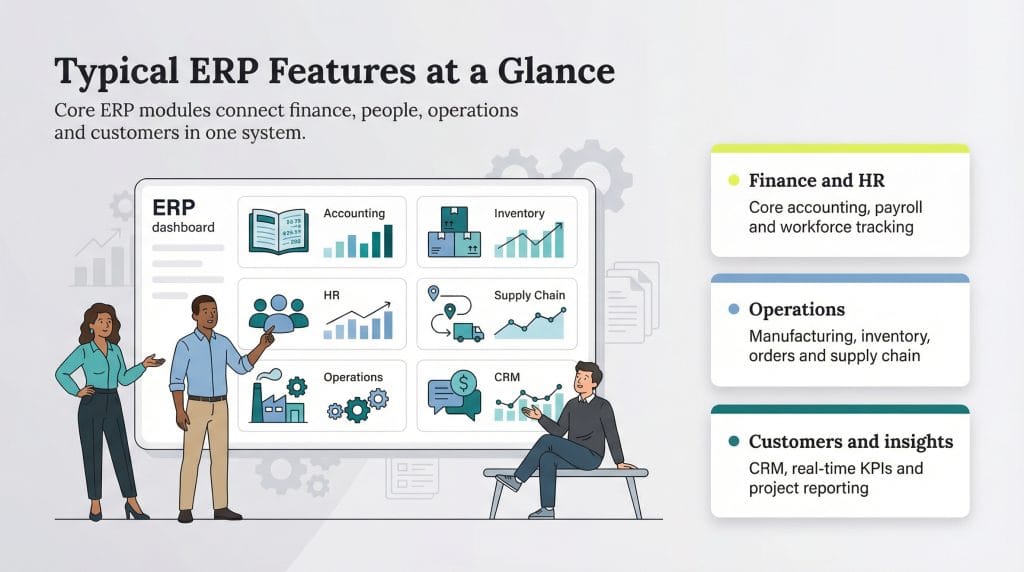
What are typical ERP features?
ERP systems generally feature some or all of the following functions:
- Accounting tools: ERP platforms’ accounting tools manage a company’s standard financial recordkeeping. Many systems have additional management accounting capabilities capable of generating complex financial reports for C-suites, senior managers and other stakeholders. Read our Oracle NetSuite Accounting review to learn about accounting software that includes ERP resources.
- HR tools: ERPs may include HR tools to manage recruitment, monitor adherence to employment legislation, track performance against performance goals and metrics, record disciplinary procedures, and track sick days, missed work, leave-of-absence periods and holidays.
- Manufacturing process tools: ERP manufacturing process tools can streamline processes, eliminate redundant production tasks, prevent waste, ensure sufficient stock is available when needed, match demand and supply, and more.
- Inventory management tools: ERP inventory management tools are particularly useful for companies operating “just in time” models. Broader benefits include observing high-selling products, automatically replenishing stock, calculating the landed cost of goods sold, and monitoring sales channel performance, turnover rates, quality checking and shrinkage.
- Order processing tools: ERP order processing tools manage customer data processing, packaging and shipping teams, invoice and receipt creation, payment processing, investigations into delayed orders, and more.
- Supply chain management tools: ERP supply chain management tools improve vendor collaboration and handle demand planning and warehouse planning. They also monitor parts and personnel utilization, create import and export documentation, and more.
- Business analytics: Modern ERP systems include analytics capabilities with customizable dashboards, predictive analytics and real-time KPI monitoring.
- Project management tools: ERP project management tools assign costs to individual projects, monitor progress against milestones, coordinate engineer-to-order projects, provide dashboard insights for project managers and other stakeholders, and more.
- CRM tools: ERP CRM tools manage marketing and sales channels and customer and technical support. CRM systems are not ERP systems, but many ERP systems have built-in CRM functionality. Read our reviews of the best CRM software to learn about solutions that incorporate ERP capabilities.
The
2024 ERP Report reveals the sectors most likely to invest in ERP systems, including manufacturing (38.9 percent), healthcare (13.7 percent), distribution and wholesale (9.9 percent) and professional services (7.6 percent).
What are the different types of ERP solutions?
The three primary ERP solution types are on-premises, cloud-based and hybrid. However, there are seven ERP types in total.
- On-premises: On-premises ERPs are hosted on a company’s servers and terminals in buildings it owns or leases.
- Cloud-based: Cloud-based ERPs are hosted in the cloud as SaaS offerings. Businesses pay via monthly or annual subscriptions. The vendor provides automatic updates, training and support. Customization levels vary.
- Hybrid: Hybrid ERPs combine on-premises and cloud-based services. The individual arrangement between the client and the cloud vendor determines where data and apps are hosted and stored. Hybrid clouds offer greater customizability than cloud-based apps.
- Generic: Generic ERPs are excellent for finance and accounting but don’t cover operational analysis. You may need a developer to add the broader functionality you want at an extra cost.
- Industry-specific: Industry-specific ERPs fit the specific needs of sectors like hospitality, waste management, construction and retail. Much less customization is needed on these systems than generic ERPs.
- Open-source: Open-source ERPs provide basic functionality for accounting and processes. Like generic ERPs, you must employ a developer at your cost to customize the ERP to perform the functions you need. Open-source ERP software is often free or very low cost.
- Two-tier: As mentioned above, two-tier ERPs are for larger companies with a head office and regional centers. All locations share the same database, and the head office sets general functionality across the entire system. However, regional centers can customize the head office ERP to match local languages and legal and accounting customs.
Taking advantage of modern ERP capabilities for competitive advantage
The ERP landscape continues to evolve rapidly, with artificial intelligence, cloud migration and composable architectures driving change. For businesses considering ERP adoption or upgrades, the current market offers more options than ever before — from affordable cloud-based solutions for small businesses to AI-powered platforms for enterprises.
Whichever route you take, ensure you’re clear about how you want to improve your business, and use that as a starting point in your ERP planning.