One of the first things to do when choosing a business internet provider is to consider all the ways in which your business relies on internet service or will. With this information, you can determine what kind of bandwidth you need, and then you can assess your needs for any extra services or add-ons. From there, you’ll want to use guides like this one to research which ISPs offer packages that meet your needs and then confirm the service is available in your area.
Of course, there are several other factors you should weigh before choosing a business internet plan. Business.com spoke with business owners and leaders to learn what they prioritized when signing up with a business internet provider.
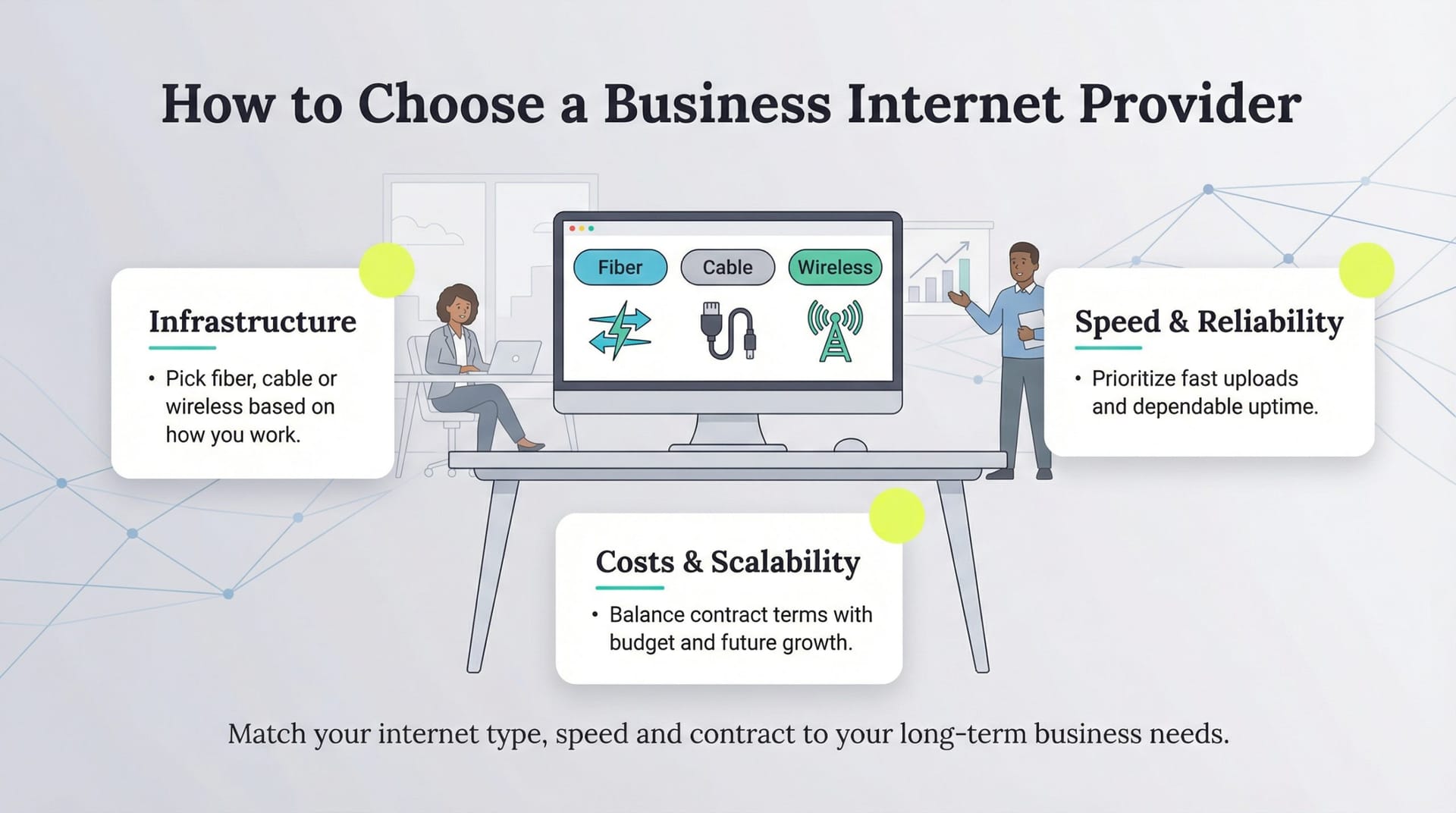
Infrastructure
Consider whether you need fiber, cable or wireless services. Fiber optics provide the fastest, most symmetrical speeds available, making them ideal for data-heavy operations. Cable is a cost-effective alternative for general use, while 5G and LTE wireless solutions offer rapid deployment and redundancy for mission-critical continuity.
Victor Santoro, CEO of Profit Leap, wanted a high-speed, stable connection, leading him to choose fiber internet.
“With fiber connectivity, our team spends less time troubleshooting connectivity and more time innovating,” he told us. “For fellow CEOs, the right technology infrastructure empowers your business to reach its full potential. Do your homework, understand your needs and find tools to build on.”
At Lush Life Brands, CEO Natasha Williams required “flexibility and mobility,” so she chose a wireless solution.
“Since we host two major events and several smaller ones throughout the year, having a reliable internet service that we can take with us is crucial,” she said. “With over 1,000 attendees at these events, everyone is trying to connect to Wi-Fi, so having a dedicated service specifically for our vendors is essential. This allows them to stream content, process payments and manage other important tasks seamlessly.”
Speed & Reliability
Dependability and speed are critical in business internet. Pay special attention to upload speeds, which are vital for video conferencing and cloud backups, rather than focusing solely on download metrics.
Robert Hill of Bullmight named “reliability and speed” as his “top priorities,” explaining, “Our digital marketing campaigns require fast upload and download speeds, especially when collaborating with clients via video conference.”
Costs & Contracts
Consider future internet technology needs and your long-term budget. Review contract terms carefully; while long-term agreements often lock in lower rates, month-to-month plans provide the flexibility to pivot if your business moves or requirements change rapidly.
“Advanced systems cost more upfront but prevent replacement costs down the road,” Santoro said. “If [I were] starting over, I would have negotiated a longer contract term to lock in rates.”
Hill also regretted not locking in rates with a longer contract. “Don’t assume a short-term deal is more flexible. For most businesses, internet service is a necessity, not a luxury. Lock in the best rates for as long as possible.”
Scalability & Customization
Evaluate providers based on your specific business needs and future goals to find a customized solution rather than settling for a generic one-size-fits-all plan. Scalability is key as your business grows.
“Don’t just consider current needs,” Cremer said. “Think long-term and choose a provider able to scale with your business … I wish I’d anticipated how much internet needs can change. I’d suggest choosing a provider offering scalable, customizable options as your business grows.”
“For startups and SMBs, I recommend choosing a provider known for reliability and scalability over initial cost savings,” said Albert Brenner, co-owner of Altraco. “Transitioning providers is time-consuming and risky, so choose a partner ready to support your growth for the long haul.
“My advice is to evaluate providers based on your specific business needs and future goals to find a customized solution rather than settling for a generic one-size-fits-all plan,” he added.