Business.com aims to help business owners make informed decisions to support and grow their companies. We research and recommend products and services suitable for various business types, investing thousands of hours each year in this process.
As a business, we need to generate revenue to sustain our content. We have financial relationships with some companies we cover, earning commissions when readers purchase from our partners or share information about their needs. These relationships do not dictate our advice and recommendations. Our editorial team independently evaluates and recommends products and services based on their research and expertise. Learn more about our process and partners here.
Learn how business insurance can protect your company, what types of coverage are available and how to choose the right policy for your needs.


As a business owner, you work hard to build and grow your company, but unexpected events can put everything you’ve built at risk. From property damage and employee injuries to costly lawsuits, even a single incident can create serious financial challenges. Having the right business insurance can help protect your company from these expenses and keep operations running smoothly.
However, figuring out which policies you need and how much coverage to buy isn’t always straightforward. This guide explains the basics of business insurance, explores the different types of coverage available and answers common questions to help you make informed decisions about protecting your business.
Every business faces risks, whether it’s a customer getting injured on the premises, a product causing harm or a client filing a lawsuit over services provided. Even if your company did nothing wrong, defending yourself against a claim can be expensive. That’s why business insurance is important for companies of all sizes and industries.
For example, a customer might slip on a wet floor in your store or have a bad reaction to a product you sell. Either situation could lead to a lawsuit, leaving your business responsible for attorney fees, court costs and potentially a settlement or judgment. The right insurance policy can help cover these expenses, up to your coverage limits, so one unexpected incident doesn’t put your company’s financial health at risk.
Some types of business insurance aren’t optional. Depending on your state, industry and the services you provide, you may be legally required to carry certain policies. For example, some healthcare professionals must maintain malpractice insurance, while certain financial professionals are required to carry professional liability coverage. Even when insurance isn’t mandated by law, clients may require errors and omissions coverage before they’ll sign a contract with your business.
Workers’ compensation is another important requirement. Nearly every state requires businesses with employees to carry workers’ compensation insurance, although the rules vary depending on the number of employees, industry and location. This coverage helps pay for medical treatment and lost wages when employees suffer work-related injuries or illnesses.
Failing to carry required coverage can lead to substantial fines, lawsuits and, in some jurisdictions, criminal penalties.
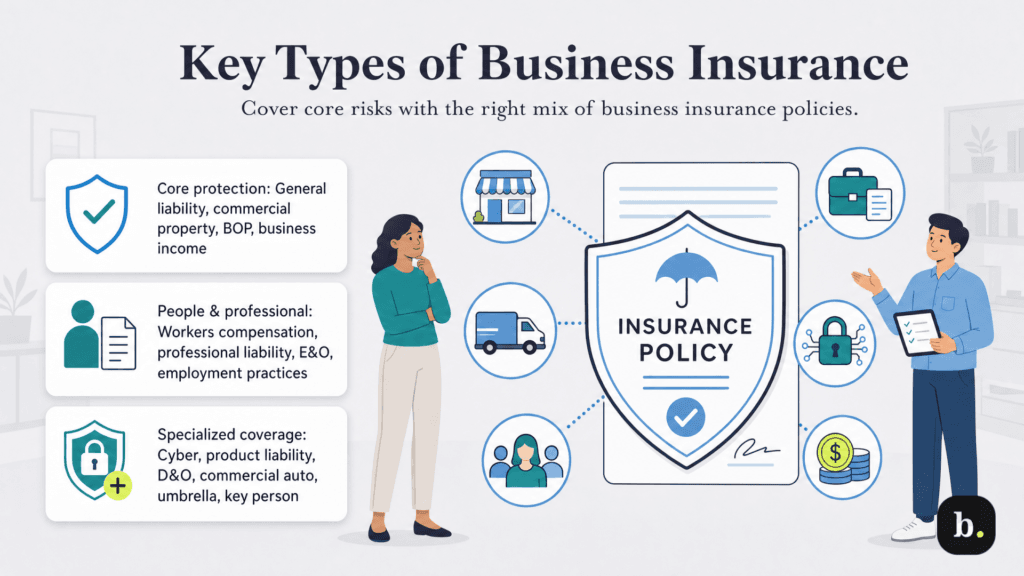
Choosing business insurance can feel overwhelming because there are so many options, and the right coverage depends on your company’s size, industry and risks. Below are some of the most common types of business insurance:
General liability insurance helps protect your business from the financial consequences of third-party claims involving bodily injury or property damage. If someone sues your company over a covered incident, this insurance can help pay for attorney fees, court costs and any resulting settlements or judgments, up to your policy limits.
For example, if an employee accidentally damages a client’s property while working or a customer slips and falls at your business, general liability insurance can help cover the resulting repair costs or medical expenses.
Commercial property insurance helps protect your business’s building and physical assets, including tools, equipment, furniture and inventory, from damage or loss. Standard policies typically cover events like fires, lightning strikes, explosions, windstorms, hail, smoke damage, vandalism and theft.
Note that floods and earthquakes are generally excluded from standard policies, which means you could be responsible for expensive repairs if your business is damaged by one of these events. Depending on where your business is located, you may want to look into purchasing separate flood or earthquake insurance or adding coverage through an endorsement.
Commercial auto insurance helps protect your business from the financial costs of accidents involving company vehicles. For example, if an employee gets into an accident while making a delivery in a company van, this coverage can help pay for injuries, property damage and other covered expenses.
If your business owns or leases vehicles, commercial auto insurance is essential and generally required by law. However, if employees use their personal vehicles for work-related tasks, you may also need hired and non-owned auto insurance to protect your business from liability. Personal auto policies often limit or exclude certain business uses, so it’s important to make sure you have the right coverage. [Read Related Article: Commercial Car Insurance Laws by State]
Business owner’s insurance, also known as a business owner’s policy (BOP), combines general liability and commercial property insurance into a single policy. Many BOPs also include business interruption coverage, which helps replace lost income if a covered event temporarily forces your business to close. Bundling these protections is often more affordable than purchasing separate policies.
Business income insurance, also known as business interruption insurance, helps replace lost income if your company is forced to temporarily close because of a covered event, such as a fire or severe storm. It can also help pay ongoing expenses like rent, payroll and loan payments while your operations are suspended.
This coverage is especially valuable for businesses that rely on a physical location, such as retail stores, restaurants and service providers. It’s often included in a BOP or added to a commercial property policy through an endorsement.
The importance of this coverage becomes especially clear when you consider how difficult it can be for a business to recover from a disaster. According to the Federal Emergency Management Agency (FEMA), about 40 percent of small businesses never reopen after a disaster. Having business income insurance can help ease the financial strain and give your company a better chance of getting back on its feet.
Professional liability insurance helps protect businesses that provide professional services or advice. If a client claims you made a mistake, failed to deliver promised services or caused them financial harm, this coverage can help pay for legal defense costs and any resulting settlements or judgments, subject to your policy’s terms and limits.
This insurance is especially important for consultants, accountants, attorneys, architects and other service-based professionals. While general liability insurance typically covers bodily injury and property damage, professional liability focuses on claims involving errors, negligence or other problems with the services you provide.
Errors and omissions (E&O) insurance is a type of professional liability insurance that protects businesses against claims involving mistakes, oversights or failure to deliver promised services. The terms “professional liability insurance” and “E&O insurance” are often used interchangeably, although E&O is particularly common in industries that provide advice or specialized services. If a client claims your work caused them financial harm, this coverage can help pay for legal defense costs and covered settlements or judgments, even if the allegations turn out to be unfounded.
E&O insurance is commonly carried by real estate agents, insurance brokers, financial advisors, IT consultants and marketing agencies. Depending on your industry and location, you may be required to carry this coverage to maintain a professional license or fulfill the terms of a client contract.
Product liability insurance helps protect your business if a product you manufacture, distribute or sell causes bodily injury or property damage. Even carefully designed and tested products can have defects, and the resulting lawsuits can be expensive. This insurance can help cover legal defense costs, settlements or judgments, as well as medical expenses related to a covered injury.
Product liability insurance is especially important for manufacturers, retailers and wholesale distributors. It’s often included in a general liability policy, but businesses that face greater risks may need a standalone policy with higher coverage limits.
Workers’ compensation insurance helps pay medical expenses and a portion of lost wages for employees who suffer work-related injuries or illnesses. It also provides death benefits to eligible dependents of workers who die from job-related causes.
Most states require businesses with employees to carry workers’ compensation insurance, although the specific rules vary by state and industry. Beyond meeting legal requirements, this coverage generally protects employers from lawsuits over covered workplace injuries. How much workers’ comp coverage you need depends on your state’s laws and factors like the size and nature of your workforce.
Cyber insurance, also known as cyber liability insurance or cyber risk insurance, helps protect your business from the financial fallout of cyberattacks and other online threats. Depending on your policy, coverage may include data breach response costs, ransomware payments, lost income from business interruptions and certain legal or regulatory expenses.
A cyberattack can leave your business dealing with everything from lost sales and operational disruptions to the expense of notifying customers about a data breach. And those costs can add up quickly. According to Statista, cybercrime was estimated to cost $10.29 trillion worldwide in 2025, with that figure expected to reach nearly $18 trillion by 2030. Cyber insurance can help protect your business from some of these financial losses.
Employment practices liability insurance (EPLI) helps protect your business against employee claims involving discrimination, wrongful termination, harassment and other workplace issues. This coverage can help pay for legal defense costs, settlements and judgments related to covered claims.
As your business grows and you bring on more employees, it’s important to think about the possibility of workplace disputes. Even if you believe you’ve handled a situation fairly, an employee could still file a discrimination or wrongful termination claim, leaving your company with expensive legal bills. These cases can also result in substantial settlements. In fiscal year 2025, the Equal Employment Opportunity Commission (EEOC) recovered $660 million for nearly 17,700 victims of workplace discrimination.
You can purchase EPLI as a standalone policy or add it as an endorsement to certain business insurance policies, depending on your insurer.
Directors and officers (D&O) insurance helps protect the personal assets of company executives and board members if they’re sued over decisions made while managing the business. This coverage can help pay for legal defense costs, settlements and judgments involving claims of mismanagement, breaches of fiduciary duty or failure to comply with regulations.
D&O insurance isn’t just for large, publicly traded companies. Private businesses, startups and nonprofits can also benefit from this protection. For example, a startup seeking outside investment may face claims from investors, while a nonprofit’s board members could be held accountable for decisions involving the organization’s finances. As your business grows and more people become involved in major decisions, D&O coverage is worth considering.
Commercial umbrella insurance provides an extra layer of liability protection when a claim exceeds the limits of your existing insurance policies. For example, if your business faces a lawsuit with damages that exceed your general liability coverage, umbrella insurance can help pay the remaining costs, up to its own policy limits.
Commercial umbrella insurance typically works alongside general liability, commercial auto and employers’ liability policies. It’s especially valuable for businesses that face the risk of costly lawsuits or significant liability claims. In many cases, purchasing umbrella coverage is more affordable than increasing the coverage limits on each of your individual policies.
Key person insurance helps protect your business from financial losses if an owner, founder or essential employee dies. Separate key person disability coverage may also be available if that individual becomes unable to work.
This insurance is especially valuable for small businesses that depend heavily on one person’s expertise, client relationships or leadership. Losing that individual could seriously disrupt operations and put the company’s financial stability at risk. In some cases, lenders or investors may even require key person insurance before providing financing.
The cost of business insurance depends on your industry, company size, location and the types of coverage you need. To give you an idea of what to expect, The Hartford reports that its small business customers pay an average of $810 per year for general liability insurance and $1,687 annually for a business owner’s policy (BOP). However, your actual costs could be higher or lower depending on your company’s specific risks.
Several factors can affect how much you’ll pay for business insurance, including:
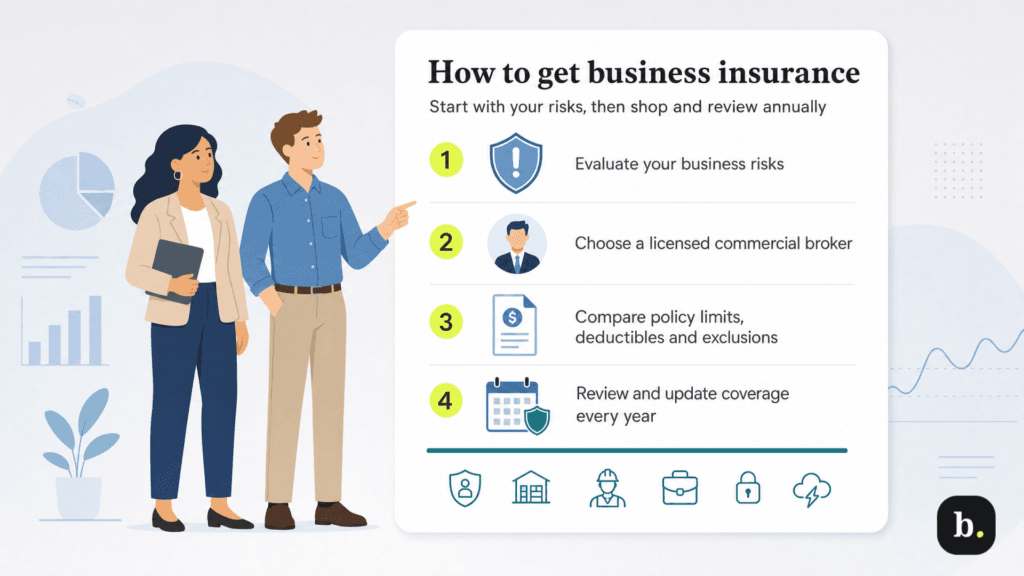
Getting business insurance doesn’t have to be complicated, but it’s important to understand what your company needs before you start shopping for coverage. An experienced insurance broker can help you evaluate your risks, explore different policies and find coverage that fits your budget.
Here are four steps to help you get started:
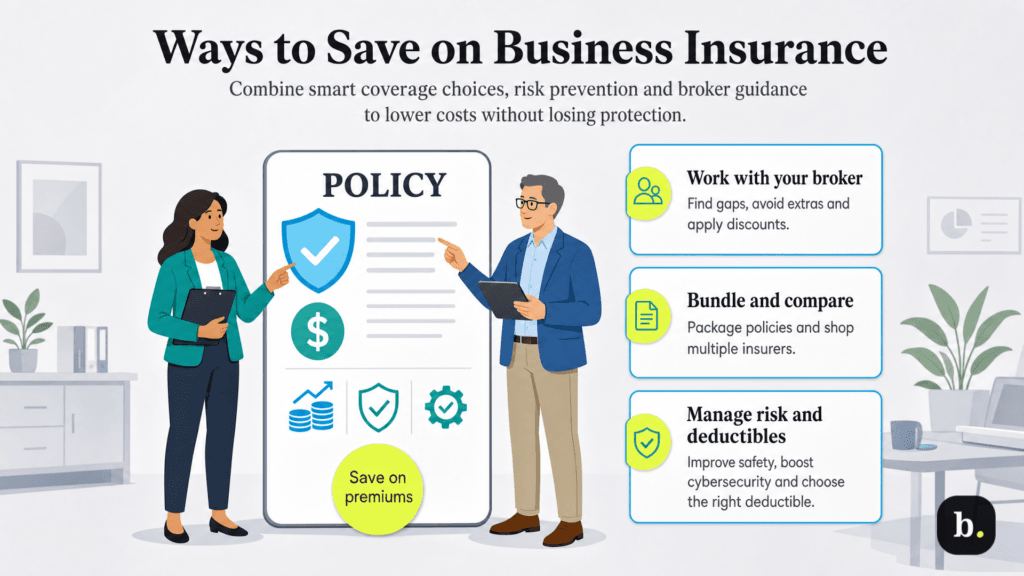
Business insurance costs can add up quickly, especially when you need several types of coverage to protect your company. Fortunately, there are ways to keep your premiums manageable without sacrificing important protections. Here are some practical tips to help you save money on business insurance while making sure you have the coverage you need.
A knowledgeable insurance broker can help you find the right coverage at a competitive price. Because independent brokers work with multiple insurance companies, they can compare policies, identify potential gaps in your coverage and help you avoid paying for protections you don’t need. They can also explain exclusions and other policy details that might be easy to overlook.
Your broker can also help you find ways to keep your insurance costs down. For example, if you’ve made improvements to workplace safety or taken steps to prevent property damage, you may qualify for lower premiums. It’s also worth checking in with your broker as your business grows. Hiring more employees, buying equipment or expanding your operations can all affect the coverage you need and how much you’ll pay.
Insurance rates and coverage options can vary significantly between providers, so it’s worth getting quotes from several companies before making a decision. Look for insurers and brokers who have experience working with businesses in your industry, and compare policies with similar coverage limits, deductibles and benefits.
A low premium isn’t much of a bargain if your insurance company can’t pay claims when you need it. Before choosing a provider, take a look at its financial strength and track record. AM Best rates insurers based on their ability to meet financial obligations, and an A- rating or higher is a good benchmark. You can also check with your state’s insurance department to see whether customers have filed complaints against the company and how frequently problems have been reported.
Buying several types of business insurance together can be more affordable than purchasing separate policies. For example, a business owner’s policy (BOP) combines general liability and commercial property coverage, often at a lower cost than buying each policy individually.
You may also qualify for discounts by bundling other types of coverage with the same insurer. Besides saving money, keeping your policies with one provider can make it easier to manage your coverage, payments and renewals.
Choosing a higher deductible can help lower your business insurance premiums. For example, increasing your deductible from $500 to $1,000 or $2,500 may reduce your monthly or annual costs. However, the amount you’ll save depends on your insurer and the type of coverage you have.
Before raising your deductible, make sure your business has enough cash reserves to cover the additional out-of-pocket costs if you need to file a claim. Consider putting the money you save on premiums into an emergency fund so it’s available when you need it.
Insurance companies want to see that you’re making an effort to prevent accidents and other costly problems. For example, installing business security systems with professional monitoring could help you get a better rate on commercial property coverage. You may also qualify for lower premiums by improving workplace safety, such as providing regular employee training and addressing potential hazards before someone gets hurt.
You don’t necessarily need to make expensive upgrades to reduce your risks. Routine equipment maintenance, training and strong cybersecurity practices can all help prevent accidents and other costly incidents. Be sure to document your safety efforts and review them regularly to identify areas for improvement. Over time, fewer claims and a strong safety record may help you qualify for more favorable insurance rates.