Your free business.com+ membership unlocks exclusive tech deals and advisor support
Join Free
BDC Hamburger Icon

Menu

Close
BDC Logo with Name
Search Icon
Search Icon
Advertise with us
Advertising Disclosure
Close
Advertising Disclosure

Business.com aims to help business owners make informed decisions to support and grow their companies. We research and recommend products and services suitable for various business types, investing thousands of hours each year in this process.

As a business, we need to generate revenue to sustain our content. We have financial relationships with some companies we cover, earning commissions when readers purchase from our partners or share information about their needs. These relationships do not dictate our advice and recommendations. Our editorial team independently evaluates and recommends products and services based on their research and expertise. Learn more about our process and partners here.

Salesforce Marketing Cloud Next Review and Pricing

author image
Written by:
Sean Peek, Senior Analyst
author image
Editor verified:
Gretchen Grunburg,Senior Editor
Last Updated Jul 16, 2026
Business.com earns commissions from some listed providers. Editorial Guidelines.
Table Of Contents Icon

Table of Contents

Open row
Editors Score:9/10
Salesforce Marketing Cloud Next is ideal for enterprise businesses looking to unify email marketing and customer engagement across channels. Built on Salesforce CRM and part of Agentforce Marketing, it combines AI-powered automation, personalization and customer journey orchestration.
Thumbs Up Pros
  • AI-powered campaign creation, personalization and customer journeys help enterprise teams create more relevant marketing with less manual work.
  • Built on Salesforce CRM, Marketing Cloud Next makes it easy to connect marketing with sales, service and customer data.
  • Businesses can start with Marketing Cloud Next and expand the platform over time with additional Agentforce Marketing products.
Thumbs Down Cons
  • Pricing can add up quickly as you add messaging credits, AI capabilities and other Salesforce marketing products.
  • The platform takes time to implement and is better suited to organizations with the resources to manage a sophisticated marketing ecosystem.
  • Many advanced marketing capabilities require separate products or add-ons, making it difficult to estimate your total investment upfront.

Among the best email marketing platforms for enterprises, Salesforce Marketing Cloud Next is our top pick for organizations looking to create more personalized customer experiences at scale. Built on Salesforce CRM and part of Agentforce Marketing (formerly Marketing Cloud), the platform brings together AI-powered email marketing, automation, customer data and cross-channel engagement in one highly customizable solution. Whether you’re nurturing leads, launching campaigns or building long-term customer relationships, Marketing Cloud Next gives marketing teams the tools to deliver more relevant experiences across every stage of the customer journey.

Salesforce Marketing Cloud Editor's Rating:

9 / 10

Pricing/value
8.5/10
Feature
9.2/10
Customizations, add-ons and integrations
9.2/10
Ease of use
8.8/10
Customer service
9.5/10

Why We Chose Salesforce Marketing Cloud Next as the Best Enterprise Email Marketing Solution

Salesforce Marketing Cloud Next is our choice for the best email marketing software solution for enterprises because it combines sophisticated email marketing, AI-powered automation and cross-channel engagement in one highly customizable platform. Built on Salesforce CRM and part of Agentforce Marketing (formerly Marketing Cloud), it helps organizations create, personalize and optimize campaigns while delivering more relevant customer experiences at scale.

What impressed us most is how deeply AI is woven into the email marketing experience. Marketing teams can use Agentforce to generate email and SMS messages, build audience segments, personalize customer journeys and optimize campaign performance without relying on separate AI tools. Because Marketing Cloud Next is built on Salesforce CRM — one of the best CRM software solutions around — marketers also have access to rich customer data that helps them deliver more targeted email campaigns and personalized interactions throughout the customer lifecycle.

We also like that Marketing Cloud Next is designed to grow alongside enterprise organizations. Businesses can start with the features they need and expand the platform over time with additional Agentforce Marketing products, such as Marketing Intelligence and Personalization. While its modular pricing and implementation requirements make it a significant investment, few competitors match its combination of enterprise email marketing, AI-powered automated email sequences and deep integration with the Salesforce ecosystem.
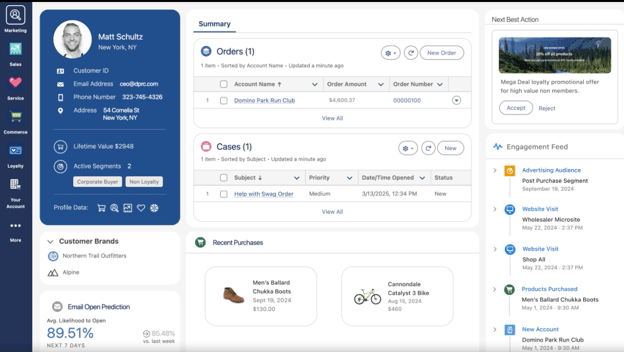
Customer profile dashboard in Salesforce Marketing Cloud Next showing customer data, orders, cases, engagement history and AI-powered next-best-action recommendations.
Marketing Cloud Next combines CRM data, customer history and AI insights to help marketers create more personalized campaigns across the customer journey. Source: Salesforce
Did You Know?Did you know
Marketing Cloud Next is part of Agentforce Marketing, Salesforce's overall marketing product family. Businesses can expand it with additional products for personalization, marketing intelligence, customer loyalty and more.

Ease of Use

Despite its enterprise focus, we found Marketing Cloud Next easier to navigate than many platforms with similar capabilities. The interface is clean and well organized, and Salesforce does a good job bringing together AI-powered marketing tools, customer data and campaign management in a unified workspace. While new Salesforce users should expect a learning curve because of the platform’s depth and customization options, these are the ease-of-use features that stood out most during our evaluation.
  • Unified workspace: Marketing Cloud Next gives marketers quick access to campaigns, audiences, customer journeys, email analytics and performance insights from a centralized workspace, making it easy to move between tasks without constantly switching tools.
  • AI-assisted workflows: Agentforce helps marketers generate email and SMS marketing content, build audience segments, personalize customer journeys and optimize campaign performance, reducing the manual work involved in managing sophisticated marketing campaigns.
  • Connected Salesforce ecosystem: Because Marketing Cloud Next is built on Salesforce CRM, marketing, sales and service teams can work from the same customer data. That shared view helps marketers create more personalized campaigns and customer journeys without relying on disconnected systems.
  • Comprehensive training resources: Salesforce offers free Trailhead courses, certifications and hands-on learning paths, along with the Trailblazer Community, to help users learn the platform and continue building their Salesforce expertise.
  • Flexible support options: Every Marketing Cloud Next license includes Salesforce’s Standard Success Plan with self-service resources and online case submission. Businesses that need faster response times or live technical support can upgrade to the Premier or Signature Success plans.
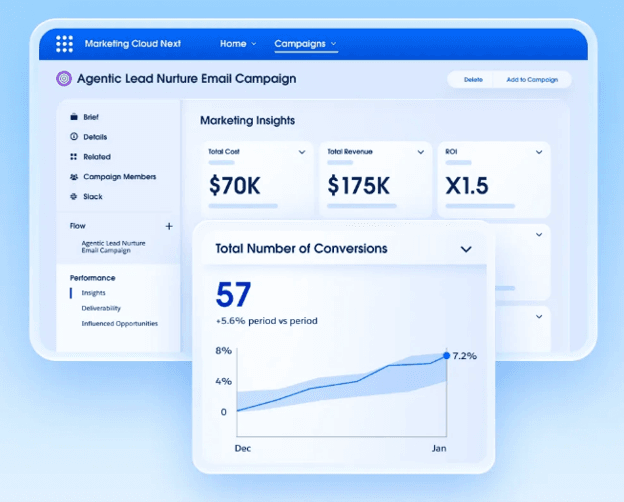
Marketing Cloud Next dashboard displaying an email campaign workspace with campaign navigation, marketing insights and performance metrics.
Marketing Cloud Next brings campaign management, marketing insights and performance metrics together in a unified workspace, making it easier for enterprise teams to manage and monitor email campaigns. Source: Salesforce

Salesforce Marketing Cloud Next Features

Salesforce Marketing Cloud Next combines AI-powered campaign creation, customer journey automation and CRM-driven personalization in a single marketing platform. While it includes the core email marketing tools businesses expect, its biggest strengths are helping enterprise teams create more personalized campaigns, automate customer engagement and measure marketing performance at scale. 

Below are the Marketing Cloud Next features that impressed us most.

AI-Powered Campaign Creation

Creating enterprise email marketing campaigns often requires multiple teams, countless revisions and hours of manual work. Marketing Cloud Next speeds up that process with Agentforce Campaign Creation, which lets marketers use natural-language prompts to generate campaign briefs, audience segments, email content and customer journeys. Rather than starting every campaign from scratch, marketing teams can use AI-generated recommendations as a starting point and refine them before launch.

We also like that Marketing Cloud Next combines AI with Salesforce CRM data to personalize email design and content based on customer attributes, behaviors and engagement history. Dynamic content, audience segmentation and behavioral targeting all work together to help marketers deliver more relevant messages while keeping campaigns consistent with their brand.
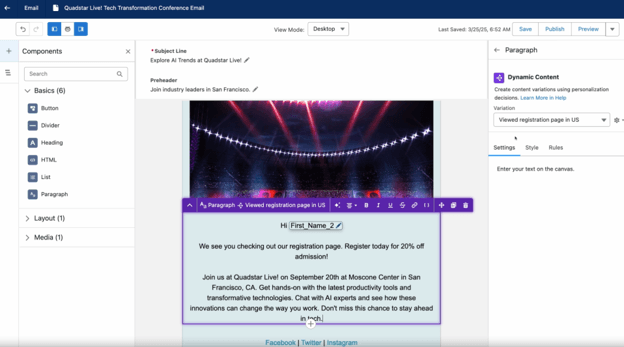
Marketing Cloud Next email editor showing a personalized campaign with drag-and-drop components, dynamic content and customer targeting settings.
Marketers can build personalized email campaigns using drag-and-drop components, dynamic content and customer-specific messaging within Salesforce’s marketing platform. Source: Salesforce

Customer Journeys and Marketing Automation

Enterprise email marketing goes far beyond sending email newsletters. Marketing Cloud Next helps businesses build automated customer journeys that respond to customer behavior, preferences and interactions across multiple channels. Instead of creating one-size-fits-all campaigns, marketers can design journeys that automatically deliver the right message at the right time based on actions such as making a purchase, abandoning a shopping cart or engaging with previous emails.

We were especially impressed by the platform’s multichannel approach. Marketing Cloud Next can coordinate tailored experiences across email, landing pages and other digital touchpoints, with SMS and WhatsApp available through supported editions and messaging add-ons. This helps businesses create seamless customer experiences without manually managing every interaction. AI also helps optimize customer journeys by recommending next steps and adapting campaigns as customer behavior changes.
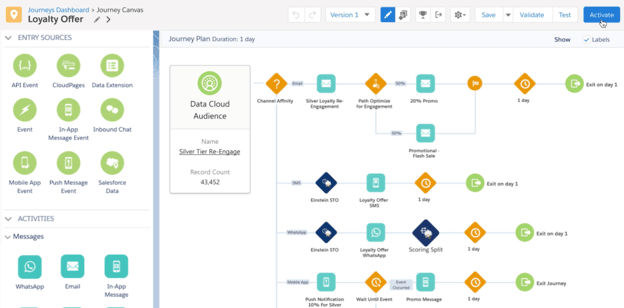
Salesforce Journey Canvas displaying an automated customer journey with branching workflows across email, SMS, WhatsApp and mobile messaging.
Salesforce’s Journey Canvas lets marketers visually build automated customer journeys with branching paths across multiple communication channels. Source: Salesforce.
FYIDid you know
You'll still see the Einstein name throughout Marketing Cloud, but Salesforce now uses Agentforce for many of its newest AI capabilities. Agentforce helps create campaigns and customer journeys, while Einstein continues to power predictive features like recommendations, engagement scoring and send-time optimization.

Personalization and Audience Insights

Enterprise marketers need more than static email lists to create relevant campaigns. Marketing Cloud Next uses Salesforce CRM data to personalize email content based on customer attributes, purchase history, engagement history and other behavioral signals. Email personalization helps businesses deliver more relevant messages throughout the customer journey while reducing the manual work required to build and maintain audience segments.

We were especially impressed by the platform’s AI-powered personalization tools, including People Scoring, which helps marketers identify customers who are most likely to engage with a campaign. Advanced Edition also adds Predictive Scoring and Path Experimentation to help teams refine customer journeys and improve campaign performance over time.

Businesses that need even deeper real-time personalization across email, websites and mobile apps can expand Marketing Cloud Next with Salesforce Personalization, an optional add-on that extends the platform’s one-to-one customer experiences.
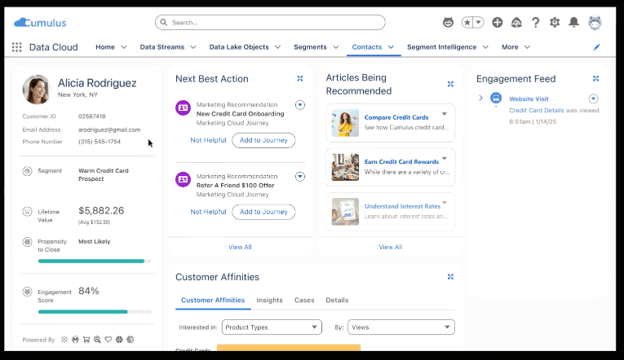
Salesforce Personalization dashboard displaying a customer profile with engagement score, customer affinities, AI recommendations and next-best marketing actions.
Salesforce Personalization uses CRM data, engagement history and AI-powered recommendations to help marketers deliver more relevant one-to-one customer experiences. Source: Salesforce

Marketing Analytics and Performance Insights

Creating campaigns is only half the job — understanding how they perform is what helps marketing teams get better results. Marketing Cloud Next includes robust analytics that measure campaign performance across channels, helping businesses see what’s working, where email subscribers are engaging and which marketing efforts are driving results.

We were particularly impressed by the platform’s attribution reporting and customizable dashboards, which let marketers track conversions, engagement and campaign performance from a single interface. Marketing Cloud Next also uses AI-powered insights to surface trends, recommend optimizations and help teams identify opportunities to improve future campaigns instead of manually digging through reports.

For organizations with more advanced reporting needs, Salesforce offers Marketing Intelligence, which combines data from multiple marketing channels into a centralized dashboard for deeper performance analysis. This gives enterprise marketing teams a broader view of their campaigns, advertising spend and return on investment while making it easier to share results across departments.
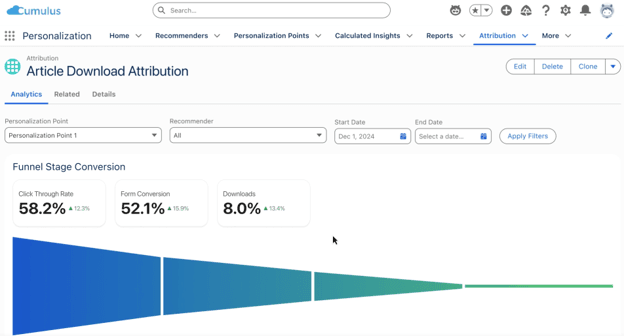
Salesforce attribution dashboard displaying campaign conversion metrics, attribution reporting and marketing analytics.
Marketing Cloud Next provides attribution reporting and AI-powered analytics that help marketing teams measure campaign performance and optimize future marketing efforts. Source: Salesforce

Salesforce Ecosystem and Integrations

One of Marketing Cloud Next’s biggest advantages isn’t just the number of integrations it offers — it’s how deeply it’s connected to the Salesforce ecosystem. Built on Salesforce CRM and part of Agentforce Marketing, the platform gives marketing, service, commerce and sales teams access to the same customer data, helping businesses deliver more consistent, personalized experiences across every customer touchpoint.

We were also impressed by AgentExchange (formerly AppExchange), Salesforce’s marketplace for thousands of third-party applications, AI agents and integrations. Businesses can extend Marketing Cloud Next with prebuilt tools for analytics, productivity, e-commerce, customer service and countless other business functions instead of building custom solutions from scratch.

For organizations with more specialized requirements, Marketing Cloud Next also supports APIs and custom integrations, making it easier to connect proprietary software and other enterprise applications. As marketing needs evolve, businesses can expand the platform with additional Salesforce products, including Data 360, Marketing Intelligence and Salesforce Personalization, allowing Marketing Cloud Next to grow alongside their marketing strategy.
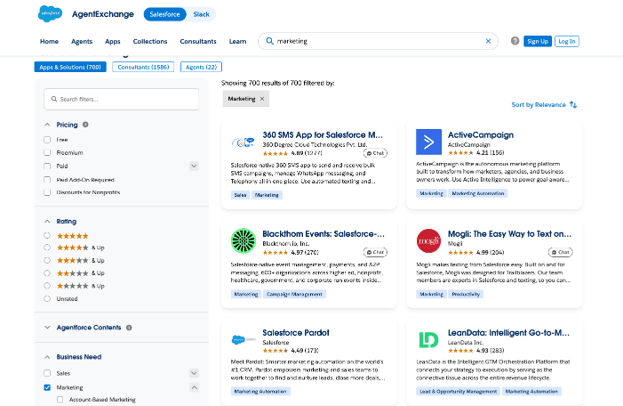
AgentExchange marketplace displaying 700 marketing-filtered apps and solutions for Salesforce.
Businesses can extend Marketing Cloud Next with hundreds of marketing-focused apps through AgentExchange, Salesforce’s marketplace for AI agents, integrations and third-party solutions. Source: Salesforce

Salesforce Marketing Cloud Next Pricing

Salesforce offers four main Marketing Cloud editions, from affordable CRM plans with built-in email marketing to enterprise Marketing Cloud Next plans packed with AI-powered marketing tools. As your marketing strategy grows, you can expand the platform with additional products and capabilities. Here’s a quick overview.

Plan

Pricing

Key features

Salesforce Starter

$25 per user/month (billed annually)

  • Email marketing and analytics
  • Drag-and-drop builders
  • Lead, account and contact management
  • Campaign analytics
  • Sales flows and lead routing
  • Slack integration

Salesforce Pro

$100 per user/month (billed annually)

Everything in Starter, plus: 

  • Greater customization
  • Enhanced CRM capabilities
  • Access to AgentExchange
  • Real-time chat

Marketing Cloud Next Growth

$1,500 per organization/month (billed annually)

  • Agentforce Campaign Creation
  • Automated customer journeys
  • Forms and landing pages
  • Advanced personalization and People Scoring
  • Segment creation
  • Content creation for email and SMS

Marketing Cloud Next Advanced

$3,250 per organization/month (billed annually)

Everything in Growth, plus:

  • AI Scoring and Predictive Scoring
  • Predictive engagement frequency
  • Path Experimentation
  • Unified SMS and WhatsApp conversations
  • Conversational email
  • Mobile app messaging

Keep the following additional pricing considerations in mind when considering a Salesforce marketing solution:

  • Many advanced capabilities cost extra: Salesforce sells Marketing Intelligence for $10,000 per organization, per month and Salesforce Personalization for $8,000 per organization, per month. It also offers Engagement+ and Account Engagement+ packages for customers extending existing Salesforce marketing products with Marketing Cloud Next capabilities.
  • Some features are edition-specific: Marketing Cloud Next Growth includes AI-powered campaign creation, automated customer journeys and advanced personalization, while Predictive Scoring, Path Experimentation and Unified Conversations for SMS and WhatsApp are reserved for the Advanced Edition. SMS and WhatsApp messaging require separate add-ons or credits with both plans.
  • Implementation may increase your total cost: Like many Salesforce products, Marketing Cloud can require implementation services, consulting or additional Salesforce products depending on how extensively you customize the platform or expand your marketing ecosystem.
  • Free trials depend on the edition: Salesforce offers free trials for Starter and Pro, but businesses evaluating Marketing Cloud Next Growth or Advanced generally need to contact Salesforce sales. The company also provides a free Marketing Cloud Next Developer Edition through Trailhead for learning and testing the platform before committing to a purchase.
TipBottom line
If you're planning to use Marketing Cloud alongside Salesforce's customer service platform, check out our Salesforce Agentforce Service review to see how the two products work together to unify marketing, sales and customer support.

Implementation and Onboarding

Marketing Cloud Next isn’t the type of email marketing platform you’ll master in an afternoon. While businesses using Salesforce Starter or Pro can get up and running relatively quickly, organizations implementing Marketing Cloud Next should expect a more involved onboarding process because of the platform’s AI, automation and personalization capabilities.

Fortunately, Salesforce provides plenty of resources to help new users learn the platform. We found Trailhead especially useful during our evaluation. The free learning platform offers self-paced courses, videos and hands-on exercises covering everything from creating email campaigns to building automated customer journeys, making it a valuable resource for onboarding new team members and learning advanced features over time.

Businesses with more complex requirements may also want to budget for implementation assistance. Salesforce works with consulting partners to help organizations configure the platform, integrate customer data and customize workflows, but these professional services can significantly increase the overall cost of adopting Marketing Cloud Next.

Customer Support

Salesforce offers a mix of self-service resources, community forums and live support, though the level of assistance you receive depends on your Success Plan. During our evaluation, we found Salesforce’s support representatives knowledgeable and responsive, and we were equally impressed by the quality of the company’s online learning resources.

  • Support channels: Every Marketing Cloud license includes Salesforce’s Standard Success Plan, which provides access to documentation, Trailhead, the Trailblazer Community and online case submission for technical issues. Businesses that need 24/7 phone and chat support for business-stopping issues must upgrade to the Premier Success Plan, which costs 30 percent of their net license fees, or purchase a custom Signature Success Plan.
  • Knowledgeable support team: We had positive experiences with Salesforce support throughout our testing. Our questions were answered quickly, and when a topic required more explanation, the team pointed us toward useful Trailhead lessons and help documentation.
  • Excellent self-service resources: Salesforce’s free Trailhead learning platform is one of the best we’ve encountered. We found its self-paced courses, videos and hands-on exercises easy to follow, while the Trailblazer Community offered helpful discussions and practical advice from experienced Salesforce users.
FYIDid you know
If your team is new to Salesforce, spend some time exploring Trailhead before contacting support. The free courses answer many common setup and configuration questions and can significantly shorten the learning curve.

Limitations

While Marketing Cloud Next is one of the most capable enterprise email marketing platforms we’ve tested, it isn’t the right fit for every business. Here are the biggest tradeoffs we found during our evaluation.

  • The total cost can add up quickly: While Marketing Cloud Next’s base pricing is publicly available, many advanced capabilities — including Marketing Intelligence, Salesforce Personalization and some messaging services — require additional purchases. Businesses looking for a free or lower-cost email marketing platform may want to consider Mailchimp. As we note in our detailed Mailchimp review, this platform offers a free plan for smaller contact lists and lower-cost paid tiers.
  • Implementation can be a significant investment: Organizations deploying Marketing Cloud Next often need to configure customer data, integrations and automated workflows before they can take full advantage of the platform. Depending on your environment, implementation assistance from Salesforce partners or consultants can add substantially to your overall costs. If you want advanced automation and personalization without the complexity of the broader Salesforce ecosystem, Campaigner is worth considering. As we explain in our Campaigner review, this platform offers many enterprise-focused email marketing features in a platform that’s typically easier and less expensive to implement.
  • There’s a learning curve: Marketing Cloud Next is designed for sophisticated marketing teams, and its extensive customization options take time to learn. Salesforce’s excellent Trailhead training platform helps flatten the learning curve, but new users should still expect a more involved onboarding process than with most email marketing platforms. Businesses looking for a simpler experience may want to check out our Constant Contact review, which explains how this platform is generally easy to learn and quick to get up and running.

Methodology

To identify the best email marketing software, we researched the most popular platforms, evaluated each vendor’s reputation and spent several weeks reviewing their features, pricing, customer support and user feedback. Whenever possible, we also tested the software firsthand and supplemented our research by watching product demonstrations, tutorials and implementation resources.

When evaluating enterprise email marketing platforms, we paid particular attention to AI-powered campaign creation, marketing automation, personalization, reporting, scalability and integration capabilities. We also considered how well each platform supports larger organizations with complex marketing needs, multiple teams and growing customer data. Based on those criteria, we selected Salesforce Marketing Cloud Next as the best enterprise email marketing solution because of its powerful AI capabilities, deep CRM integration and extensive Salesforce ecosystem.

Salesforce Marketing Cloud Next FAQs

Salesforce Marketing Cloud Next is an enterprise marketing platform that helps businesses create, automate and personalize email marketing campaigns using AI and Salesforce CRM data. It combines customer journeys, audience management, analytics and multichannel marketing tools to help organizations deliver more relevant customer experiences at scale.
Agentforce Marketing (formerly Marketing Cloud) is Salesforce's overall marketing platform and product family. It includes multiple products, including Marketing Cloud Engagement and Marketing Cloud Next — the primary focus of this review. Marketing Cloud Engagement remains available, but Salesforce's current marketing and pricing pages center on Marketing Cloud Next and its AI-powered marketing capabilities.
Salesforce Marketing Cloud Next starts at $1,500 per organization, per month for the Growth Edition and $3,250 per organization, per month for the Advanced Edition, with annual billing. Businesses that need additional capabilities, such as B2B marketing, advanced journey orchestration, marketing intelligence or 1:1 personalization, can purchase optional products and add-ons separately. If you only need basic email marketing, Salesforce also offers lower-cost Starter and Pro plans beginning at $25 and $100 per user, per month, respectively.

Bottom Line

We recommend Salesforce Marketing Cloud Next for …

  • Mid-sized and large businesses that want AI-powered marketing automation.
  • Companies already using Salesforce CRM or other Salesforce products.
  • Marketing teams that need advanced personalization, multichannel campaigns and customer journey orchestration.
  • Organizations that expect their marketing platform to scale as their business grows.

We don’t recommend Salesforce Marketing Cloud Next for …
  • Small businesses with limited budgets or simple email marketing needs.
  • Teams that want simple, predictable pricing without numerous add-ons.
  • Businesses that need a platform that’s quick to learn and implement without dedicated marketing or technical resources.
Did you find this content helpful?
Verified CheckThank you for your feedback!
author image
Written by: Sean Peek, Senior Analyst
Sean Peek co-founded and self-funded a small business that's grown to include more than a dozen dedicated team members. Over the years, he's become adept at navigating the intricacies of bootstrapping a new business, overseeing day-to-day operations, utilizing process automation to increase efficiencies and cut costs, and leading a small workforce. This journey has afforded him a profound understanding of the B2B landscape and the critical challenges business owners face as they start and grow their enterprises today. At business.com, Peek covers technology solutions like document management, POS systems and email marketing services, along with topics like management theories and company culture. In addition to running his own business, Peek shares his firsthand experiences and vast knowledge to support fellow entrepreneurs, offering guidance on everything from business software to marketing strategies to HR management. In fact, his expertise has been featured in Entrepreneur, Inc. and Forbes and with the U.S. Chamber of Commerce.