Business.com aims to help business owners make informed decisions to support and grow their companies. We research and recommend products and services suitable for various business types, investing thousands of hours each year in this process.
As a business, we need to generate revenue to sustain our content. We have financial relationships with some companies we cover, earning commissions when readers purchase from our partners or share information about their needs. These relationships do not dictate our advice and recommendations. Our editorial team independently evaluates and recommends products and services based on their research and expertise. Learn more about our process and partners here.
A cash flow statement tracks how money moves in and out of your business. Here’s how to prepare one and use it to understand your company’s financial health.


Cash flow is essential to running a successful business. Understanding your company’s liquidity is nonnegotiable, and a cash flow statement gives you clear visibility into how money moves through your business. These reports show how much cash is coming in, how much is going out and where it’s coming from. Below, we explain how to prepare a cash flow statement and what the numbers actually mean for your business.
A cash flow statement is a report that summarizes how much cash and cash equivalents flow into and out of your business over a specific period. It also shows how much cash you have on hand, including bank deposits, short-term investments and other business assets that can quickly be converted into cash. It does not include credit items, such as invoices you’ve sent but haven’t received payment for or bills you’ve received but haven’t paid yet.
“A cash flow statement is a great tool to give business owners insight into where their actual cash is spent, since most businesses are run on an accrual basis,” said Katie Thomas, a certified public accountant and corporate controller at Trust & Will.
A cash flow statement helps you understand whether your business has enough cash to cover expenses and stay financially healthy. It shows how money moves through your business so you can spot potential issues before they become serious problems.
For example, if your cash flow statement shows a deficit, you may need to adjust your pricing, shorten payment terms or cut expenses to improve cash flow. If you have a cash surplus, it may be a good time to invest in new equipment, hire staff or set aside savings.
Cash flow statements, along with your balance sheet and income statement, are also commonly required by banks and investors when you apply for financing. Lenders use these reports to evaluate whether your business is financially stable and able to repay a loan or investment.
A cash flow statement has three main sections: operating activities, investing activities and financing activities. Each section shows a different way money moves through your business.
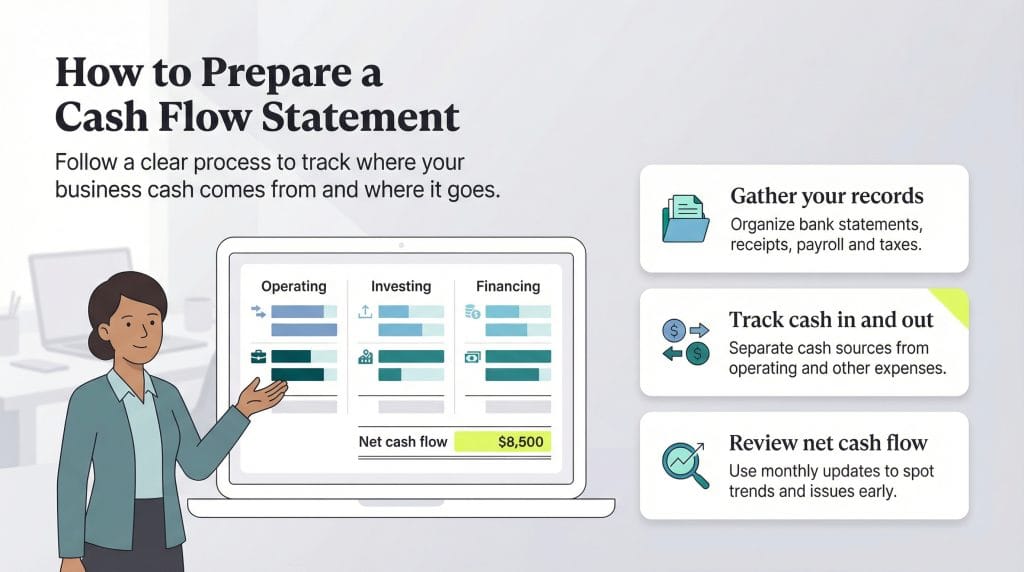
To build a cash flow statement that accurately reflects your business’s financial situation, follow these steps. Note that using one of the best accounting software platforms can also make the process faster and more accurate.
Accurate financial reporting starts with organized data. Gather all relevant documents, including bank statements, credit card receipts, payroll journals and tax records. The more organized your records are, the easier it will be to create an accurate cash flow statement.
Cash sources include all the ways money enters your business. For most small businesses, inflows include customer payments, sales revenue, tax refunds, small business grants, capital from business investors and business loans.
Go through your records and categorize each source of cash. Be sure to distinguish between cash you’ve actually received and invoices that haven’t been paid yet. This step matters because a cash flow statement tracks real money movement, not accounts receivable.
Next, map out where your money is going. Categorize expenses into groups like operating costs (such as rent, utilities, overhead costs and salaries), inventory purchases, equipment investments, loan repayments and taxes. Account for both fixed and variable expenses as well as one-time purchases, since they can significantly impact your cash flow.
The goal is to understand how much cash is leaving your business and where you’re spending the most.
Small businesses typically use one of two accounting methods: cash basis or accrual basis. The cash basis method records transactions when money actually changes hands, while the accrual method records revenue when it’s earned and expenses when they’re incurred, even if no cash has been paid or received yet.
For many small businesses, the cash basis is simpler and provides a clearer view of actual cash movement. However, some businesses are required to use accrual accounting, including those with inventory, certain corporations and companies that must follow Generally Accepted Accounting Principles (GAAP). Decide which method makes the most sense for your business and use it consistently.
To calculate net cash flow, subtract your total cash expenses from your total cash income for the period you’re reviewing (such as a month, quarter or year). If the number is positive, you have extra cash to save or reinvest. If it’s negative, you’re spending more cash than you’re bringing in. This gives you a quick snapshot of how healthy your cash flow is.
Now, organize your findings into a structured statement with three main sections:
List cash inflows and outflows in each category and detail the sources and uses of cash. Most accounting software can automate this process, but you can also build a simple spreadsheet manually.
Don’t just create the statement — study it. Look for trends, such as seasonal dips in revenue or rising operating costs. Are there months with cash shortages? Are expenses consistent or unpredictable? Use these insights to identify opportunities to cut business costs and plan for future growth.
A cash flow statement isn’t a one-time document. To stay useful, update and review it regularly, ideally monthly or quarterly. Routine monitoring helps you address liquidity issues before they become serious problems. Consider setting aside time each month to update your statement and reflect on your financial performance.
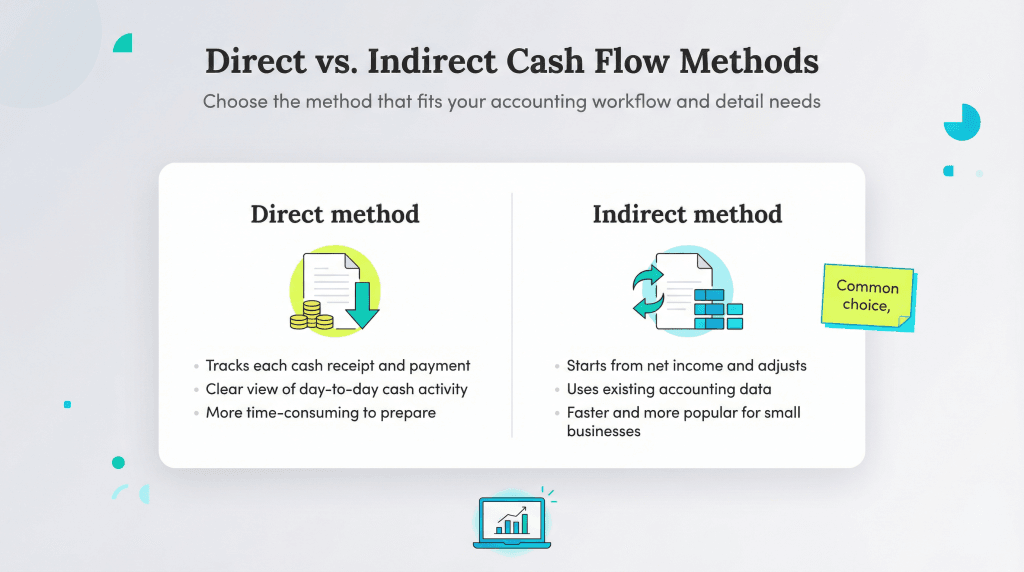
Most small businesses use accounting software to generate a cash flow statement automatically, but you can also build one manually using a template or spreadsheet. Regardless of how you create it, you’ll need to choose between the direct method and the indirect method.
Most small businesses use the indirect method because it’s easier to generate from accounting software, but the direct method can provide a clearer view of day-to-day cash movement.
A cash flow statement is a useful tool for reviewing past financial activity, but it has limits. For example, it focuses on historical data and doesn’t predict future cash flow.
“A cash flow statement is historically based,” explained Katie Swanson, a certified public accountant, certified valuation analyst and corporate controller at Inter-State Studio & Publishing Co. “It does not help a business look forward to manage cash today, next week or a month from now. Business owners are concerned with the ongoing operations of their business, not what happened last year.”
Swanson also noted that cash flow statements can be difficult to interpret without accounting skills. “The information is not presented in a way that makes sense to nonaccountants,” Swanson noted. “Therefore, the information is difficult for small business owners to use when making decisions.”

Most modern accounting software calculates cash flow automatically, which can reduce errors. If you prefer to calculate it manually, you’ll need data from your balance sheet and income statement.
>>FREE TOOL: Cash Flow Calculator<<
A cash flow statement includes three main categories: operating, investing and financing activities. Together, these sections show whether your business gained or lost cash during the period. Here’s what each one means.
Operating cash flow reflects cash generated by your core business activities, such as selling products or services. It starts with net income and adjusts for noncash expenses and changes in working capital.
Operating cash flow = net income + depreciation and other noncash charges ± changes in working capital
Investing cash flow tracks cash spent on or generated from long-term assets and investments. Examples include purchasing equipment or selling property, as well as buying or selling investments.
Financing cash flow shows how your business raises capital and repays debt. This includes issuing equity or debt, repaying loans, paying dividends or buying back shares.
A simplified formula is:
Financing cash flow = cash from equity or debt issuance − dividends and debt or equity repayments
Net cash flow combines all three categories:
Net cash flow = operating cash flow + investing cash flow + financing cash flow
It’s important to understand the difference between accounts receivable and accounts payable, because both affect your cash flow. Accounts payable is the money your business owes suppliers, while accounts receivable is the money customers owe you. Changes in accounts payable and accounts receivable can increase or decrease your cash flow, depending on whether those balances rise or fall.