Business.com aims to help business owners make informed decisions to support and grow their companies. We research and recommend products and services suitable for various business types, investing thousands of hours each year in this process.
As a business, we need to generate revenue to sustain our content. We have financial relationships with some companies we cover, earning commissions when readers purchase from our partners or share information about their needs. These relationships do not dictate our advice and recommendations. Our editorial team independently evaluates and recommends products and services based on their research and expertise. Learn more about our process and partners here.
Cutting business expenses can boost profitability and productivity. Learn how.


Increasing cash flow without overloading employees or sacrificing product or service quality can be challenging, especially if your finances are tight and resources are limited. However, learning how to reduce operational costs can be more straightforward — and it directly impacts your profit margin.
Simply put, cutting business costs can boost profitability. We’ll explain how implementing systematic cost-control methods can yield immediate savings while helping ensure competitive profit margins.
Many small business operations and spending categories lend themselves to cost-cutting measures, including the following:
Here’s a closer look at these cost-cutting tips and how they can boost profitability.
Examine current administrative processes and identify areas where automation and technology could relieve employees of manual tasks. Business technology is changing rapidly, and implementing modern software and solutions can reduce operational costs significantly. And because machines aren’t prone to human error, technology can also improve accuracy throughout your operations.
Here are a few ways to reduce your operational costs with technology:
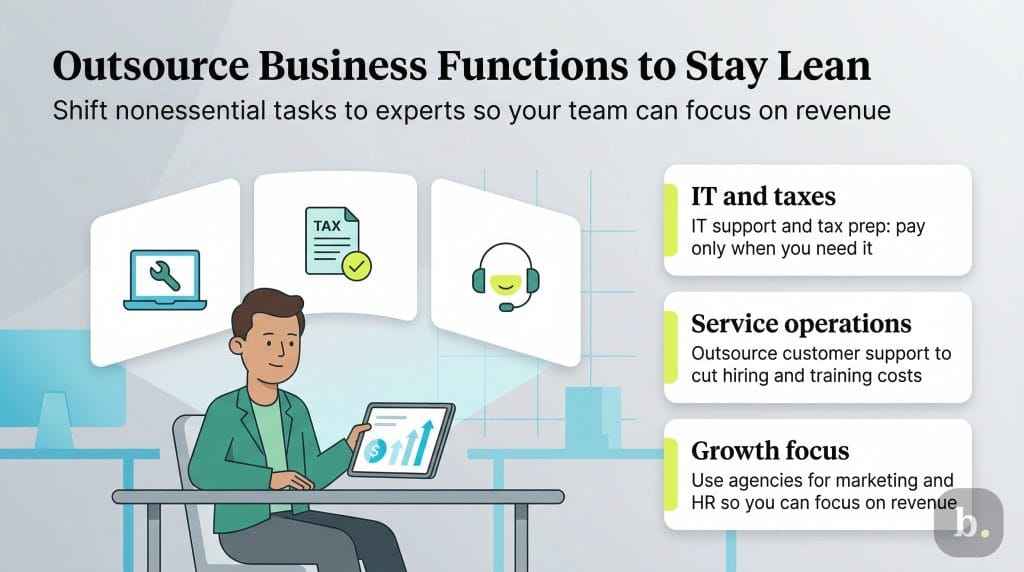
Finding an outsourcing partner for secondary business functions is another smart way to reduce operational costs. Outsourcing helps keep your organization lean while lowering payroll costs. Instead of diverting your focus and effort to managing nonessential tasks, you’ll be able to devote your time to revenue-generating activities.
Here are some services that may lend themselves to successful outsourcing:
A smarter, more thoughtful hiring process can reduce your payroll expenditures. For example, if your new administrative assistant understands content marketing, that’s a huge plus.
Investing in your team and the employee experience is also a good strategy. “It might sound counterintuitive, but sometimes spending a little more on your employees can actually reduce costs in the long run,” said Rushi Patel, co-founder of Homebase. “Higher pay, flexible schedules and good training help attract great people — and keep them around longer. Lower turnover means you spend less on hiring and training new folks, and a happier team usually means better performance and higher productivity.”
Another option is to hire contractors instead of full-time employees. Many small businesses turn to skilled freelancers for ad hoc work, allowing them to complete projects without adding long-term payroll costs. Contract professionals can step in when needed, helping you finish projects without committing to a full-time salary.
Here are a few areas where businesses often benefit from hiring freelancers:
Are you paying the best possible prices for goods and services? Examine your operating expenses and see where you may be able to negotiate better rates.
Kimberly DeCarrera, managing attorney and chief financial officer at Springboard Legal, suggested reviewing contract terms, especially regarding notice, termination and renewal. “Recognizing that it takes time and money to change vendors, my first priority is to negotiate with the current vendor for lower prices,” she said.
Consider the following factors:
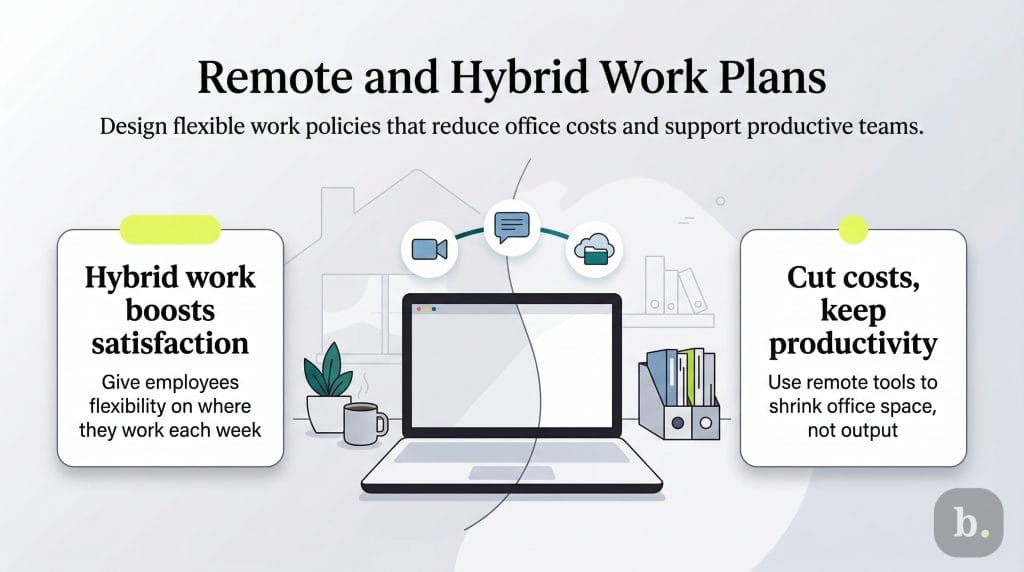
Expansive — and expensive — office space isn’t always necessary. Many jobs can be done just as efficiently from home, while others work well with a mix of remote work and occasional in-person meetings.
If you haven’t already, create a remote work plan and allow employees to telecommute for part of the week. You may be able to downsize your office space and use remote work tools, including video conferencing systems, to facilitate client, vendor and co-worker meetings. Collaboration platforms like Slack, Trello and Zoom support virtual meetings and day-to-day teamwork, while tools like Google Drive and Basecamp centralize documents and file storage to keep workflows running smoothly regardless of where your team is located.
Beyond saving money on office space, remote work can benefit your business in multiple ways. For example, many employees prefer working from home and avoiding the commute, leading to higher job satisfaction, loyalty and even increased productivity. In fact, according to a 2025 Owl Labs report, 69 percent of managers say hybrid or remote work improves productivity.
You may be able to adjust your employee benefits package to save money without shortchanging your employees. Here are some tips:
Many vendors offer early-payment discounts to reduce nonpayment risk and collection expenses. If you have the available cash on hand, pay your invoices early to take advantage of these discounts, which can add up quickly.
If your vendors don’t currently offer this kind of discount, ask about it or include it in contract renegotiations, especially if you are a long-term customer or spend significant amounts with them.
Conversely, many vendors charge interest or late fees on unpaid invoices. If you have been paying these penalties, paying your bills on time can help you avoid them and reduce unnecessary costs.
Enlist and incentivize employees to identify redundancies and waste in the organization. “One of the most effective ways to reduce expenses is by first understanding where your money is going,” said Gary Jain, CEO of The Ledger Labs. “Use detailed financial reports to spot inefficiencies, such as underutilized software, redundant tools or excessive manual processes.”
Here are some examples:
Shifting to a sustainable business model is good for the planet and your bottom line. Although you’ll have some upfront expenses, sustainability measures like installing solar panels on your facility’s roof can save you thousands in utility costs each year. In addition, the federal government and many state and local governments offer tax credits and incentives for specific green initiatives, so be sure to explore any that may apply to your business.
Running a successful business is an ongoing process that requires continuous monitoring, analysis and adjustment. Examine your major cost factors regularly to ensure you aren’t paying more than necessary. “I look for some quick wins — even small expenses that I can eliminate or reduce; then I look for the larger, more difficult expenses that may take more negotiation and effort to bring down,” DeCarrera said.
Here are some examples of areas to continually monitor for potential cost-cutting opportunities:
Operating costs — sometimes called operational costs or operating expenses — are the day-to-day expenditures required to run your business. These expenses include both direct costs tied to producing goods or services and indirect expenses, often called overhead (more on overhead below).
Operating costs can include:
On financial statements, COGS is subtracted from total revenue to get gross profit. Then, other operating expenses are subtracted from the gross profit to get the net profit. This is the amount left over to be distributed to the business owners or reinvested.
Overhead costs are the ongoing expenses required to run your business that aren’t directly tied to producing a product or delivering a service. These costs support your operations but generally don’t fluctuate based on how much you sell. Common overhead expenses include rent, utilities, insurance, administrative salaries, office supplies and internet service.
Overhead costs are a type of operating expense, but the two terms aren’t identical. Operating costs include all day-to-day expenses required to run a business, including both overhead and direct costs like COGS, sales commissions or production labor.
In simple terms:
Understanding this distinction can help business owners better identify where cost reductions are possible without affecting revenue-generating activities.
Reducing overhead can make a meaningful difference to your bottom line because these expenses don’t change much with sales. Whether business is booming or slow, you still have to pay for things like rent, utilities and administrative support. Keeping those costs under control helps protect your margins and gives your business more flexibility when conditions change.
“Profit. That’s why reducing costs is important — every dollar that you reduce your expenses means that you are adding to the bottom line,” DeCarrera said. “With costs going up everywhere, it’s important to maintain strong discipline when it comes to how we spend. This provides a more disciplined team that can better pivot when circumstances change.”
It’s important to identify where it’s actually feasible to reduce overhead. Consider involving customers and suppliers to evaluate possible areas for improvement. It’s also crucial to review your profit and loss statement carefully so you don’t take risks that could hurt your business’s performance.
There’s no one-size-fits-all approach to reducing costs and improving profitability. A strategy that works well for one business may not translate to another. Still, businesses with streamlined expenses and disciplined cost management are almost always in a stronger position to improve margins.
At the same time, cost discipline shouldn’t come at the expense of the areas that help your business grow. Be careful not to reduce spending in areas that directly support growth, such as customer experience, product development or skilled labor.
When you regularly review expenses, control overhead and protect growth-driving investments, your business is better positioned to stay profitable and resilient.
Danielle Bauter contributed to this article. Source interviews were conducted for a previous version of this article.