Business.com aims to help business owners make informed decisions to support and grow their companies. We research and recommend products and services suitable for various business types, investing thousands of hours each year in this process.
As a business, we need to generate revenue to sustain our content. We have financial relationships with some companies we cover, earning commissions when readers purchase from our partners or share information about their needs. These relationships do not dictate our advice and recommendations. Our editorial team independently evaluates and recommends products and services based on their research and expertise. Learn more about our process and partners here.
Launching an advertising agency can be a low-cost way to enter entrepreneurship. Here's exactly how to do it.


If you are an aspiring entrepreneur with a background in digital marketing, communications or creative design, launching an advertising agency can be a high-potential path to business ownership. You likely already have many of the skills needed to succeed, such as a strong grasp of marketing best practices. And while media and technology continue to evolve, advertising will remain essential as long as companies have something to sell.
In this guide, you’ll learn why starting an advertising agency is a smart pursuit, get expert tips from agency founders on how to get your business off the ground and explore the tools and software that can help you grow.
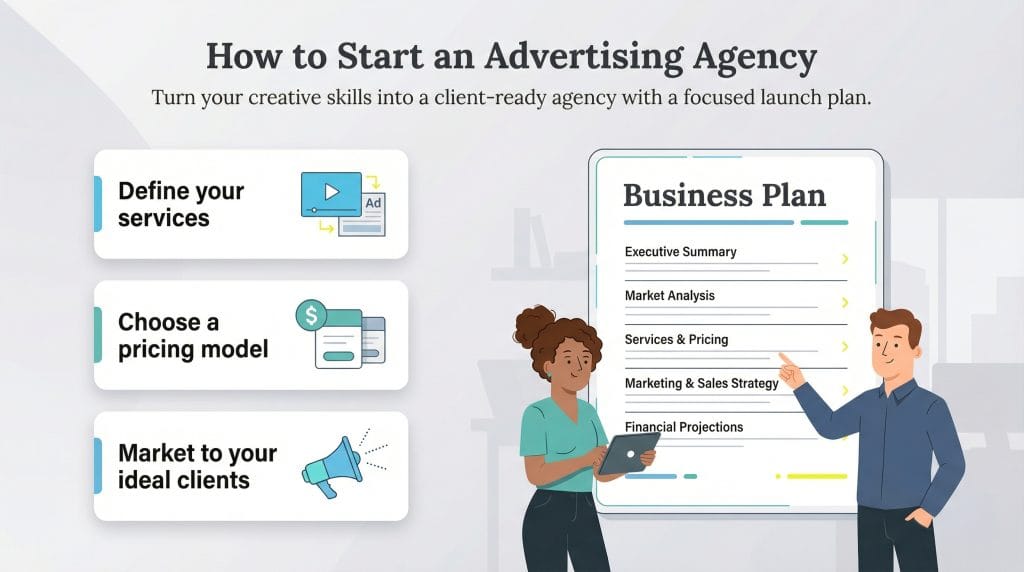
Some of the aspects of starting an advertising agency are applicable across all industries, such as developing a business plan. However, some are specific to this business type. That’s why business.com spoke with established agency owners to gather their best practices and tips. This guidance will walk you through the step-by-step process of starting your own firm.
Before you can get up and running, you’ll need to create a detailed business plan that outlines your strategies for launching and growing an advertising agency. The three main purposes of a business plan are to establish your business focus, secure funding (if needed to launch or, later, expand your agency) and attract potential C-suite executives to help manage the company if you don’t want to operate it as a solo entrepreneur.
Include the following elements in your plan:
Your business plan should also incorporate SMART goals — specific, measurable, attainable, relevant and time-based goals — to increase your chances of success. Expect this plan to evolve as you gather input and refine your approach.
“You’re not going to get everything right, right off the bat,” said Rob Lewis, founder and executive creative director at Good Conduct.
As you lay the groundwork for your advertising agency, you’ll have different options for forming the legal structure of your business, such as an S corporation, C corporation, LLC, sole proprietorship or partnership.
For John Kovacevich, founder and creative director at Agency SOS, starting solo allowed him to make decisions independently, move faster and build direct relationships with business associates. But running a successful one-person business isn’t everyone’s goal. Other ad agency founders, like Lewis, choose to lighten the load with a partner who has complementary skills to support the business.
“Have a partner with good business sense,” Lewis advised. “Someone in the agency will need to make time for the business side of the agency. From payroll to legal [counsel], production insurance, regular insurance, to processes and server space, there’s a lot of things a pure creative [person] doesn’t consider when starting an agency.”
If you still prefer not to have a co-owner, consider staffing your business with employees or contractors who can tackle tasks that aren’t in your wheelhouse.
Most advertising agencies make money by brainstorming and developing creative assets for their clients. While traditional print campaigns remain a factor, modern agencies typically focus on digital assets, such as short-form videos for social media (e.g., Reels, TikToks), responsive display ads and email marketing campaigns. You may want to focus on a specific niche audience, but whether you’re targeting a broad client base or a narrow one, you’ll need a unique value proposition that helps your business stand out from the competition.
The best pricing model for your business will depend on the specific services you’ll provide and how you’ll work with your clients. As you price your services, you’ll need to decide if you’ll charge per hour, per project or according to a fixed retainer model, in which a client pays an agreed-upon amount in advance for a certain number of service hours. Productized services, where you offer a specific deliverable (like four blog posts a month) for a flat monthly fee, have also become increasingly popular for agencies looking to streamline revenue.
A flexible or hybrid approach that combines different payment structures can help you meet clients’ needs while staying within their budgets.
A marketing plan outlines how you’ll promote your agency, reach your target audience and communicate what makes your business different. Your plan should define your core messaging, marketing channels, content strategy (including your video content strategy) and goals for generating leads and turning them into customers.
For advertising agencies, the plan also includes your own marketing and advertising, which doubles as a portfolio of your work. That’s why you need to put extra effort into your digital presence and show off your strengths to prospects. For example, a video-focused agency should highlight motion graphics and video case studies on its website homepage and social media accounts. If copywriting is your focus, a well-written, SEO-friendly blog can demonstrate your expertise and writing style.
In other words, let your own digital marketing strategy help build visibility and credibility so your agency can keep growing.
Every advertising agency needs clients. Before you start spreading the word about your services, decide what types of clients you’d like to work with in terms of industries, business sizes, locations, services needed and other characteristics. Conducting market research and developing customer personas will help you narrow in on your ideal client. Think of this step as the sales side of your marketing plan: identifying specific prospects and turning visibility into revenue.
Once you’ve defined your target customer, research businesses that fit that description and study their current advertising efforts. Reach out to these prospects with proposals for how you can help take their advertising to the next level and grow their revenue. Be sure to tailor your pitch to each company.
“A couple [of] times, we found ourselves over-estimating budgets or a brand’s creative aspirations because of our past experience, and it scared those potential clients away,” Lewis recalled. “So, consider why a brand is speaking with you and not the 1,000 other more established agencies, and budget accordingly.”
Lewis further warned not to “underestimate the difficulty of getting clients” when starting out, which is why building blocks like your marketing plan are critical. Once you have a few regular clients, you can politely and professionally request a testimonial or referral to keep expanding your client base through word-of-mouth recommendations.
If you’re planning to help your clients with ad placements on television, radio shows, podcasts, blogs and news publications, you’ll need to start building a network of media contacts. As you develop these relationships, collect media kits from each outlet that list advertising rates, demographics and specs, so you know what kinds of campaigns might be appropriate for your clients to place there.
Start building your network in a few key ways:
Even dormant connections can lead to opportunities, referrals or advice when you least expect it, Kovacevich noted. And don’t be afraid to leverage this support when necessary; many people in your network are likely willing to help, but you must make your needs known and invest effort in maintaining those connections.
“Relationships are everything,” Lewis said. “As a new agency, you’re asking people to take a risk by working with an unproven entity. If you’re talking to people you’ve already built trust with in a previous role, they’ll be much more likely to give you a shot.”
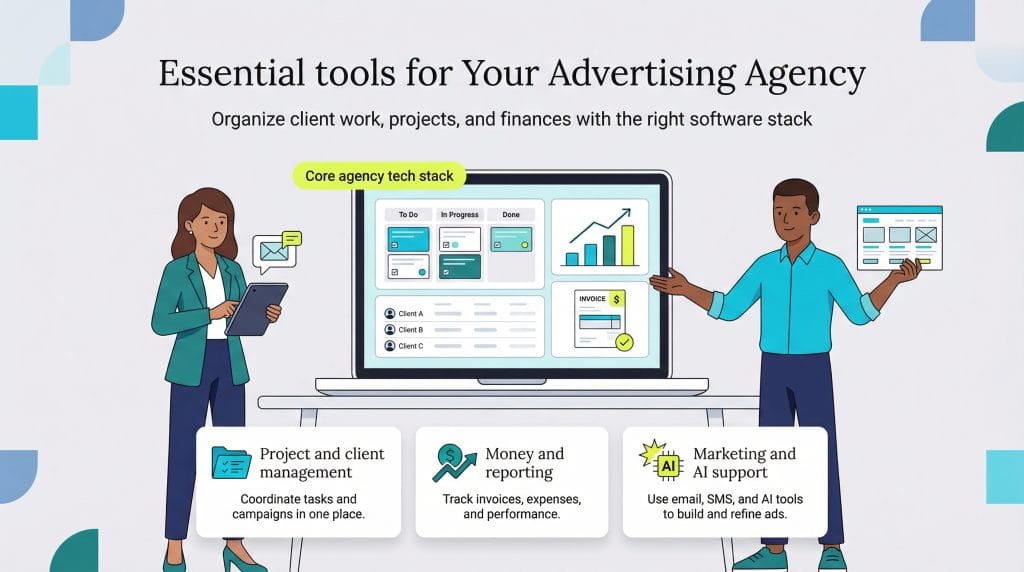
Running an advertising agency requires more than creative ideas. You’ll need tools to manage client work, coordinate projects, handle finances and deliver campaigns efficiently. Investing in the right software early can help you stay organized, scale your workload and present a professional operation to clients.
As you start your business, consider the following tools:
Starting an advertising agency can be a rewarding and profitable entrepreneurial path if you have the right skills and interests. Here are some of the key benefits to consider.
Miranda Fraraccio and Jenni Simcoe contributed to this article. Source interviews were conducted for a previous version of this article.