Business.com aims to help business owners make informed decisions to support and grow their companies. We research and recommend products and services suitable for various business types, investing thousands of hours each year in this process.
As a business, we need to generate revenue to sustain our content. We have financial relationships with some companies we cover, earning commissions when readers purchase from our partners or share information about their needs. These relationships do not dictate our advice and recommendations. Our editorial team independently evaluates and recommends products and services based on their research and expertise. Learn more about our process and partners here.
Social media offers women-owned businesses an accessible way to share their story, connect with customers and grow.

Starting a business hasn’t always been easy for women. Limited access to funding, smaller professional networks and fewer built-in opportunities have long made entrepreneurship a tougher path. Social media and other digital tools have helped change that. Today, women across industries are using online platforms to reach customers, share their story and grow businesses on their own terms.
If you’re looking to expand your business, a strong social media presence isn’t just helpful; it’s part of how growth happens now. Here’s what you need to know about how social media marketing can help women-owned businesses reach the right customers and build momentum.
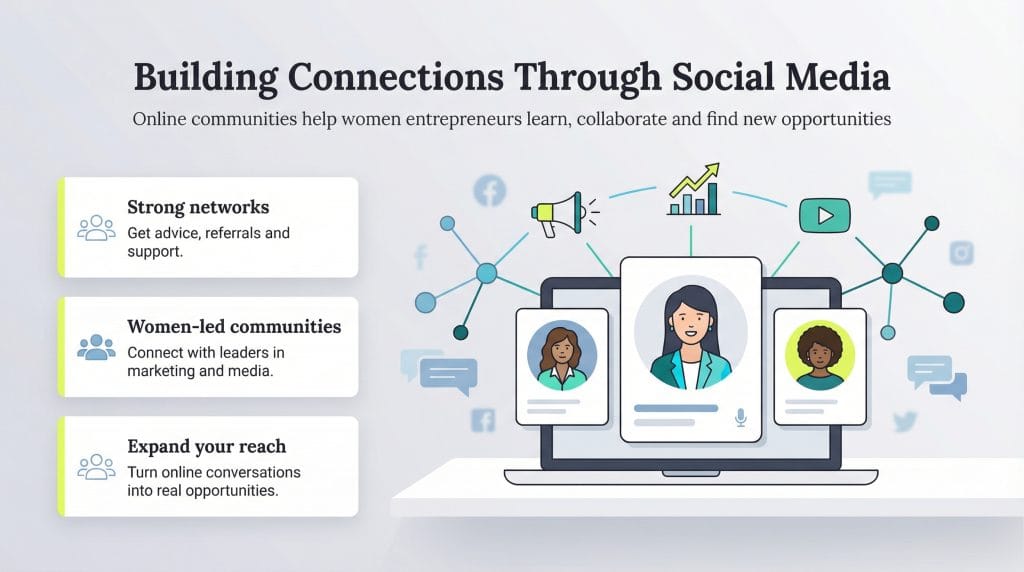
One of the most valuable aspects of social media is how easily it helps women entrepreneurs connect with one another. Beyond reaching customers, these platforms make it possible to build relationships with like-minded women, share experiences and learn from others navigating similar challenges.
Strong professional networks play an important role in long-term success. A supportive network can lead to practical advice, word-of-mouth referrals and new opportunities, especially in fields like leadership, marketing and advertising. If you’re looking to expand your network, the following organizations offer community, resources and connections for women in business:

Whether you’re launching a solopreneur venture or scaling a larger operation, it helps to think of yourself as a leader from day one. There are plenty of online tools available to support women in business, but growth starts with mindset. When you approach your work with confidence and intention, leadership follows naturally.
Social media can play a meaningful role in that growth. It gives you a way to promote your business, expand your network and build a personal brand that reflects who you are and what you offer. Used thoughtfully, social media can help you reach farther — and make a bigger impact — than you may have expected when you first started out.
Stepping into a leadership role doesn’t have to feel dramatic or intimidating. For many women, it’s simply about showing up consistently, sharing expertise and trusting the value they bring. As more women build businesses on their own terms, social media remains a powerful tool for visibility, connection and long-term growth.
Julie Thompson contributed to this article. Source interviews were conducted for a previous version of this article.











Social media marketing tools to consider
Women who use social media marketing to grow their businesses know that consistency matters. Whether you manage multiple social media accounts or focus on one platform where your audience is most active, staying organized and intentional makes all the difference.
Bartko finds her LinkedIn business profile particularly useful. “It’s a powerful platform because it targets the trifecta of your audience — your consumer, buyer and media,” she explained. “It allows you to build meaningful relationships, position yourself as an expert and consistently increase visibility in a professional space.”
As social media responsibilities grow, many businesses turn to social media management tools to simplify posting, stay organized and keep up with engagement. These platforms can help you plan content calendars, publish posts across platforms at the same time and track analytics to see what’s performing best. The right tool depends on which platforms you use, how hands-on you want to be and what features matter most to your business. Today, many of these tools also incorporate artificial intelligence (AI) to help with tasks like caption writing and optimal scheduling.
Some of the most popular social media management tools include:
While social media management tools typically come with a monthly cost, they’re often far more affordable than hiring a social media manager. Choosing the right platform comes down to evaluating features, pricing and how well a tool fits your workflow.
Smith also advises business owners not to overlook the value of built-in analytics tools on social media platforms, which can offer valuable insight into what’s actually driving results.
“Business owners often forget to read the data and only focus on the vanity metrics such as followers and likes,” Smith noted. “While those do have some importance, they do not paint the full picture of whether or not you are reaching your goals. Data points, such as reach and external link taps, for example, can help determine what content is resonating most with your audience and converting them into visiting your website, booking a call, etc. The power of data should never be underestimated.”