Business.com aims to help business owners make informed decisions to support and grow their companies. We research and recommend products and services suitable for various business types, investing thousands of hours each year in this process.
As a business, we need to generate revenue to sustain our content. We have financial relationships with some companies we cover, earning commissions when readers purchase from our partners or share information about their needs. These relationships do not dictate our advice and recommendations. Our editorial team independently evaluates and recommends products and services based on their research and expertise. Learn more about our process and partners here.
If you have a bad credit score and need a business loan, these financing options could help you secure the funding you need.


Most businesses need access to capital at one point or another, but entrepreneurs with bad credit may struggle to get funding through bank loans. So, where else can you turn if you can’t get a business loan? An entire industry of alternative lenders aims to fill the gaps when banks are unwilling or unable to lend. However, accepting money from alternative lenders requires you to be savvy, or you could dig yourself deep into debt.
Searching for funding and not sure where to start? Tell us a little more about your business and get customized quotes from qualified providers.
A FICO credit score below 600 is generally considered bad credit for a business loan, and even borrowers with a 650 credit score may struggle with rejected applications and high interest rates. Depending on your credit score, certain types of funding may be unavailable to your business.
“On the one [end] of the credit spectrum is someone who can walk into a major bank and borrow money on the business’s credit, not a personal guarantee,” said James Cassel, co-founder and chairman of Cassel Salpeter & Co. “On the other side of the rainbow are businesses that can’t get money from any kind of institutional lender.”
Credit type | Credit score range |
|---|---|
Excellent | 800 to 850 |
Very good | 740 to 799 |
Good | 670 to 739 |
Fair | 600 to 669 |
Poor | <600 |
Many alternative lenders accept credit scores as low as 500 for certain types of loans, so financing is available to most borrowers. The downside is that the worse your credit score, the more expensive the capital and the more restrictive the terms tend to be.
“The further down you are in the credit funnel, the worse the rates are,” Cassel said. “With great credit, it could be 5 percent. With bad credit … it could be the equivalent of 40 percent.”
| Loan Type | Typical Credit Score Range | Typical Loan Amount Range |
|---|---|---|
| Merchant Cash Advance | 500 – 550 | $5K – $500K |
| Invoice Factoring/Financing | 530 – 550 | Varies (% of invoice value) |
| Online Term Loan (Alternative Lender) | 580 – 620 | $5K – $500K |
| Business Line of Credit | 600 – 680 | $10K – $1M |
| Equipment Financing | 600 – 650 | $5K – $500K |
| SBA Microloan | 620 – 640 | $500 – $50K |
| Startup/Personal Loan for Business | 650 – 700 | $1K – $100K |
| SBA 7(a) Loan | 680 – 700 | $50K – $5M |
| Conventional Bank Term Loan | 680 – 720 | $25K – $5M+ |
| Commercial Real Estate Loan | 680 – 700 | $100K – $5M+ |
If your current credit score falls within the fair or poor ranges, these are some of the best business loans available to you:
Do your homework before accepting any type of funding. Research the lender thoroughly to ensure they are a reputable brand and not a predatory lender. Review any repayment terms closely before signing and have your attorney and accountant review them, too, if possible. Only accept money that you can realistically pay back in the specified time. Otherwise, further financing could expedite the demise of your business.
Short-term loans are a type of small business loan that closely resembles a conventional term loan in many ways. Short-term loans carry an interest rate and require repayment of both principal and interest within a certain period, just like a bank loan. Because the term is less than a year, however, short-term lenders are more concerned with your company’s cash flow than its credit score.
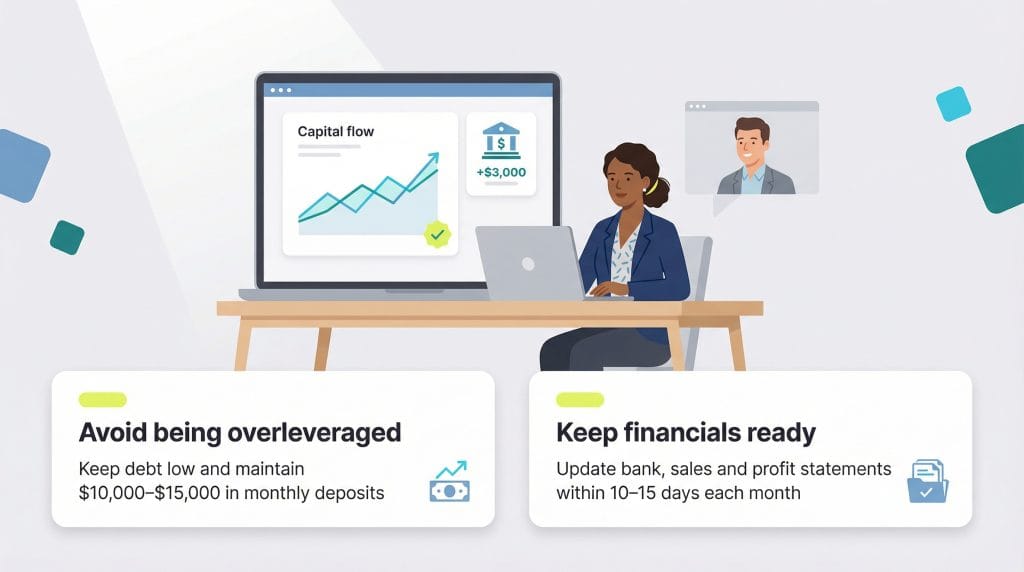
“Banks ask for all types of collateral and personal credit is very important to the bank,” said Michael Baynes, co-founder and CEO of Clarify Capital. “What’s important to us is cash flow [demonstrated] through six months of bank statements. If we feel [a business’s] bank balance can support our funding over the next four to 12 months, we’re comfortable lending to them regardless of personal credit score.”
Generally, Baynes said, alternative loans require a one-page application, along with a minimum of three months of bank statements. That’s all an alternative lender needs to approve or deny your loan application. But what exactly are alternative lenders looking for?
“The most common reason we reject an application is due to a business being overleveraged,” Baynes said. “If they already have existing debt … and we feel additional payment would overleverage them, we would turn the business down. The other reason an application would be declined is low revenue and low daily bank balances. We need to see $10,000 to $15,000 per month in revenue or deposits. If they struggle with overdrafts or negative days in their bank account, we’re not confident they can make the payments.”
The approval process for these types of alternative loans tends to be much faster than conventional banks, which could take weeks or months to approve your loan application. If approved, funding for alternative loans can often be delivered within a few days.
To expedite approval, it’s important to maintain good financial documentation. According to Cassel, keeping detailed, accurate books is one of the most important things your business can do.
“Make sure your financial house is in order,” he said. “Every business needs to have monthly financials. They need to be available no later than 10 to 15 days after the end of the month. Some businesses don’t get them until 90 days after the month. Then you’re 90 days further in the hole and it’s too late to correct it.”
Good books not only help you avoid financial trouble, but also give lenders the insight they need to make a decision on whether to extend financing to your organization.
There are advantages to repairing a damaged credit score, even if you qualify for funding. As Baynes said, an improved credit score can avail your business of better terms and rates. Rebuilding credit can be a long and arduous process, but you should do it when your financial situation has stabilized.
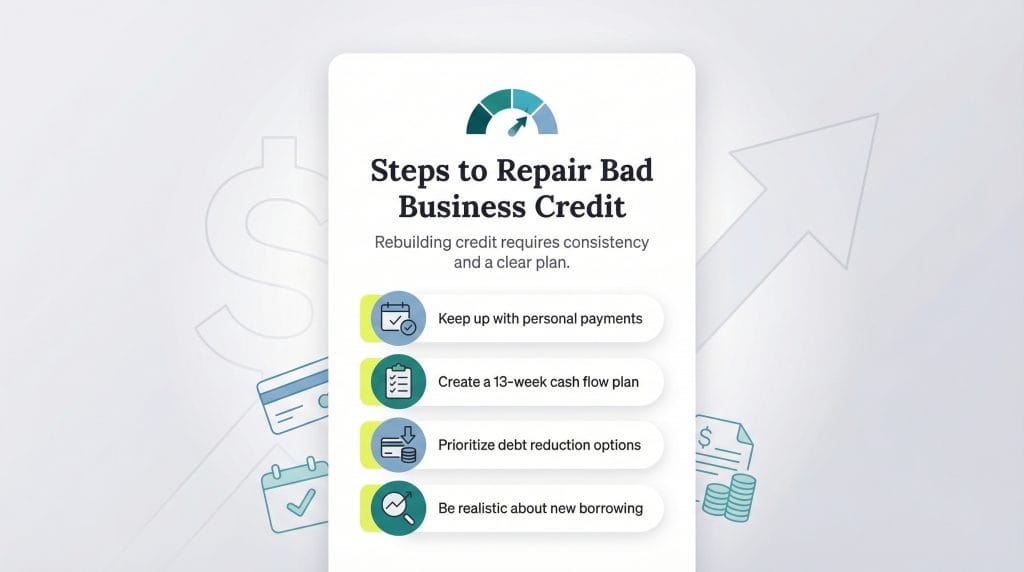
“Obviously, first and foremost is staying current on your personal credit payments,” Baynes said. “These are things like auto loans and credit cards. Maxed-out credit cards drive down your credit score. Missing payments — or just making minimum payments — brings down your credit score tremendously.”
According to Cassel, business credit rehabilitation can be extremely difficult and requires a detailed plan. While maintaining your personal credit score, you also need to keep an eye on your business’s debt service.
“When businesses get into trouble, they should put together a 13-week cash flow [projection] of expected funds in and expected funds out,” he said. “This helps them manage cash and decide what to pay for.”
There are some ways you can seek relief to stabilize your company’s financial situation, such as raising prices. You may be reluctant to raise prices, Cassel said, because you are afraid of losing customers. In many cases, however, there is more room to hike rates than you realize.
You could also ask suppliers to extend payment schedules. If you are a good customer who has kept up with payments in the past, a vendor is likely to work with you. After all, they don’t want to lose you as a customer.
If you’ve partnered with a certain lender before, they may be willing to lend a bit more to your business if they see you are on the road to financial rehabilitation. This is known as an “airball,” Cassel said.
If things become truly dire, you can usually call in a restructuring firm to reorganize operations.
“Sometimes it is a vicious cycle that is impossible to get out of,” Cassel said. “As things get worse, the cost of borrowing goes up, so you have to figure out how to stabilize the business. Once you stabilize, you can focus on repair.”
Unfortunately, when financial troubles become pervasive enough, you must reckon with the hard truth: The best option, Cassel said, is sometimes to cut your losses and stop the bleeding.
“You’ve got to look at the viability of the business,” he said. “Business owners have to be honest with themselves about long-term viability.”
Ultimately, securing financing should be a way to get your business to a better place on the credit spectrum. That way, the next time you need funding, you can successfully pursue a financial product with better rates and more favorable terms. If financing doesn’t support that type of progress, then it could just be digging your business into a deeper hole.
Cassel had this advice for struggling businesses: “Be honest, try to get a loan, and, ultimately, get back to a better lender. Some businesses never do and owners start to feel like they’re working for the bank.”
Financing can be a great tool, but, taken irresponsibly or out of desperation, expensive loans can be the death knell for your business. Always have a plan for any money you borrow and keep an open line of communication with your lenders. If you do, you could be well on the road to credit repair.
Kimberlee Leonard and Jennifer Dublino contributed to the reporting and writing in this article. Source interviews were conducted for a previous version of this article.