Business.com aims to help business owners make informed decisions to support and grow their companies. We research and recommend products and services suitable for various business types, investing thousands of hours each year in this process.
As a business, we need to generate revenue to sustain our content. We have financial relationships with some companies we cover, earning commissions when readers purchase from our partners or share information about their needs. These relationships do not dictate our advice and recommendations. Our editorial team independently evaluates and recommends products and services based on their research and expertise. Learn more about our process and partners here.
Is It Time to Hire a CPA?
Find out when it's best to let a professional handle your business's accounting and tax filing needs.
Business.com earns commissions from some listed providers. Editorial Guidelines.
Table of Contents
While some entrepreneurs file their own taxes using software or third-party services like H&R Block, these options aren’t always the best fit. In many cases, working with a certified public accountant (CPA) can provide more value. Hiring a CPA is an investment, but the expertise they bring can support your business’s growth, financial health and legal compliance.
Whether you’re facing your first tax season or managing a growing business, knowing when to bring in professional help can save money and reduce stress. We spoke with tax professionals and business leaders about when it makes sense to hire a CPA and what to consider before you do.
What is a CPA?
A CPA is a licensed professional who has passed the Uniform CPA Exam and met licensing requirements set by a state’s Board of Accountancy. The CPA designation is a professional credential that requires meeting specific education, work and examination requirements, including holding a bachelor’s degree and completing 150 hours of education.
To become a CPA, candidates must pass the rigorous Uniform CPA Exam and complete a required period of supervised professional experience, which varies by state. Following the CPA Evolution initiative launched in January 2024, the CPA exam now consists of three four-hour Core sections — Auditing and Attestation, Financial Accounting and Reporting and Taxation and Regulation — along with one four-hour Discipline section chosen by the candidate. Discipline options include Business Analysis and Reporting, Information Systems and Controls or Tax Compliance and Planning.
This structure ensures CPAs are tested on advanced knowledge in accounting practices, tax law, auditing and financial reporting.
CPA vs. accountant
While all CPAs are accountants, not all accountants are CPAs. CPAs are licensed by state boards and are authorized to perform certain regulated services, including:
Issuing audit, review or compilation reports on financial statements
Conducting external audits and signing audit reports
Representing clients before the Internal Revenue Service
CPAs must also complete continuing education requirements to maintain their license, which helps ensure they stay current with changing tax laws and accounting standards.
When to hire a CPA
If you can afford it, hiring a CPA is often a smart move, especially as your tax and financial accounting responsibilities become more complex. Trying to keep up with changing tax laws, understanding which deductions apply to your business and staying current with filings can pull your attention away from what matters most: running your business.
“As soon as you start your business, you should hire a CPA,” advised Spencer Carroll, a CPA who specializes in taxes and real estate. “Business owners all know that time is money. Hiring a CPA to manage a company’s taxes allows employees to focus on other key areas of the business and its goals.”
While hiring a CPA right away may not be feasible for every business, it is strongly worth considering if your situation includes any of the following:
Startups: Even new businesses can benefit from CPA guidance early on. Decisions around business structure, accounting methods (such as cash- vs. accrual-based accounting) and tax elections can have long-term financial consequences. Many startups don’t have an in-house finance team, and a CPA can help set up compliant systems from day one.
Complex tax situations: Multiple revenue streams, multistate or international operations and inventory-heavy businesses often face complex tax situations that require professional expertise.
IRS audits and compliance issues: If you’re behind on taxes, facing a tax audit or responding to notices from the IRS or state tax agencies, a CPA can help represent your interests and reduce the risk of costly mistakes. This may also apply if you suspect internal accounting irregularities.
Growth events and major business changes: Events such as raising capital, pursuing an acquisition or preparing for a potential exit often require higher-level financial reporting and guidance that a CPA is qualified to provide.
Major life changes: Personal or business changes, such as marriage, divorce, retirement planning or changes in ownership, can trigger complex tax implications that benefit from professional advice.
What to consider when deciding whether to hire a CPA
Before hiring a CPA (or deciding to manage your finances on your own), consider the following factors:
Your current financial picture: Can you generate accurate financial statements, including balance sheets and profit and loss statements, on your own? Even if you can, consider how much time it takes to produce these reports and whether that time would be better spent running your business.
Your understanding of personal vs. business income: Understanding the difference between personal and business income is essential for small business owners, particularly when it comes to accurate tax reporting and compliance.
Your accounting cycle: Are you confident you understand your accounting cycle, including how to manage accounting periods and maintain consistent financial oversight throughout the year?
Your legal structure and tax obligations: Your business structure, whether a sole proprietorship, C corporation, S corporation or partnership, affects how you’re taxed. Misunderstanding these rules can lead to compliance issues or unexpected tax liabilities.
The complexity of your revenue sources: Businesses with multiple revenue streams, multistate or international operations or industry-specific requirements often benefit from CPA expertise.
Your knowledge of tax laws and regulations: Tax rules change frequently, and keeping up with those changes can be challenging. A CPA can help you identify which deductions apply to your business and ensure you meet evolving requirements.
Unique financial complexities: If your business manages complex inventory, accounts receivable or cash flow cycles, a CPA can help align your accounting approach with accurate reporting and compliant tax filings.
“CPAs can enhance a company’s financial strategy and optimize their tax strategy to reduce their tax bill, all while increasing the accuracy of their tax returns,” Carroll said. “Companies that try to organize their taxes on their own are more likely to run into errors.”
For John Kinskey, CEO and president of AccessDirect, working with a CPA has been well worth the investment.
“I use a CPA to do my taxes and wouldn’t consider doing it on my own,” Kinskey said. “[Eliminating the headaches] of trying to keep up with all the shifting changes in tax laws — and just the sheer amount of detail required to file state and federal tax returns — is well worth paying a professional.”
Did You Know?
CPAs and tax consultants can help with strategic tax planning, not just filing, which is especially valuable for businesses with complex finances or long-term growth plans.
How to hire the right CPA: step-by-step guidance
Hiring the best CPA for your business requires researching and interviewing candidates.
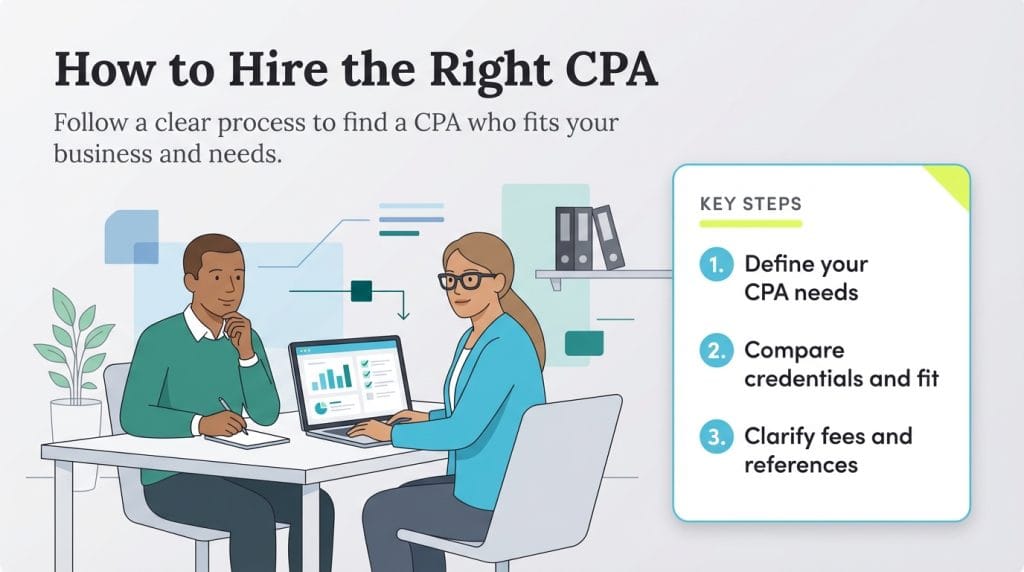
The right CPA can save you time, reduce risk and help you make better financial decisions. Use the steps below to evaluate your options and choose the right fit.
1. Define your needs.
Before you begin your search, take stock of where a CPA would actually add value. That might be limited to tax preparation, or it could include ongoing bookkeeping, audit support or help with more strategic financial planning. Having a clear sense of that scope upfront makes it easier to evaluate whether a CPA’s background aligns with your business.
2. Research potential candidates.
Start by asking for referrals from other business owners in your industry, your banker or trusted professional contacts. It’s best to look for CPAs who regularly work with businesses similar to yours in size and industry.
If you need help finding qualified candidates, state CPA societies and the American Institute of Certified Public Accountants have directories of licensed CPAs who meet state certification standards. You can also search the IRS directory of credentialed tax professionals, which lists accountants and preparers with active preparer tax identification numbers.
As you research options, you’ll also need to decide whether to work with an independent CPA or a firm:
Independent CPA: An independent, freelance CPA typically works alone and may be more hands-on and cost-effective for businesses with straightforward needs.
CPA firm: Firms often have multiple CPAs on staff, so it’s easier to get help during busy-season workloads. They can also access specialists if there are complicated issues, such as international tax or mergers. That structure often makes more sense for fast-growing businesses.
3. Verify credentials and specialization.
Make sure any CPA you’re considering is licensed in your state and in good standing with the state board of accountancy. It’s also worth checking for any disciplinary history and confirming the CPA has experience relevant to your business or industry.
4. Conduct interviews.
Schedule conversations with a few promising CPAs before making a decision. These meetings are less about credentials and more about how well they’ll fit into your business. How clearly do they explain things? How responsive are they? Do they seem to understand how your business actually operates? It’s also worth asking how they handle deadlines and workload during peak periods.
5. Review fee structure.
Understand how each CPA charges for services, whether hourly, by project or through a retainer. Request detailed estimates for the services you need and clarify what’s included versus what may cost extra.
6. Check references.
Ask for job references from current clients, ideally those with businesses similar to yours. Inquire about reliability, communication and overall quality of work.
FYI
There are more than 653,000 licensed CPAs nationwide, but that doesn’t mean they’re easy to book. Retirements and fewer new accountants entering the field have tightened availability, especially during tax season. Starting your search earlier gives you more choices.
CPA pre-hire checklist
Before you make a final decision, it’s worth double-checking a few basics. Use this list to confirm you’re hiring a CPA who’s properly credentialed, a good operational fit and clear about scope and cost.
Working knowledge of the tax laws and regulations that apply to your business
Communication and availability
A communication style that matches how you prefer to work
Reasonable response times for questions and requests
Availability during busy periods, including tax season
Comfort working with your existing technology, such as cloud-based accounting software and document-sharing tools
Fees and engagement terms
A clear fee structure and billing approach
A written engagement letter outlining services and costs
A defined scope of work and expected deliverables
Clear cancellation terms and policies for returning your data
Pros and cons of hiring a CPA
Before hiring a CPA, weigh the benefits of expertise against the cost.
Pros of hiring a CPA
Cons of hiring a CPA
Deep knowledge base
Expensive
Audit support
Still requires adequate bookkeeping
Additional financial modeling support
Limited availability
CPAs can be a huge asset for businesses that want help managing finances and tax responsibilities more effectively. That said, hiring a CPA comes with costs and trade-offs, so it’s worth weighing both sides before making a decision.
Consider the following advantages and disadvantages before deciding whether to hire a CPA.
Pros of hiring a CPA
CPAs help reduce errors: Accounting and tax rules change frequently, and CPAs are trained to stay current on those updates. Their expertise can help you avoid accounting mistakes that lead to penalties, amended returns or unnecessary scrutiny.
CPAs may help you save money: A CPA can identify deductions and credits you might otherwise miss and provide guidance on tax planning and larger financial decisions that affect your bottom line.
CPAs can save you time:IRS time-burden estimates show that completing Schedule C alone can take more than seven hours, including recordkeeping and tax preparation. That figure doesn’t include estimated payments, state filings or year-round bookkeeping. For many business owners, turning this work over to a CPA frees up far more time than the form itself suggests.
CPAs are experienced in working with the IRS: If you’re audited or dealing with back taxes, a CPA can help you respond appropriately and navigate the process. Their involvement may help limit penalties, clarify what you owe and keep issues from escalating.
Tip
Consider using one of the best online payroll services to handle payroll runs and related payroll taxes. These tools are often more affordable than full-service accounting support and can help ensure payroll tax compliance.
Cons of hiring a CPA
CPAs can be expensive: CPAs complete extensive education and licensing requirements, which is reflected in their rates. Depending on the scope of work, location and experience level, small businesses may see hourly rates ranging from roughly $150 to $400 or more. For businesses with tight margins, that cost can be difficult to justify.
CPAs have busy schedules: The weeks leading up to the April 15 tax deadline are typically the busiest time of year for CPAs, with another spike toward year-end. During these periods, their attention is spread across many clients. As a result, response times may slow, and returns can take longer to complete.
CPAs may be harder to find: Demand for CPAs remains high, particularly during peak tax season. If you wait until the last minute, you may have fewer options — or none at all.
You may still need day-to-day accounting help: CPAs typically focus on higher-level work such as tax planning, compliance and financial strategy rather than routine bookkeeping. Many businesses may still hire a bookkeeper for daily tasks, though some CPAs offer bookkeeping services as an add-on.
CPA FAQs
CPA rates vary based on location, experience and the scope of work. In many markets, hourly rates fall between $150 and $400, though highly specialized consulting can cost more. At larger firms, junior staff may bill at lower rates, while senior partners typically charge more for complex or advisory work.
Hiring a CPA usually starts with a consultation, followed by a written engagement agreement. Before you commit, take time to research candidates. Look for a CPA who has experience with businesses like yours and be clear about what you need help with, whether that’s tax filing, financial statements or budget planning. Reviews and referrals can also help you gauge communication style, which matters if the CPA will interact with your team or outside partners.
Beyond licensure, look for experience in your industry and familiarity with the tax and accounting rules that apply to your business. It’s also worth considering whether the CPA’s firm size and service model fit your needs. Responsiveness, clear communication and the ability to scale support during busy periods are just as important as credentials.
A CPA is an accountant who is licensed by their state after meeting education, exam and experience requirements. That license allows CPAs to perform certain regulated services, such as issuing audit and review reports and representing clients before the IRS. While all CPAs are accountants, not all accountants are CPAs, and non-licensed accountants are more limited in the services they can legally provide.
You may want to hire an accountant when managing your finances starts to take more time or expertise than you can comfortably handle. For very simple sole proprietorships, basic bookkeeping or tax software may be enough. As transactions, expenses or reporting needs grow, working with an accountant (or a CPA) often makes sense.
Non-CPA accountants and bookkeepers typically charge less than CPAs. Hourly rates often range from $40 to $150, depending on experience and services provided. More specialized or in-demand professionals may charge higher rates.
The time required depends on how complex your tax situation is. A simple individual return may be completed relatively quickly, while business returns take longer due to additional forms, deductions and reporting requirements. Factors such as payroll, inventory, multiple revenue streams or prior-year issues can also add time. Even so, working with an accountant generally reduces the overall burden compared with preparing a business return on your own.
Amanda Hoffman and Jennifer Dublino contributed to this article. Source interviews were conducted for a previous version of this article.
For almost a decade, Max Freedman has been a trusted advisor for entrepreneurs and business owners, providing practical insights to kickstart and elevate their ventures. With hands-on experience in small business management, he offers authentic perspectives on crucial business areas that run the gamut from marketing strategies to employee health insurance.
At business.com, Freedman primarily covers financial topics, including debt financing, equity compensation, stock purchase agreements, SIMPLE IRAs, differential pay, workers' compensation payments and business loans.
Freedman's guidance is grounded in the real world and based on his years working in and leading operations for small business workplaces. Whether advising on financial statements, retirement plans or e-commerce tactics, his expertise and genuine passion for empowering business owners make him an invaluable resource in the entrepreneurial landscape.