Business.com aims to help business owners make informed decisions to support and grow their companies. We research and recommend products and services suitable for various business types, investing thousands of hours each year in this process.
As a business, we need to generate revenue to sustain our content. We have financial relationships with some companies we cover, earning commissions when readers purchase from our partners or share information about their needs. These relationships do not dictate our advice and recommendations. Our editorial team independently evaluates and recommends products and services based on their research and expertise. Learn more about our process and partners here.
Learn what employee benefits your company should offer and how providing benefits can strengthen your business.


While a competitive salary is certainly a priority for many employees, it’s not the only thing they care about. Job seekers also look for a great company culture, a positive work-life balance and a comprehensive benefits plan when searching for a place to work. Businesses that fall short in these areas risk losing strong candidates and struggling to retain key employees.
By offering competitive employee benefits, your company can attract top talent, keep current employees happy and build a positive reputation. Below, we’ll explain how to create a robust employee benefits plan and highlight the advantages these packages can bring to your business.
Employee benefits are forms of nonwage compensation employees receive in addition to their salary, such as health insurance, retirement plans, paid time off (PTO) and wellness programs. Some of these benefits are legally required, while others are optional perks employers use to attract and keep great employees.
The benefits your company provides will vary, but they should make sense for your workforce, budget and company culture.
When an employer creates an employee benefits package, it can be offered as a standard set of benefits or as a plan that lets employees choose from several options. If optional benefits are available, employees typically make their selections during the annual open enrollment period.
Employee benefits plans generally work through the following steps:
After employees enroll, the employer is responsible for administering and managing the benefits plan throughout the year. This process — often called employee benefits management — includes maintaining plan records, coordinating with insurance providers, updating employee elections after qualifying life events and ensuring payroll deductions and employer contributions are processed correctly. Many businesses use one of the best HR software or benefits administration platforms to help manage these responsibilities and keep their plans compliant.
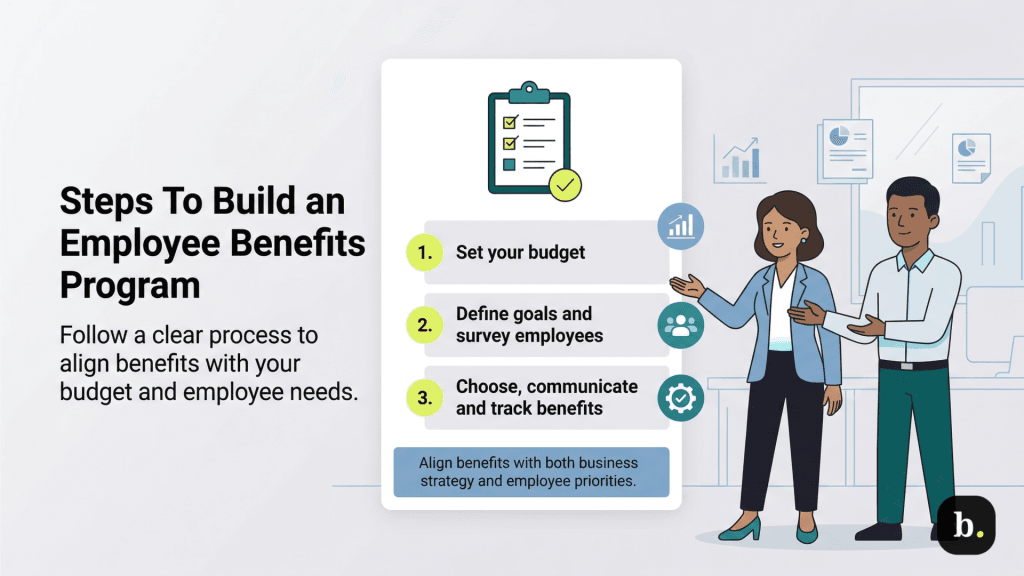
Employers and HR leaders must consider both the company’s goals and employees’ needs when designing a benefits package. Below are seven steps you can follow to build a strong employee benefits program.
Before selecting specific benefits, determine how much your business can realistically spend on an employee benefits program. Here’s how to conduct your benefits budget planning:
Before finalizing your benefits package, decide what you want your benefits program to accomplish. For example, your goal might be to improve employee retention, attract stronger job candidates, support employees’ health and well-being or stay competitive with benefits offered by similar companies in your industry.
Vincent DiDonna, national employee benefits operations leader for World Insurance Associates, said employers who view benefits as a way of caring for their employees — rather than simply meeting an obligation — often see higher employee engagement and greater appreciation for their benefits programs.
“While being cognizant of budget, employers can genuinely make an impact on the lives of their employees by offering a robust, well-rounded benefits package consisting of both employer-paid and employee-paid benefits,” DiDonna said. “Giving employees options helps signal that the employer took their wants and needs into account when selecting benefits. Ultimately, this approach leads to higher employee satisfaction, translating into a more loyal and productive workforce.”
To build a benefits program employees will actually value, gather input from your workforce. Conduct an employee benefits survey with questions designed to reveal what employees care about most, such as health coverage options, retirement plans, flexible work arrangements or wellness benefits.
When designing your survey, consider including scenario-based questions that show how employees would respond in real-life situations. For example, you might ask whether employees would prefer a plan with higher monthly premiums but lower out-of-pocket costs, or a cheaper plan with higher deductibles. These questions can often reveal what benefits people value most.
You can also work with a benefits broker or consultant who can help analyze employee feedback, identify benefits that align with your workforce’s needs and recommend potential vendors.
Once you’ve established your budget and gathered employee input, decide which benefits best align with your company’s goals and workforce needs. Focus on the benefits employees value most while keeping an eye on what similar businesses in your industry offer.
Many employers start with a core set of benefits — such as health insurance, retirement plans and paid time off — and then add optional perks that reflect their company culture or workforce priorities. Flexible work arrangements, wellness programs and professional development benefits are common ways businesses expand their offerings.
At this stage, you’ll also decide how benefits will be structured, including which benefits your company will fully fund and which employees can choose as optional, employee-paid benefits.
Once you’ve decided which benefits to offer, choose a provider that can administer your plan and support your employees. Many businesses work with benefits brokers, insurance carriers, one of the best professional employer organizations (PEOs) or an HR software platform that bundles benefits administration with payroll and HR tools.
When considering providers, compare their plan options, pricing, administrative support and how easily the system integrates with your current payroll or HR software. Some platforms also help employees enroll in benefits, update coverage after qualifying life events and manage contributions throughout the year.
Even the best benefits package won’t have much impact if employees don’t understand what’s available to them. Once your benefits program is in place, clearly explain the options employees can choose and how the enrollment process works.
Many employers introduce benefits during the onboarding process and revisit them during open enrollment each year. Provide employees with clear plan summaries, outline any enrollment requirements and remind them of important deadlines so they can make informed decisions about their coverage.
Once your benefits program is in place, keep an eye on how employees actually use the benefits you offer. Reviewing participation rates, enrollment trends and employee feedback can help you understand which benefits employees value most and which ones might need adjustment.
Low participation doesn’t always mean a benefit isn’t useful. Some voluntary benefits appeal only to certain groups of employees. However, consistently low enrollment in core benefits like medical or dental coverage could signal that the plan design doesn’t meet employees’ needs or that the costs are too high during open enrollment.
Regularly reviewing benefits participation data can help you spot gaps, adjust your offerings and make sure your benefits program continues to support your workforce as your business grows.
Employers typically offer a mix of core benefits employees expect and additional perks that help round out their overall benefits package.
DiDonna noted that medical, dental, vision, life and disability insurance — along with tax-advantaged health spending accounts such as flexible spending accounts (FSAs) and health savings accounts (HSAs) — are among the benefits many employees expect to see.
“From there, employers can offer a variety of benefits on both an employer-paid or employee-paid basis to help round out their overall benefits offering,” DiDonna explained. “It is typically here where employees compare and contrast benefits packages when evaluating multiple job offers.”
In general, employee benefits fall into three categories: legally required benefits, commonly offered benefits and additional fringe benefits that can help employers stand out.
Employers must provide certain benefits to comply with federal and state labor laws. These requirements vary based on factors such as company size and location, but some of the most common legally required benefits include the following:
Some states and municipalities require additional benefits, such as paid leave (e.g., paid sick leave and family leave) or disability insurance. Employers should check with their state and local labor departments to determine which benefits apply to their business.
These are some of the most common benefits employers offer their employees:
Fringe benefits are additional perks employees receive beyond their standard salary or core benefits. These offerings can help employers make their workplace more attractive and support employees’ personal and professional needs.
When deciding which fringe benefits to offer, consider what would be most valuable to your workforce and what aligns with your business. For example, companies with many working parents might offer child care assistance, while a fitness-focused business could provide free or discounted gym memberships.
These are some other possible fringe benefits:
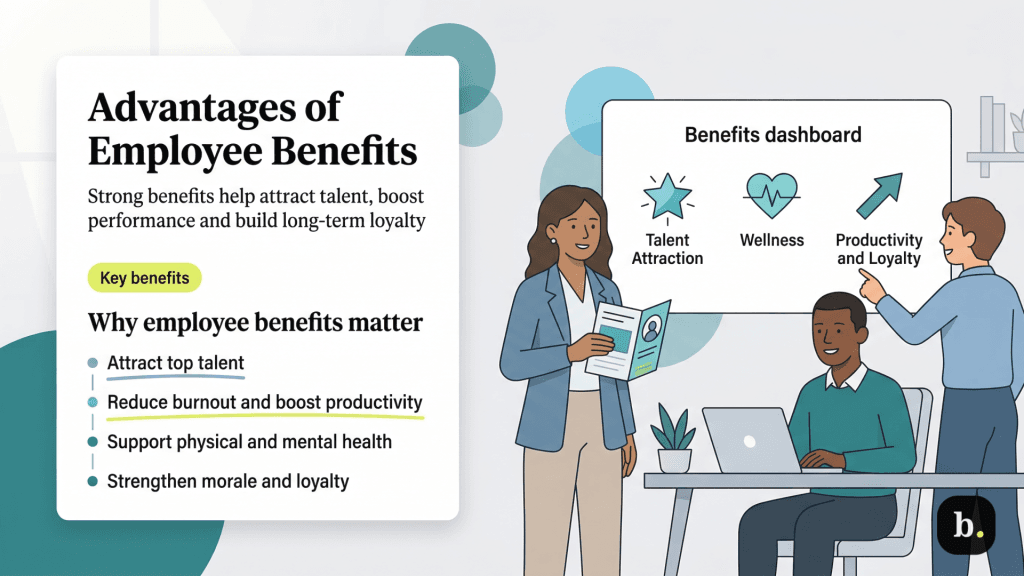
Employee benefits don’t just help workers — they can also give employers a competitive advantage. Here are four ways offering strong benefits can help your business.
The cost of employee benefits varies widely depending on factors such as company size, location and the types of benefits offered. Both employers and employees typically share the cost of benefits through employer contributions and payroll deductions.
According to the Bureau of Labor Statistics, private industry employers spent an average of $46.05 per hour on total compensation in the third quarter of 2025, including $13.68 per hour on employee benefits — about 30 percent of overall compensation.
Health insurance is typically the most expensive benefit employers offer. However, payroll taxes for Social Security and Medicare, paid time off and retirement contributions can also represent significant benefit costs.
Employers can manage benefits expenses in several ways. For example, they may offer multiple plan options, including high-deductible health plans with lower premiums. Some businesses also provide wellness programs or preventive care incentives that can help reduce long-term healthcare costs.
The amount employees pay for benefits depends on the type of coverage they select, how their employer’s plan is structured and their individual circumstances. In most cases, employees share the cost of benefits through premiums, deductibles, copays and coinsurance. Health, dental and vision insurance — along with retirement plans — are among the benefits employees most commonly contribute toward.
According to the 2025 KFF Employer Health Benefits Survey, the average annual premium for employer-sponsored health coverage is $9,325 for single coverage and $26,993 for family coverage. On average, workers contribute $1,440 per year toward single coverage and $6,850 toward family coverage.
Employees should carefully consider the cost of benefits when evaluating job offers and selecting coverage during open enrollment. Reviewing benefits statements and plan details regularly can also help employees better understand their costs, coverage and out-of-pocket responsibilities.
Kimberlee Leonard contributed to this article. Source interviews were conducted for a previous version of this article.