Business.com aims to help business owners make informed decisions to support and grow their companies. We research and recommend products and services suitable for various business types, investing thousands of hours each year in this process.
As a business, we need to generate revenue to sustain our content. We have financial relationships with some companies we cover, earning commissions when readers purchase from our partners or share information about their needs. These relationships do not dictate our advice and recommendations. Our editorial team independently evaluates and recommends products and services based on their research and expertise. Learn more about our process and partners here.
The bureaucratic management theory claims it will increase your business’ efficiency.

Max Weber, a German sociologist, believed bureaucracy was the most efficient way to run both private businesses and public institutions. His ideas shaped how many businesses and government agencies were structured in the 20th century and still influence organizations today. Weber’s management theory, often called bureaucratic theory, focuses on clear rules, defined responsibilities and a formal chain of authority.
Weber viewed bureaucracy not as an obstacle but as the ideal framework for organizing complex operations. He argued that as companies grow, they need formal systems to increase productivity and maintain control as employee counts and responsibilities expand.
“Precision, speed, unambiguity, knowledge of files, continuity, discretion, unity, strict subordination, reduction of friction and of material and personal costs — these are raised to the optimum point in the strictly bureaucratic administration,” Weber said.

Max Weber’s management theory encourages efficiency.
In Weber’s ideal bureaucracy, employees are treated consistently, and work is divided based on expertise. A clear hierarchy spells out reporting lines and who has business decision-making authority.
“Everyone in the organization should know their role, who they report to and who’s accountable for what,” explained Luke Beerman, CEO and founder of Freedom Fence FL. “This structure avoids confusion, speeds up decision-making and ensures accountability from top to bottom.”
Advancement is based on merit, qualifications and performance rather than personal relationships. Weber believed the workplace should be professional and impersonal, with personal relationships kept separate from business decisions. At its core, his approach to business management prioritizes efficiency, consistency and a clear chain of authority.
Even agile startups and small to midsize businesses (SMBs) can benefit from some of Weber’s structural ideas. You don’t need a rigid bureaucracy, but applying a few core principles can add stability and clarity as your company grows. Here are a few ways to use Weber’s approach.
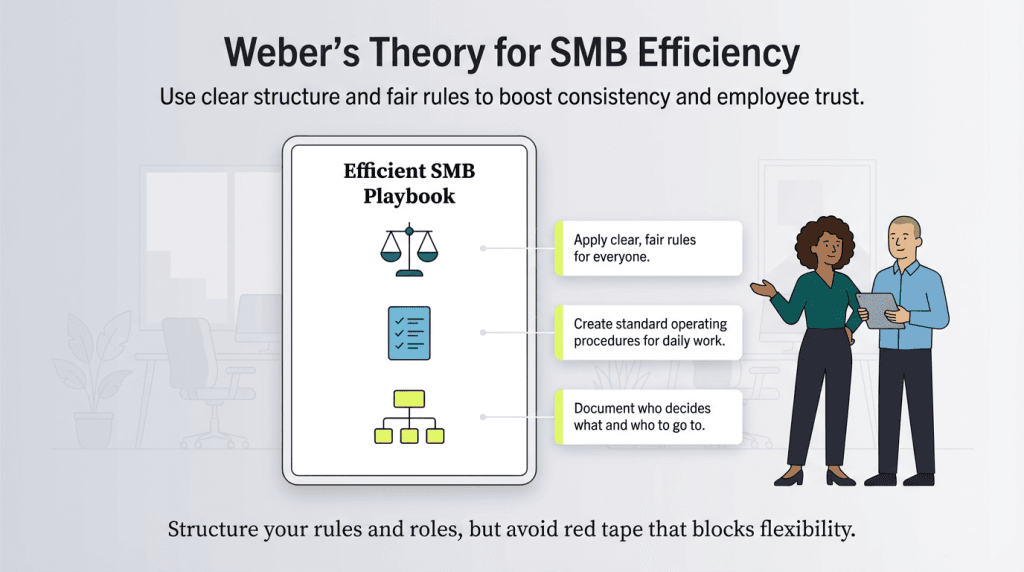
Clear, consistent rules help employees feel confident that decisions are fair, which can improve morale and trust. For example, a well-defined employee handbook sets expectations around dress codes, company values, employee rights and appropriate behavior with co-workers and customers.
“These official guidelines form the foundation of the company, offering a transparent framework for decision-making and helping ensure procedures are followed consistently,” said Jonathan Hinton Westover, Ph.D., chair and professor of organizational leadership and change at Utah Valley University and a consultant at Human Capital Innovations.
Weber’s emphasis on formal rules shows up today in standard operating procedures (SOPs). For growing businesses, SOPs act as written playbooks that spell out how work gets done, so everyone follows the same process and new hires can get up to speed faster. They’re also critical for safety; for example, step-by-step instructions for operating heavy machinery help prevent mistakes that could lead to workplace accidents and injuries or costly downtime.
Beerman said standardized processes for operations, employee behavior and customer interactions help maintain consistency and simplify onboarding. “For example, clear guidelines on handling customer complaints or processing orders can prevent a lot of headaches,” Beerman noted.
Clear roles and specialization can also reduce confusion. When employees understand where their responsibilities begin and end, businesses avoid duplicated work and wasted time. Specialization also helps companies develop expertise and place people in roles where they’re most effective.
As remote work plans and hybrid work arrangements become more common, documented hierarchies matter more than ever. Small businesses can benefit from creating organizational charts that clarify who reports to whom and where decisions are made. Clear power structures improve organizational performance and efficiency by giving employees a straightforward reference for who to contact with questions or approvals.
“Weber believed every employee should report to a supervisor within a clear chain of command,” Westover explained. “When subordinates are accountable to their managers, decisions move more smoothly from the top down.”
Clear reporting lines can also help employees at the same level understand their responsibilities and feel accountable for their work, which can help create a culture of empowered employees and coordinated teams.
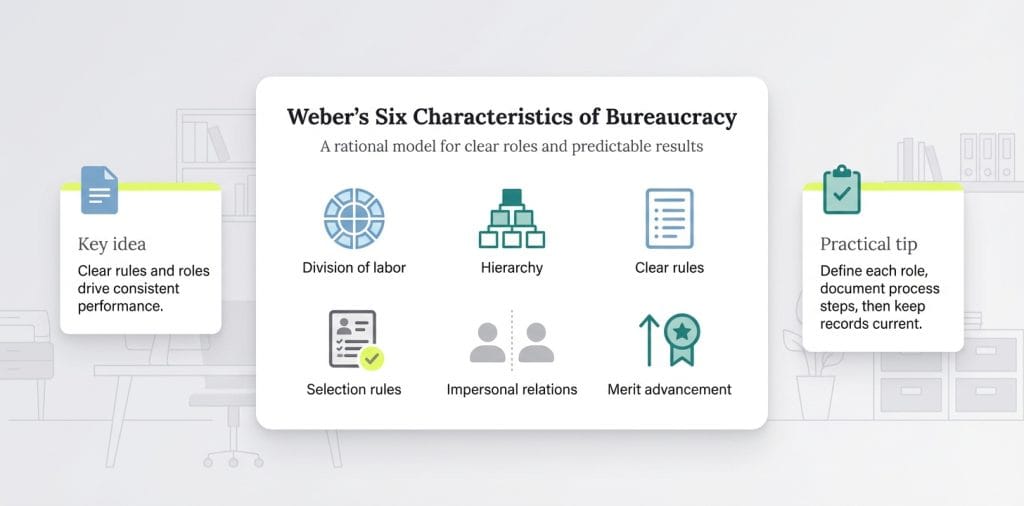
Weber believed organizations should be designed and run in a logical, formal and impersonal way. “He argued that following clearly defined rules could help companies build more predictable structures and, over time, improve performance,” Westover said.
Here are six characteristics of bureaucracy that Weber outlined.
Beyond the six core characteristics, several additional elements reinforce the structure, accountability and professionalism central to Weber’s ideal bureaucracy. These traits support the efficiency and predictability that Weber believed were essential for effective business management.
Weber’s bureaucratic approach laid the groundwork for modern organizational structure, but it isn’t the only way to run a business. Over time, newer management theories have emphasized the human side of work, including employee motivation, relationships and culture. Some of these theories contrast sharply with Weber’s focus on formal rules and hierarchy. Here’s a look at some notable ones:
Elton Mayo’s human relations management theory grew out of the Hawthorne experiments and highlights the role of social factors in productivity. Mayo argued that employees are motivated not just by pay or working conditions but also by workplace teamwork, communication and a sense of belonging.
Mayo vs. Weber: Elton Mayo’s management theory takes a very different view of people and relationships at work than Weber’s bureaucratic model. Weber emphasized structure, hierarchy and impersonal decision-making to promote fairness and consistency. Mayo focused instead on employee collaboration, morale and informal social dynamics as important drivers of productivity and engagement.
Frederick Taylor’s management theory, often called scientific management or “Taylorism,” centers on making work more efficient and repeatable. Taylor believed managers could study how tasks are performed, break them into smaller steps and redesign jobs so work gets done faster and more consistently.
His approach popularized the idea of “a fair day’s pay for a fair day’s work,” where tasks are carefully analyzed and productivity standards are set. Employees who met those standards were rewarded, while those who didn’t could face reduced pay or other consequences.
Taylor vs. Weber: Taylor and Weber looked at management from different angles. Taylor focused on individual productivity and performance management, while Weber focused on creating structured organizations with clear hierarchies.
Taylor tied motivation to measurable output and financial rewards, while Weber emphasized rules, consistency and neutral decision-making over individual incentives.
Developed around the same time as Taylor’s work, Frank and Lillian Gilbreth’s management theory advocates the reduction of unnecessary tasks and motions. Their theory breaks down tasks into their smallest components, identifying ways to reduce time and effort through precise and deliberate movements.
Gilbreth vs. Weber: The Gilbreths took a different approach from Weber’s focus on hierarchy and formal rules. Their work centered on human factors, ergonomics and reducing physical strain to improve productivity. Rather than restructuring organizations, they showed how small changes in tools, workspace design and task flow could boost efficiency and employee well-being.
Mary Parker Follett’s management theory focuses on shared power and collaboration between managers and employees. Instead of viewing authority as top-down, Follett argued that organizations work best when leaders and employees participate in decision-making together.
Follett vs. Weber: Follett saw workplace conflict as a natural part of work and believed it could lead to better outcomes when handled through collaboration and integration. This view contrasts with Weber’s emphasis on hierarchy and impersonal decision-making.
Follett emphasized open communication, shared authority and flexible leadership, ideas that helped shape modern human resource management. Her work encouraged leaders to value employee input and use it to drive growth, innovation and stronger team performance.
Henry Gantt’s management theory focused on scheduling, task tracking and incentives to improve productivity. He emphasized clear timelines, task-based planning and employee bonus systems that reward employees for meeting deadlines. His most famous contribution, the Gantt chart, is a visual project management tool that helps managers track progress, assign resources and keep projects on schedule.
Gantt vs. Weber: Where Weber focused on structure and hierarchy, Gantt focused on getting work done. His system centers on timelines, task management and incentives that encourage employees to hit goals and stay on schedule.
Gantt also believed managers should guide and support employees, not just enforce rules, which introduced a more flexible and people-centered leadership style than Weber’s impersonal approach.