Business.com aims to help business owners make informed decisions to support and grow their companies. We research and recommend products and services suitable for various business types, investing thousands of hours each year in this process.
As a business, we need to generate revenue to sustain our content. We have financial relationships with some companies we cover, earning commissions when readers purchase from our partners or share information about their needs. These relationships do not dictate our advice and recommendations. Our editorial team independently evaluates and recommends products and services based on their research and expertise. Learn more about our process and partners here.
Requirements for Keeping Paycheck Records
Employers are required to keep thorough paycheck records, and the rules aren't always simple. Here's what you need to know.
Business.com earns commissions from some listed providers. Editorial Guidelines.
Table of Contents
A crucial aspect of managing payroll records is knowing how long to keep them, and unfortunately, the rules aren’t straightforward. Federal law says payroll records must be kept for three years (and tax documents for four), and some states may require you to keep them as long as six years. With so many overlapping requirements, a solid recordkeeping system isn’t just good practice — it’s key to staying compliant and avoiding problems when questions come up.
Searching for payroll software or services and not sure where to start? Tell us a little more about your business and get customized quotes from qualified providers.
Most companies store these records digitally now, which helps keep everything organized and easy to retrieve, but the format matters less than following the rules. We’ll break down the different types of paycheck records, how long you’re required to keep each one and the best ways to manage payroll documents so you avoid employee disputes, messy accounting meetings and unwanted attention from the IRS.
What are paycheck records?
Paycheck records are the documents that show how you pay your employees and how you calculate those payments. They cover everything from hiring forms and W-4s to timecards, pay stubs, direct deposit authorizations and any paperwork tied to employee benefits.
In short, these records need to clearly show an employee’s pay rate, tax withholdings, benefit deductions and whether they’re classified as salaried or hourly employees. If it affects someone’s paycheck, there should be a record of it — and you’re required to keep it.
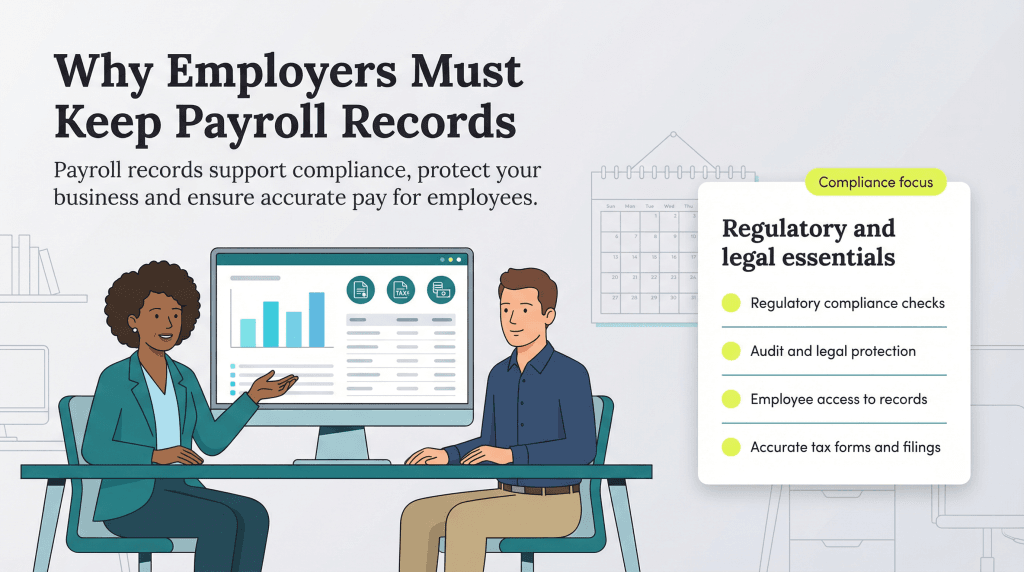
Why do employers have to keep payroll records?
Employers are required to keep payroll records for several important reasons, including the following:
Regulatory compliance: Federal and state agencies set strict retention rules and can review a company’s payroll records at any time, often without advance notice.
Audit and legal protection: Paycheck records create a documented trail that can protect your business during a tax audit, an employee complaint or a business lawsuit.
Employee access rights: Workers in many states have the right to review their payroll records, which helps them verify accuracy and request corrections when something looks off.
Accurate tax reporting: Reliable payroll documentation makes it possible to prepare quarterly tax filings, annual W-2s and 1099s, and other required forms correctly and on time.
Which payroll record items are employers required to keep?
Federal rules set the baseline for how long you’re required to hold onto different payroll documents, and the timelines vary depending on the type of record. Here’s a quick breakdown of the minimum federal retention periods:
Record type
Storage length requirement
Personal and employment records
1 year
Hiring documents
1 year
Merit increases and pay grade changes
1 year
Form I-9s (three years after hire or one year after termination, whichever is later)
3 years
Timecards and timesheets
3 years
Employee handbooks
3 years
Family and Medical Leave Act (FMLA) leave records
3 years
Termination documents
3 years
Benefit plan participant records
3 years
Payroll documents (FLSA)
Payroll forms
Pay and benefits information
Pay stubs
W-4 forms
Payment or employment dispute records
Form 941 quarterly returns
Copies of W-2 and 1099 forms
3 years
Tax documents (IRS)
Tax records and supporting documents
Tax payments and filings
4 years
Documents related to active retirement plans
Indefinitely
Employee benefit program records
Indefinitely
These timelines represent the federal minimums, but they’re only part of the picture. Some agencies and states require businesses to keep certain records even longer, so it’s important to understand the additional rules that may apply to your organization.
From here, we’ll break down the other major recordkeeping requirements you need to know.
Fair Labor Standards Act (FLSA) records storage requirements
The FLSA has its own set of recordkeeping rules to show employers are following minimum wage, overtime, equal pay and child labor laws. These requirements apply to all nonexempt employees and anyone covered by federal minimum wage protections. You can keep these records electronically or on paper, as long as they’re complete and accessible.
Most FLSA records must be kept for three years, although wage-calculation records only need two years of retention.
Tip
If you have exempt employees or workers who receive things like complimentary housing or remedial education, it's worth checking with legal support services to be sure your recordkeeping covers every requirement.
IRS payroll record storage requirements
The IRS requires employers to keep all employment tax records for four years after the date the tax becomes due or is paid, whichever comes later. These documents help verify accurate withholding, tax payments and credits, so maintaining complete files is essential, including updated W-4 forms for every employee.
Here’s what falls under IRS payroll record requirements:
Employer identification number (EIN)
Wages, annuity payments and pension payments (with amounts and dates)
Reported employee tips and allocated tip amounts
The fair market value of any in-kind wages paid
Personal employee information, such as full name, address, Social Security number and occupation
Employment start date (and end date, if applicable)
Qualified sick leave and family leave wages paid under applicable federal acts
Employer and employee contributions to Social Security taxes
Remote work stipends and reimbursements
Retirement plan record storage requirements
Companies that offer retirement benefits have stricter recordkeeping responsibilities than they might expect. Because these plans fall under ERISA rules — and because they can be audited by the Department of Labor at any time — employers are required to maintain retirement plan records indefinitely while the plan is active.
That means maintaining a complete history for every participant, not just their most recent paperwork, including the following:
Account balances
Contribution amounts and dates
Earnings reports
Loan records
Compensation reports
Participant statements, especially any that require a signature
Form 5500 annual returns
Summary plan descriptions
ERISA audits can go back many years, so having accurate, well-organized records is essential for staying compliant and resolving questions quickly.
Equal Employment Opportunity Commission (EEOC) and Age Discrimination in Employment Act (ADEA) record storage requirements
The EEOC requires employers to keep personal and employment records for one year. If an employee leaves the company, those records must be retained for one year after the termination date.
The ADEA has longer requirements. Employers must keep paycheck records for three years, and any documents related to benefit plans need to be stored while the plan is active and for at least one year after it ends.
FYI
While paycheck record laws vary by state, the Small Business Administration recommends keeping paycheck records and payroll forms for six years to keep your business compliant with all employment laws (federal and state).
Affordable Care Act (ACA) record storage requirements
Businesses classified as applicable large employers (ALEs) — those with 50 or more full-time equivalent employees — should keep ACA compliance records for at least six years to ensure records are available during the entire statute of limitations period. These documents show how you calculated employee hours, whether coverage was offered, and how you determined affordability for each worker. Keeping these records organized is essential for supporting your Forms 1094-C and 1095-C if questions ever arise.
Additional payroll records you should consider keeping
Beyond standard paycheck documentation, it’s a good idea to keep a few other records on file. These documents can help resolve employee questions, support audits and give you a more complete picture of each team member’s employment history.
You may also want to retain:
Any forms that show employee-approved pay deductions, including benefits and retirement plan contributions
An employee’s job application, resume or academic transcript
Keeping these records isn’t always required by federal law, but maintaining them can save you time and frustration if issues come up later.
How to manage and store payroll records
There are three primary ways to maintain paycheck records:
Store the files yourself.
Pay a company to store the files offsite.
Invest in payroll software to preserve the files electronically.
Tip
If your company is new or your payroll needs are simple, choose a payroll provider that offers a free or low-cost tier. It's an easy way to stay compliant without committing to a big monthly expense.
1. Store your payroll records yourself.
While you can keep paper records in boxes or file folders, this approach comes with real limitations:
It doesn’t scale well: As your team grows, the volume of records grows with it, and managing all that paper gets harder every year.
Finding what you need takes time: Pulling a specific document during an audit or employee inquiry can quickly turn into an afternoon project.
Paper is fragile: Physical files are vulnerable to water damage, theft, fire or simple misplacement if you don’t have strong backup systems in place.
Did You Know?
You don't have to rely on paper even if you store records in-house. Many businesses use one of the best document management software platforms to keep everything searchable and secure without relying on physical storage.
2. Use offsite storage for payroll records.
Offsite storage can be a helpful option if you don’t have room to house boxes of old payroll files, and it often offers stronger physical security than keeping records onsite. However, it also comes with a few drawbacks businesses should be aware of:
Limited accessibility: Pulling documents from an offsite facility can slow down time-sensitive requests from employees, auditors or legal counsel, especially if the provider requires notice for retrieval.
Compliance concerns: Not all storage facilities are equipped to meet strict industry standards for safeguarding your business’s sensitive information. Depending on your business, you may need protections that align with HIPAA laws, SOC 2 or other regulatory frameworks.
Ongoing costs: Monthly storage fees, retrieval charges and transportation expenses can stack up over the years you’re required to keep these records.
3. Use payroll software to keep paycheck records.
Modern payroll platforms take most of the work out of recordkeeping. They create and store the documents you’re required to keep, keep everything organized in one place and maintain the audit trails you need for payroll tax filings and compliance. Even better, you can pull up older records instantly instead of digging through boxes or waiting on an offsite facility to track something down.
Cloud-based payroll software also provides secure access through web portals or mobile apps, so you can pull records anytime you need them. Some of the best online payroll services include:
Gusto: Gusto handles payroll processing, tax compliance and benefits administration while storing detailed records for every run. Pay stubs, tax forms and other payroll files are automatically saved with bank-level encryption. Our Gusto review breaks down its recordkeeping tools and overall pricing.
Paychex: Paychex offers enterprise-grade record management with automated retention policies that align with federal and state requirements. It includes dedicated compliance support and stores documents for the proper length of time. Our Paychex review covers its compliance features and integrations.
QuickBooks Payroll: QuickBooks Payroll integrates payroll records with your accounting data, giving you a complete financial picture in one system. The platform automatically archives payroll runs, tax filings and year-end forms. Our QuickBooks Payroll review highlights its recordkeeping features and accounting benefits.
Paycheck recordkeeping FAQs
Holding onto payroll documents longer than necessary can actually create more risk than reward. The longer you keep files with sensitive information — like Social Security numbers, bank details or medical notes — the more vulnerable your business becomes to data breaches or identity theft incidents. Once the required retention period ends, those records should be securely destroyed.
It's also smart to maintain a simple destruction log that notes what was shredded and when. If questions ever come up about a discarded record, you'll have documentation showing you followed the rules.
Most states follow the federal timelines set by the IRS and Department of Labor, but many have their own rules for certain payroll or employment records. Some states require longer retention periods for unemployment insurance, workers’ compensation, tax documentation or personnel files.
Because these rules vary by state — and sometimes by record type — it’s best to check your state’s labor department or ask your payroll provider whether your state has longer requirements than the federal baseline.
Yes. Employers must keep complete payroll records for every worker — full-time and part-time employees, as well as temporary employees. These records should include personal details, hours worked, wages paid and any deductions so you can document accurate pay and stay compliant with federal and state requirements.
A compliant payroll system must accurately track hours worked, calculate wages and overtime, process tax withholdings, manage authorized deductions, automate tax deposits and generate proper pay statements and tax forms. In short, it should create a complete and accurate record of how each employee was paid.
No. Under the FLSA, employees must be paid for all the hours they actually worked, even if they forgot to clock in. You can implement discipline for repeated timeclock violations, but you can't deduct pay because of administrative mistakes. Any timekeeping errors should be corrected before the next payday.
Yes. The IRS and the Department of Labor allow electronic recordkeeping as long as the system can accurately reproduce the required information and keep it secure. You'll need proper backup procedures, strong security controls and an easy way to produce readable copies during audits or investigations.
If payroll documents go missing because of a system failure, natural disaster or simple human error, employers are still responsible for reconstructing them. The IRS expects businesses to rebuild records using available resources, including bank statements, payroll registers, accounting software, employee pay stubs or copies of W-2s and 1099s.
Losing records doesn't automatically trigger a penalty, but it can lead to problems if you're unable to verify wages paid, taxes withheld or filings submitted. Errors or missing information may result in fines, interest or corrections you'll need to make with the IRS or state agencies. A strong backup system and disaster recovery plan is the best protection against permanent record loss.
With nearly two decades of experience under her belt, Julie Thompson is a seasoned B2B professional dedicated to enhancing business performance through strategic sales, marketing and operational initiatives. Her extensive portfolio boasts achievements in crafting brand standards, devising innovative marketing strategies, driving successful email campaigns and orchestrating impactful media outreach.
At business.com, Thompson covers branding, marketing, e-commerce and more.
Thompson's expertise extends to Salesforce administration, database management and lead generation, reflecting her versatile skill set and hands-on approach to business enhancement. Through easily digestible guides, she demystifies complex topics such as SaaS technology, finance trends, HR practices and effective marketing and branding strategies. Moreover, Thompson's commitment to fostering global entrepreneurship is evident through her contributions to Kiva, an organization dedicated to supporting small businesses in underserved communities worldwide.